B2B Lead Generation Services Are Solving the Wrong Problem — Here’s What Actually Works
When companies look for B2B lead generation services, they're likely missing the fastest and most cost effective way to bring in new business without even knowing it.
Generating a consistent sales pipeline is a core part of scaling any business. For many, lead generation agencies become the natural place to start. They offer a structured, yet often costly way to reach new prospects via cold outreach.
But there’s a huge part of the picture that often gets missed.
There’s an entire route to market that doesn’t rely on cold outreach, data scraping, or paying an agency to generate cold leads from scratch.
The most common route to acquiring new business (but most companies don't even know about) is by partnering with self-employed, commission-only B2B sales professionals.
Why?
Because these are well connected sales experts who already have relationships, industry experience, and direct access to the decision-makers you’re trying to reach.
Most businesses simply haven’t considered it, because it’s never really been on their radar. But when they do, it tends to change how they think about generating new business altogether.

Why Traditional B2B Lead Generation Services Fall Short
Before looking at B2B lead generation alternatives, it’s worth understanding where traditional lead generation fits and where it tends to reach its limits. Because the issue isn’t that these approaches don’t work. It’s that they’re often expected to do more than they were designed for.
Cold Lead Generation Buys Activity, Not Guaranteed Outcomes
When companies invest in B2B lead generation services, what they are typically purchasing is not demand and it is not revenue. They are buying activity and brand awareness to a certain extent.
This activity usually comes in the form of data scraping, cold email campaigns, LinkedIn outreach. Lists are built, messages are sent, and responses are tracked. The process is positioned as a structured way to generate leads, and in many cases, it can absolutely play a useful role in building early pipeline.
The limitation is not the activity itself, but what it’s expected to deliver.
Lead generation agencies are rarely accountable for revenue. They are accountable for outputs such as the number of contacts reached, replies generated, or meetings booked. These metrics can indicate movement, but they don’t always translate directly into commercial outcomes. It's additional outgoings before any new business has actually paid.
Independent sales reps, on the other hand, only expect to be paid a sales commission after the deal is closed and the client has paid.
Cold Leads Do Not Equal Revenue (And Still Require Selling)
Even when a lead generation agency performs well, the outcome is still only a starting point. A cold lead that books a meeting does not always translate into a sale. In most cases, it is simply an early signal of interest yet the company still pays for it regardless of the outcome.
From that point onward, the responsibility shifts back to the company. Someone still needs to qualify the prospect, build trust, manage the sales process and full cycle, and ultimately close the deal.
This is where the model can become heavier than expected. Generating leads is only one part of the process. Converting them into revenue requires a different skill set entirely. And remember, you are paying your B2B lead generation company before any new business has been won.
For many companies - especially those without a dedicated or experienced sales function - this is where momentum slows. Not because the leads are inherently poor, but because the distance between initial interest and closed business is larger than anticipated and requires a special skillset to get them over the line.
Cold Outreach vs Warm Lead Introductions in B2B Sales
Cold outreach operates on probability. It relies on volume, persistence, and timing. If enough messages are sent, a percentage will convert into conversations, and some of those into new business.
However, as business owners are inundated with spam emails, not only directly into their personal inbox, but also on social business platforms like Linkedin, it's becoming harder and harder for cold B2B lead generation efforts to get through.
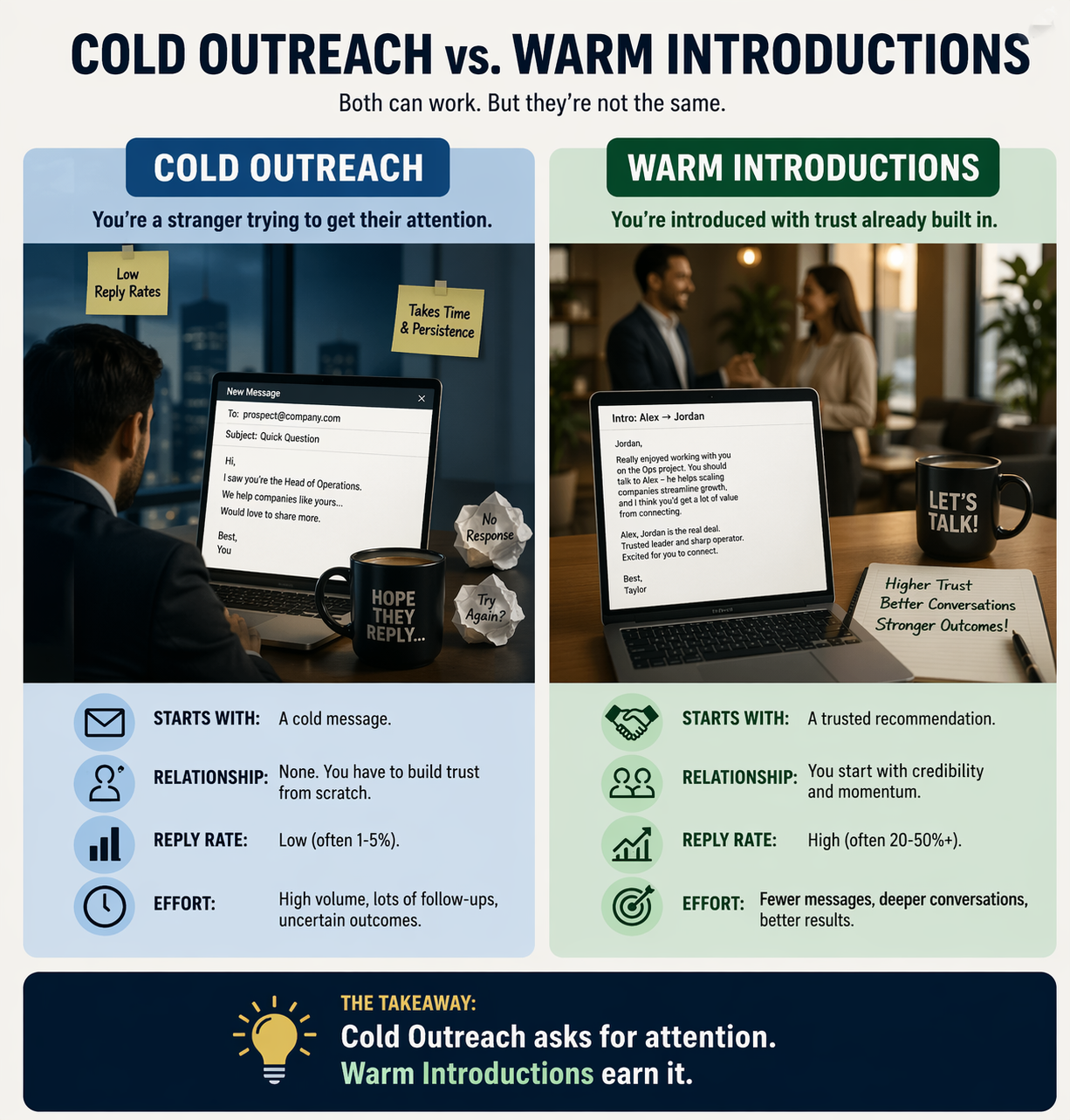
Cold outreach operates on probability. It relies on volume, persistence, and timing. If enough messages are sent, a percentage will convert into conversations, and some of those into new business.
However, as business owners are inundated with spam emails, not only directly into their personal inbox, but also on social business platforms like Linkedin, it's becoming harder and harder for cold B2B lead generation efforts to get through.
This is why warm introductions are the absolute pinnacle in B2B lead generation.
When a potential buyer is introduced through someone they already know or have worked with, the dynamic shifts immediately. The need to establish credibility is reduced, conversations move more naturally, and decision-making often accelerates.
This is not about one method replacing the other entirely. It’s about recognising that they sit at different points on the spectrum.
Cold outreach attempts to create opportunities from scratch whereas warm introductions unlock opportunities that already exist.
Most companies focus heavily on the first, while significantly underutilising the second.
The Overlooked Alternative: Independent B2B Commission-Based Sales Reps
While this article isn't meant to be a deep dive on the intricate workings of B2B commission-based reps, Manufacturer's reps or 1099 sales agents, it's certainly important to understand how their networks and experience can absolutely skyrocket the sales of the companies they choose to work with.
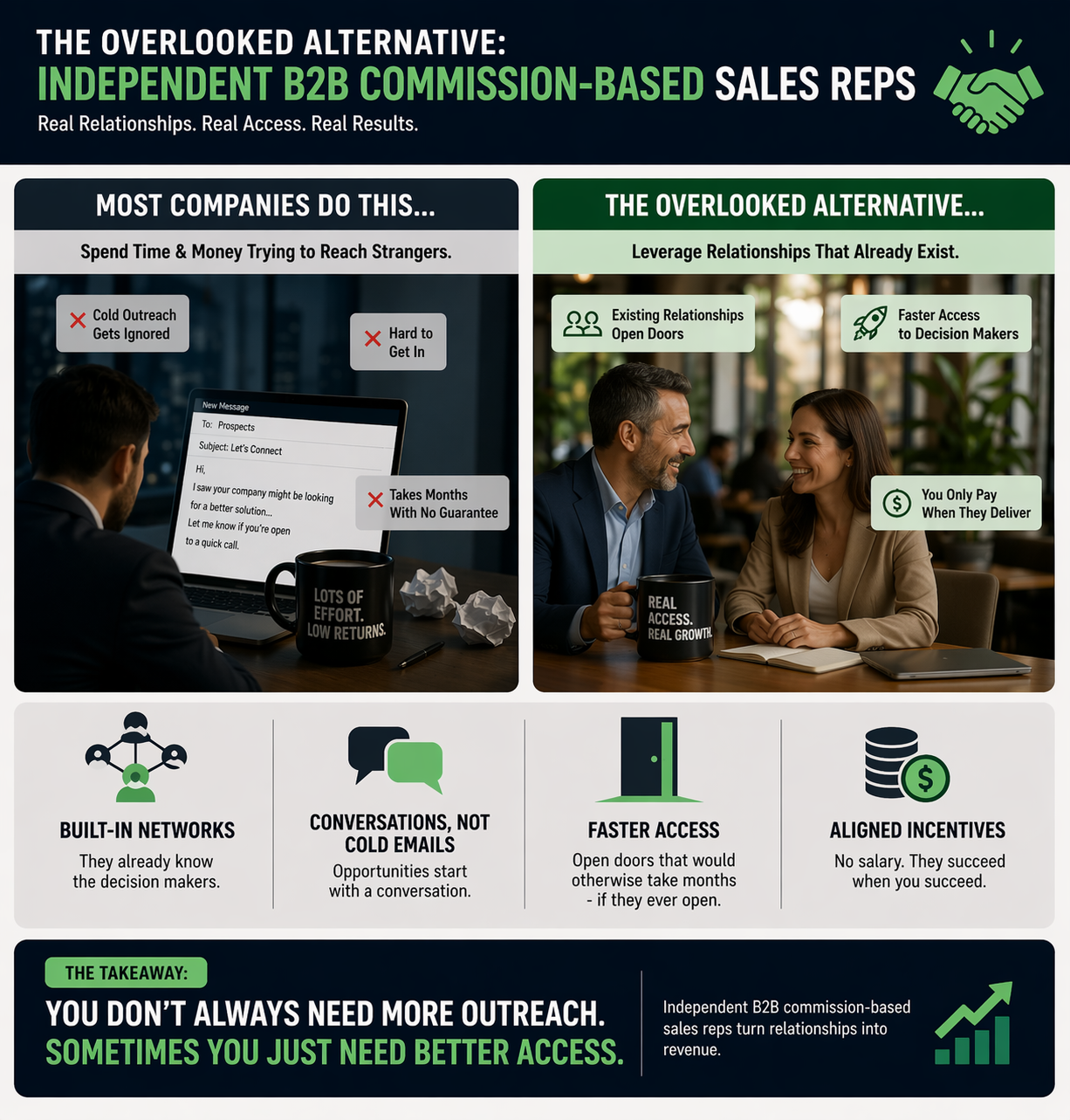
A Different Way to Generate B2B Leads
There is a group of sales professionals that operate entirely within networks of existing buyers, yet they are rarely considered when companies search for reliable B2B lead generation services.
These are independent B2B sales reps that build diverse yet complimentary sales portfolios of products and services that they sell into their growing networks.
They are experienced sales professionals who have spent years building relationships within specific industries. Their value does not come from their ability to send cold outreach messages. It comes from their existing relationship with decision-makers and their ability to open doors that would otherwise take months - if at all - to access.
For these individuals, generating new sales opportunities does not begin with prospecting. It starts by having a conversation with the decision makers in the companies that they already have access to.
This is what makes them such a powerful, but often overlooked, route to market. And what's even better is they are not paid a salary, they are rewarded with a sales commission after the deal has been closed.
Why Commission-Only Sales Reps Are Misunderstood
Most people already have a perception of commission-only selling, and it’s usually shaped by low-quality, transactional B2C experiences. The stereotype is familiar — someone pushing a product you don’t need, using pressure rather than understanding.
That’s not what professional B2B commission-only sales looks like.
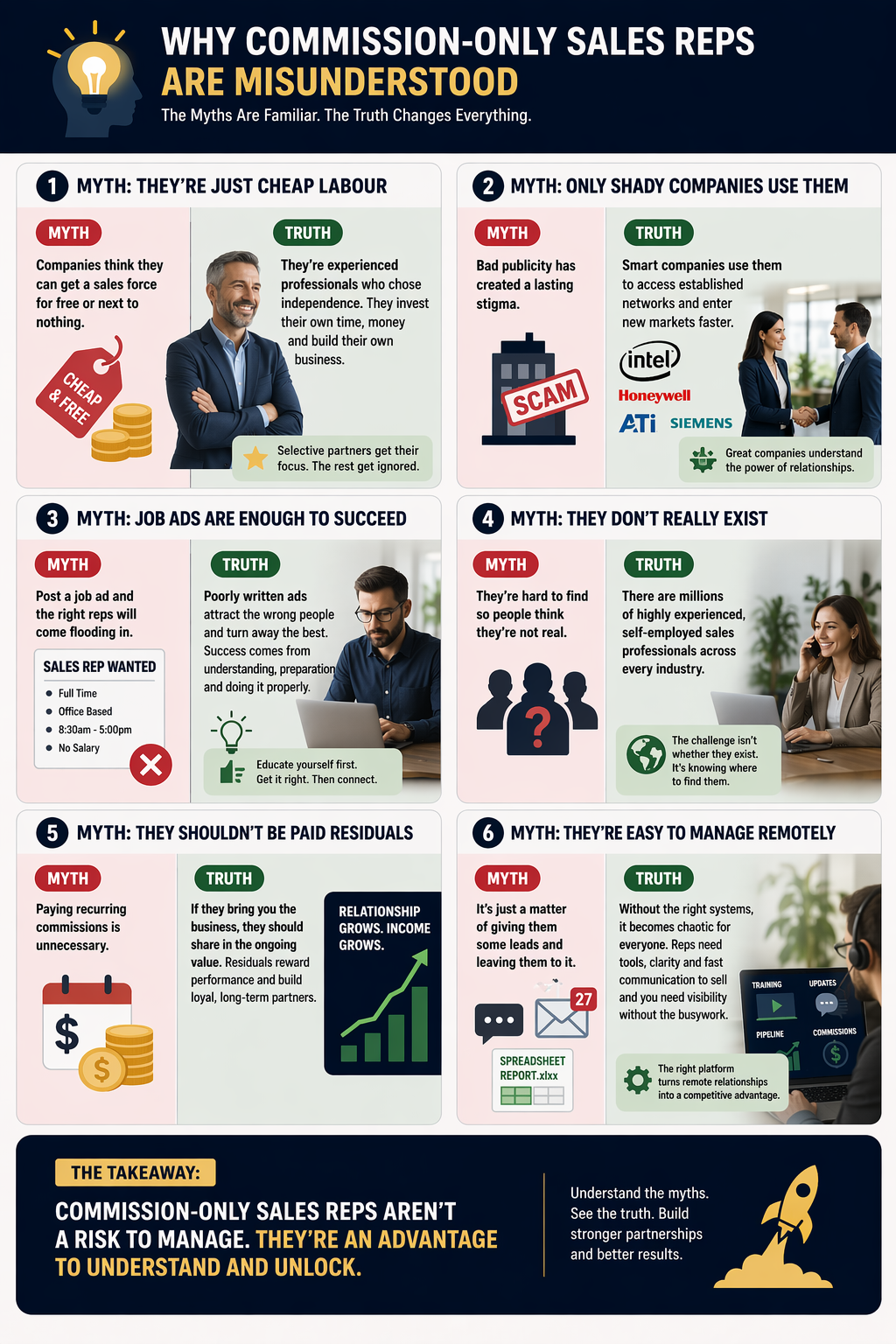
In reality, these are experienced sales professionals who have spent years building relationships, understanding their markets, and consistently generating revenue. Many have chosen to leave traditional employment, not because they couldn’t succeed in it, but because they prefer to operate independently.
Instead of being tied to a single company, they build a portfolio of complementary products and services that they can sell into the same client base. Their value comes from their ability to open doors, navigate complex buying processes, and turn existing relationships into multiple sales commission revenue streams.
Because they are self-employed, their incentives are different. They are not paid for activity, they are paid for results. In many cases, that includes ongoing or residual commissions, which means their income grows as the relationships they build continue to generate business.
This is why the comparison to traditional employment often misses the point. These are not employees working on commission. They are independent sales professionals building their own business, with direct access to the markets companies are trying to reach.
B2B Sales Outsourcing vs Lead Generation Agencies
When comparing traditional lead generation agencies with independent sales reps, the difference is not just in approach, but in alignment.
A lead generation agency is typically paid upfront for activity. Whether those activities result in revenue is separate from the engagement.
An independent (1099) sales rep, on the other hand, is compensated based on outcomes. Their incentives are directly tied to closed business and managing the sales cycle beyond a simple initial cold introduction.
This creates a different dynamic. Instead of outsourcing outreach, companies are effectively partnering with professionals who take responsibility for generating revenue within their existing networks.
This is a form of B2B sales outsourcing, but one that is built around shared outcomes rather than service delivery.
How to Find Reliable B2B Lead Generation Alternatives
The problem with lead generation today isn’t just saturation, it’s how low the barrier to entry has become. Anyone with access to scraping tools, a LinkedIn automation plugin, and a half-decent email sequencer can suddenly position themselves as a “lead generation agency.” And many do.
What most of these providers are selling isn’t access to real buying intent, it’s access to data. Lists of contacts pulled from databases, enriched, filtered, and pushed into outbound sequences that look sophisticated but feel exactly the same to the person receiving them. That’s why response rates keep dropping and why “more volume” has quietly become the default solution to poor results.
Cold outreach operates at arm’s length. It assumes that if you push enough messages into the market, a small percentage will convert into an initial meeting. Sometimes they do but it’s unpredictable, hard to control, and increasingly expensive as competition intensifies.
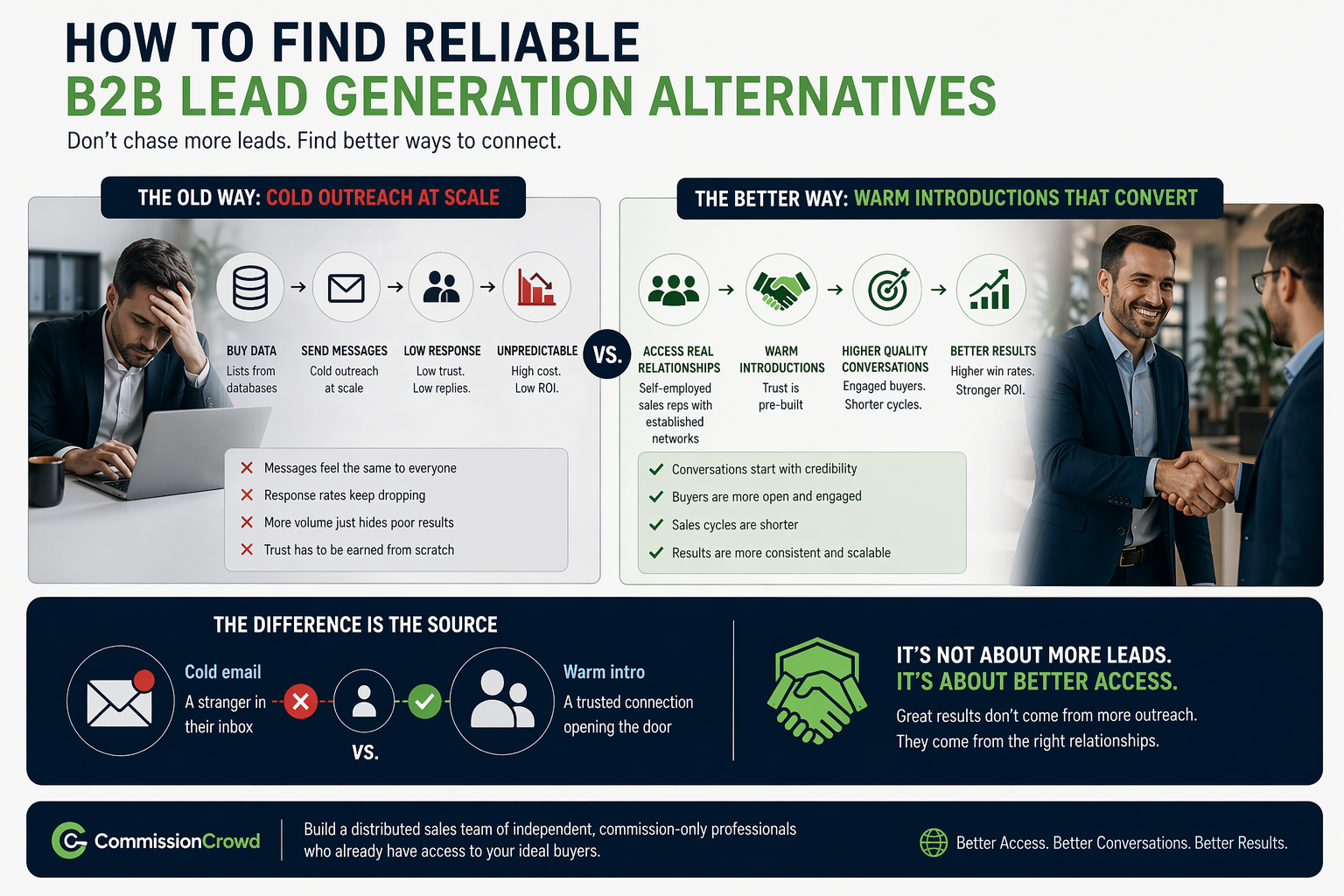
A more reliable alternative flips that model entirely:
Instead of trying to manufacture interest at scale, you work through people who already have it. Self-employed sales reps with established networks, industry credibility, and existing relationships with your ideal buyers.
This is where platforms like CommissionCrowd operate differently. Rather than generating leads in isolation, they help companies build distributed sales teams made up of independent, B2B commission-only professionals who are already embedded in the markets you’re trying to reach.
The dynamic changes immediately. Introductions are warmer. Trust is pre-built as the relationship between the seller and buyer already exists. Sales cycles shorten, not because you pushed harder, but because you entered the conversation at a completely different starting point.
And that’s the real distinction to look for when evaluating alternatives. Not “how many leads will I get?” but “where are these leads actually coming from?”
Because in B2B, the source of the lead is often the difference between a dead-end email thread and a deal that was halfway closed before you even showed up.
You may also find this article useful: How to hire commission-only sales reps
Why Discovery Is the Real Challenge
Even when companies recognise the value of working with independent sales representatives, the next challenge is knowing where to find them.
These sales professionals are not typically advertising themselves in the same way as lead generation agencies. They are selective about who they work with and tend to operate through networks, referrals, or specialist platforms like CommissionCrowd. In fact you'll be hard pushed to ever find someone describing their profession as commission-only sales.
Where Platforms Like CommissionCrowd Fit
The commission-only sales industry is highly fragmented and this is where platforms like CommissionCrowd become relevant.
Rather than acting as another lead generation provider, CommissionCrowd serve as infrastructure that connects companies with experienced, B2B commission-only remote working sales professionals.
The focus is not on generating activity, but on enabling partnerships between businesses and sales professionals who already understand how to generate revenue within specific markets.
You might also find this article useful: CommissionCrowd vs Linkedin
When This Approach Works (And When It Doesn’t)
It’s important to be clear that working with independent sales reps is not a universal solution for all companies.
ISR's are very selective about the companies they choose to work with. The approach works best for companies that already have a proven product or service, understand their target market, and are ready to scale.
Sales professionals with established networks are not looking to validate new ideas or test markets from scratch. They are looking to accelerate growth where demand already exists.
For businesses that already have paying customers and clear evidence of demand, the impact can be significant. Access to the right networks can open doors quickly and shorten the time it takes to generate meaningful revenue.
The Shift: From Lead Generation to Market Access
The most important shift here is not tactical, it’s conceptual.
Instead of asking how to generate more leads, companies should be asking how to gain better access to buyers.
Lead generation focuses on creating opportunities through effort.
Access focuses on entering opportunities through relationships.
Both have a place. But when access is missing, lead generation often ends up carrying more of the burden than it should.
If your business is investing in B2B lead generation services, you’re not doing anything wrong. It’s a fundamental part of how most companies approach growth.
But it’s rarely the full picture.
Alongside lead generation, there is another route to market that is often overlooked. One built on relationships, experience, and direct access to buyers.
For companies that understand how to combine both, the way they generate new business starts to look very different.
Frequently Asked Questions About B2B Lead Generation Services
What are B2B lead generation services?
B2B lead generation services are designed to help companies identify and connect with potential business customers. This is typically done through outbound methods such as cold email, LinkedIn outreach, data-driven prospecting, or appointment setting.
These services can be effective for creating initial pipeline, but they are only one part of the overall sales process. Generating leads is not the same as generating revenue, and most companies still need a structured sales approach to convert those leads into paying clients.
Do B2B lead generation agencies actually work?
Yes, B2B lead generation agencies can work, particularly when used in the right context.
They are useful for creating awareness, testing messaging, and building early-stage pipeline. However, they are not always designed to carry the full responsibility of generating revenue. Their output is typically measured in activity, such as meetings or responses, rather than closed business.
This is why many companies combine lead generation with other approaches, such as working with experienced sales professionals who can convert opportunities into revenue.
What is the difference between lead generation and sales?
Lead generation focuses on creating opportunities.
Sales focuses on converting those opportunities into revenue.
This distinction is important because many companies invest heavily in lead generation but underestimate the importance of what happens after a lead is created. Without a strong sales process, even high volumes of leads may not translate into consistent business growth.
How can I generate B2B leads without cold outreach?
While cold outreach is one of the most common methods, it is not the only way to generate B2B leads.
Another approach is to work with independent B2B sales professionals who already have relationships within your target market. Instead of creating conversations from scratch, they can introduce your product or service into existing networks, which often leads to higher-quality opportunities.
This approach is based on access rather than volume, and can be particularly effective when entering new markets or industries.
What are commission-only sales reps?
Commission-only sales reps are independent sales professionals who are paid based on the revenue they generate rather than receiving a fixed salary.
They typically operate as self-employed business owners and choose to represent companies whose products or services align with their existing network and experience. Because their income is tied directly to results, their focus is on generating and closing business rather than simply creating activity.
Are commission-only sales reps suitable for all businesses?
No, commission-only sales reps are not a universal solution.
They are best suited to companies that already have a proven product or service, a clear target market, and evidence of demand. These sales professionals are not usually looking to test new ideas or build markets from scratch. Instead, they focus on accelerating growth where there is already a strong foundation in place.
Is working with independent sales reps better than using a lead generation agency?
It is not necessarily a case of one being better than the other.
Lead generation agencies and independent sales reps serve different roles. Lead generation can help create initial pipeline through outreach and awareness, while independent sales reps can provide direct access to buyers and take responsibility for converting opportunities into revenue.
Many companies find the most effective approach is combining both, using lead generation for reach and sales partnerships for conversion and market access.
How do I find reliable B2B sales professionals?
Finding experienced, independent sales professionals can be challenging because they are not typically active on job boards or advertising themselves in the same way as agencies.
Many operate through established networks or specialised platforms such as CommissionCrowd, which connects companies with vetted commission-only sales agents who already have experience and relationships within specific industries.
What is the fastest way to generate new B2B business?
There is no single “fastest” method, but approaches that provide direct access to decision-makers tend to deliver results more quickly than those that rely entirely on cold outreach.
Working with professionals who already have relationships within your target market can significantly reduce the time it takes to generate meaningful conversations and close deals, particularly when entering new markets.

More articles from CommissionCrowd
World-Class Software Engineering Sales Opportunity - 35% Commission + Residuals
World-Class Software Engineering Sales Opportunity - 35% Commission + Residuals
Why You'll Never Find Great Self-Employed Sales Professionals on Gumtree or
Why You'll Never Find Great Self-Employed Sales Professionals on Gumtree or Generic Job Websites