
What Is an Independent Sales Rep? How Companies Scale Sales Without Hiring Employees
For many businesses in the process of scaling, sales growth feels closely tied to the additional expense and risk of additional hiring and even opening new offices.
More revenue usually means recruiting more salespeople, increasing payroll, expanding management structures, onboarding new staff, and building larger internal sales departments over time.
But many companies eventually discover something surprising: Entire sales ecosystems already exist outside traditional employment structures.
Across manufacturing, industrial equipment, commercial services, logistics, wholesale distribution, SaaS, construction, healthcare, hospitality, and many other industries, companies have quietly grown for decades through networks of independent sales reps operating on a performance basis rather than as salaried employees.
Yet despite how common these models are in many sectors, countless businesses never seriously encounter them during their growth journey.
Most founders are taught to think about scaling through internal hiring: build a bigger team, expand payroll, recruit regional staff, open offices, increase headcount.
What many companies do not realize is that experienced independent sales reps that operate on a commission-only basis, may already operate inside the exact markets they are trying to enter.
They may already have the relationships with the buyers your company is trying to reach, understand the territory, and actively sell into the industry every day.
For businesses exploring alternatives to hiring salespeople or looking for ways to scale revenue without dramatically increasing fixed overhead, understanding how independent sales reps work can fundamentally change the way expansion itself is approached.
Why Don't More Companies Use Independent Sales Reps?
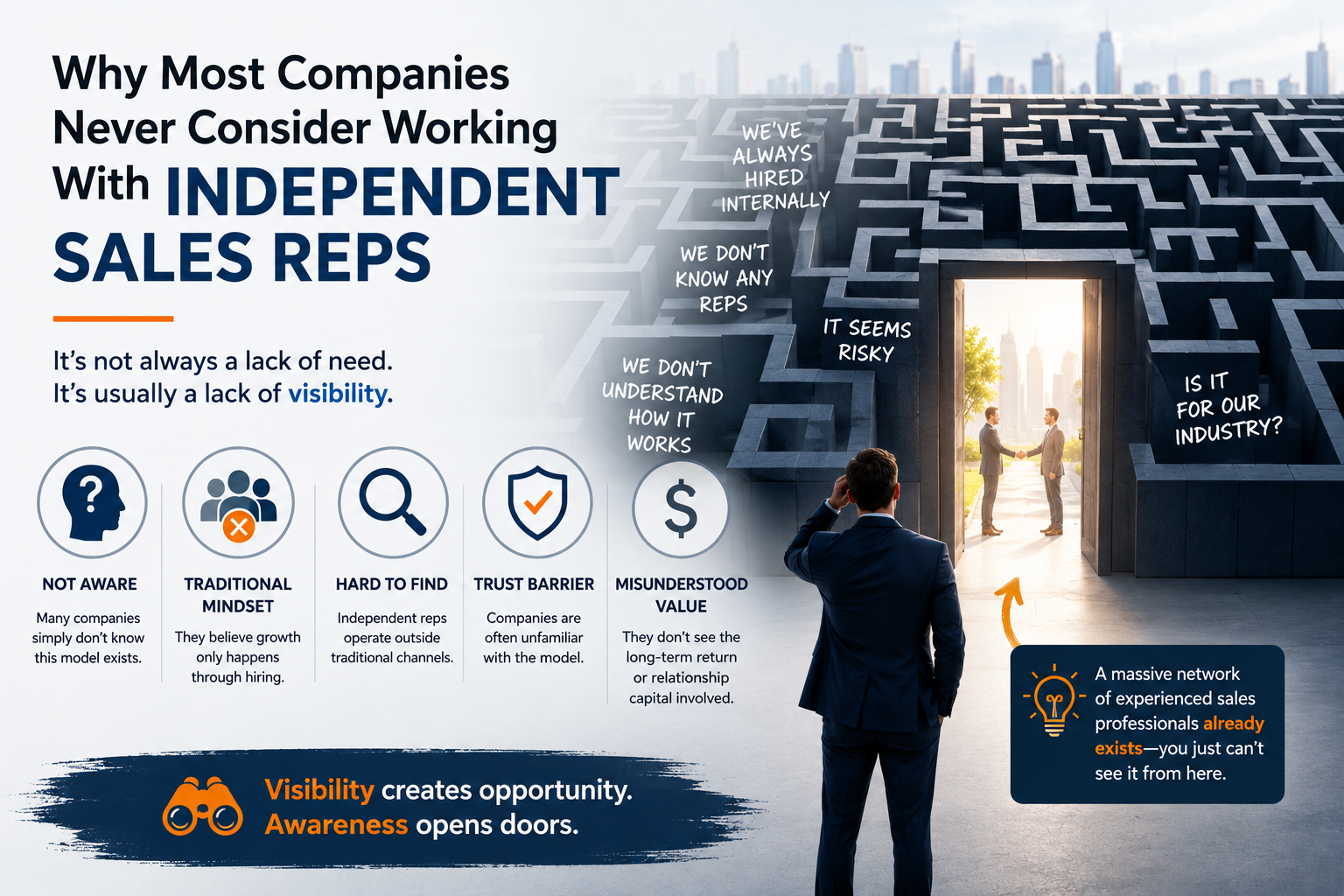
One reason many businesses never consider working with independent sales reps is because most companies simply do not realize this entire independent sales ecosystem exists.
Modern business culture is heavily centered around internal hiring.
Founders are typically taught that growth happens by:
- recruiting employees
- expanding departments
- increasing payroll
- building internal infrastructure
- opening regional offices
- scaling headcount
As a result, many businesses spend years trying to internally build commercial networks that independent reps may have already spent decades developing.
That is especially true in relationship-driven industries where trust, territory familiarity, and long-term buyer relationships often matter more than the size of the company itself.
Across manufacturing, industrial equipment, healthcare, construction, wholesale distribution, logistics, hospitality, commercial services, and many other sectors, thriving ecosystems of independent sales reps already operate inside highly specialized industries and territories.
Many of these reps spend years — sometimes decades — building relationships with distributors, procurement teams, contractors, manufacturers, plant managers, retailers, healthcare buyers, and commercial decision-makers within their market.
Most companies simply never realize this hidden part of the sales world already exists, partly because independent sales ecosystems have historically operated outside traditional hiring platforms and mainstream recruitment channels.
Part of the reason is visibility.
Independent sales ecosystems have historically operated through referrals, trade shows, manufacturing associations, regional territory networks, and long-standing commercial relationships rather than traditional hiring channels.
Unlike salaried employees applying through job boards, experienced independent reps often build careers through portfolio-based selling structures and long-term industry relationships.
Much of this ecosystem operates almost entirely outside mainstream recruitment systems.
That creates an interesting situation. Many companies assume they need to build market access from scratch.
In reality, experienced independent reps may already possess the buyer relationships, territory familiarity, and commercial access those companies are trying to spend years building internally.
For businesses trying to scale revenue without building large internal sales teams, this can fundamentally change the way sales expansion is approached.

Platforms like CommissionCrowd have helped make these ecosystems more visible by connecting companies with experienced independent sales reps operating across many industries globally.
What Is an Independent Sales Rep?
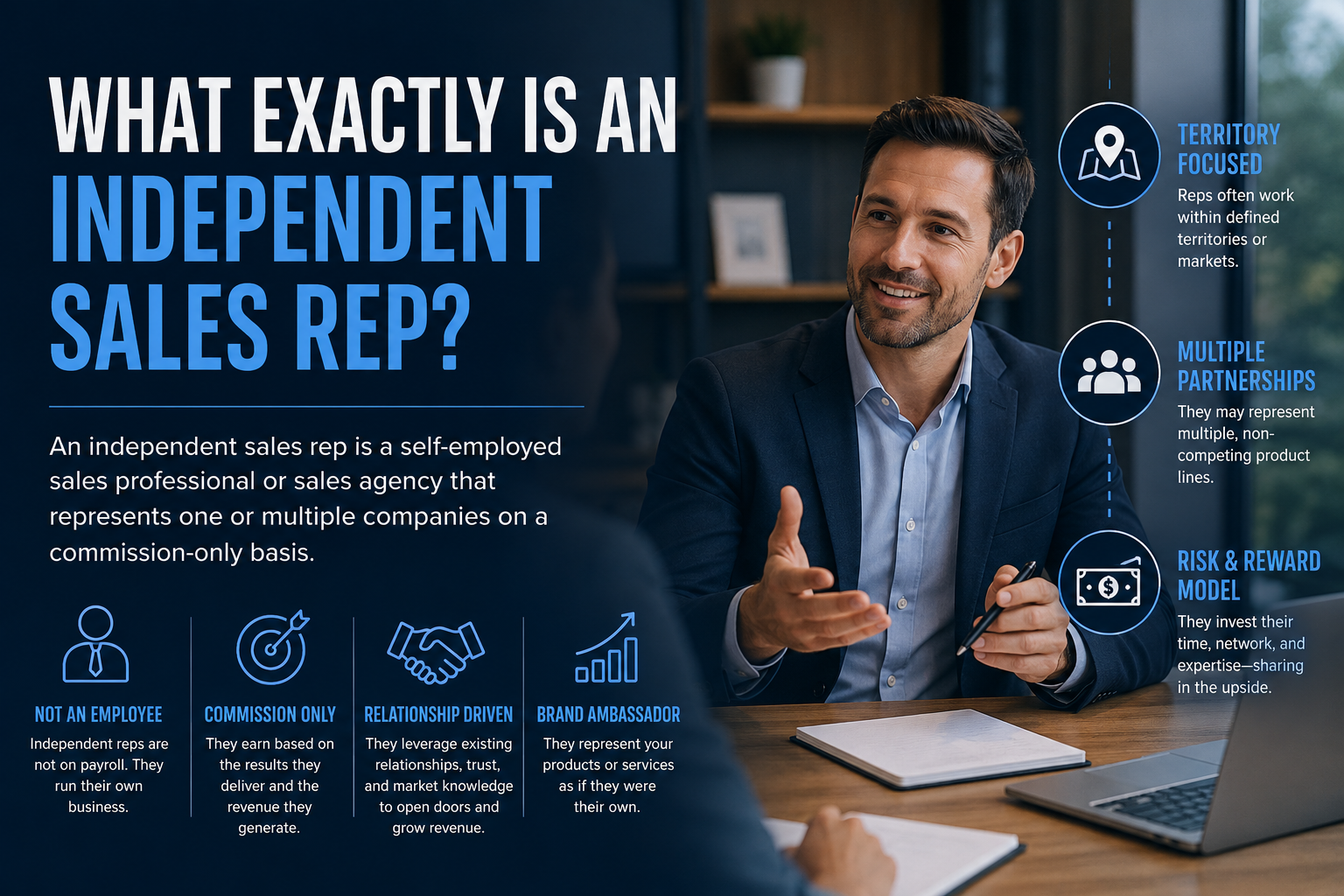
An independent sales rep is a self-employed sales professional or sales agency that represents one or multiple companies on a commission-only basis rather than working as a salaried employee.
Unlike traditional in-house salespeople, independent reps typically operate their own businesses.
They are responsible for managing their own schedules, prospecting activities, travel, relationships, territory development, and day-to-day sales operations. In most cases, they are only paid when they successfully generate revenue for the companies they represent.
Independent sales reps are also commonly known as:
- manufacturers’ reps
- 1099 sales reps
- territory reps
- commission-only sales reps
- independent sales reps
- freelance sales agents
The terminology often depends on the industry itself.
In manufacturing, the term "manufacturers’ rep" is especially common. In software or commercial services, businesses may use terms like channel partners, independent sales agents, or commission-only sales reps instead.
Despite the different terminology, the underlying commercial structure is often very similar.
The rep operates independently. The company avoids taking on fixed salary overhead. Revenue generation becomes closely tied to performance.
One of the biggest differences between independent reps and traditional employees is that many experienced reps already maintain existing buyer relationships within their industry.
Rather than starting from zero, independent reps may already sell into specific markets, territories, or verticals every day.
For example, an independent manufacturers’ rep selling industrial pumps may already have relationships with:
- plant managers
- procurement departments
- distributors
- engineering firms
- maintenance contractors
- industrial buyers
That existing access can dramatically shorten the time it takes for a company to begin entering new markets or generating conversations with buyers.
In many industries, this relationship capital becomes one of the most valuable parts of the entire model.
Independent reps are also often highly selective about the companies and products they choose to represent.
Because their income depends entirely on performance, experienced reps tend to focus on products, services, or solutions they believe they can realistically sell into their existing network.
That dynamic creates a very different commercial relationship compared to traditional employment structures.
In many ways, independent reps operate less like employees and more like entrepreneurial commercial partners whose success is directly tied to the growth of the companies they represent.
How Do Independent Sales Reps Work?
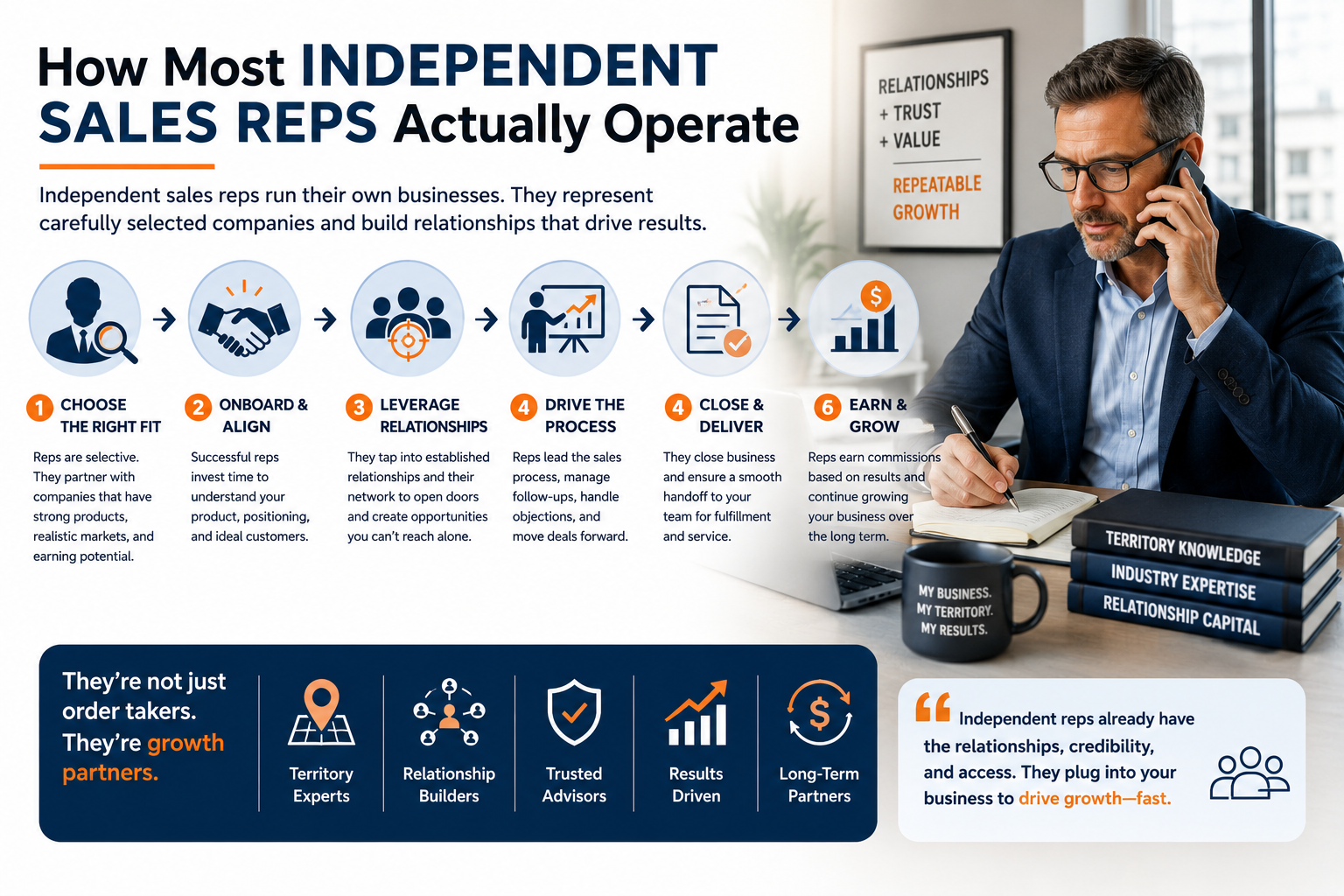
One of the biggest misconceptions about independent sales reps is that they are simply salespeople looking for commission-only work.
In reality, many experienced independent reps arrive at self-employment after already spending years building industry expertise, territory knowledge, and commercial relationships within a specific market.
Many begin their careers in traditional salaried sales roles.
Over time, they build relationships with buyers, distributors, contractors, procurement teams, manufacturers, plant managers, retailers, or commercial decision-makers inside their industry. They learn how the market operates. They understand buying cycles, territory dynamics, customer pain points, pricing expectations, and the realities of selling inside that sector.
Eventually, many realize those relationships and market knowledge hold value independently. Rather than continuing to work exclusively for a single employer, some sales professionals choose to transition into commission-only sales and represent multiple complementary companies instead.
That transition often changes the economics of selling completely.
Instead of relying on a fixed salary from one company, independent reps build portfolios of products or services that align with their existing network and industry relationships.
For example, an independent rep selling into industrial manufacturing may simultaneously represent:
- industrial pumps
- filtration systems
- control valves
- maintenance services
- safety equipment
All sold into many of the same buyers.
This portfolio approach is one of the reasons the independent rep model can become highly efficient.
Rather than attempting to create buyer relationships from scratch every time they represent a new company, experienced reps often expand existing relationships by introducing additional complementary products or services into the same market.
In many industries, every sales conversation becomes more commercially valuable because the rep already operates inside an active ecosystem of buyers, suppliers, distributors, and decision-makers.
That relationship capital is often one of the most important assets independent reps possess.
And because their income depends entirely on performance, experienced reps are usually highly selective about the companies they choose to represent.
Most independent reps are not looking to become unpaid employees.
They typically want to work with companies that:
- offer realistic earning potential
- provide competitive commissions
- communicate professionally
- support the sales process
- understand the value of long-term relationships
- treat reps like commercial partners rather than outsourced staff
The strongest relationships between companies and independent reps often function more like strategic partnerships than traditional employment arrangements.
Both sides benefit when revenue grows. Both sides are invested in long-term success. And both sides rely heavily on trust, communication, and commercial alignment to make the relationship work effectively.
Why Do Companies Hire Independent Sales Reps?
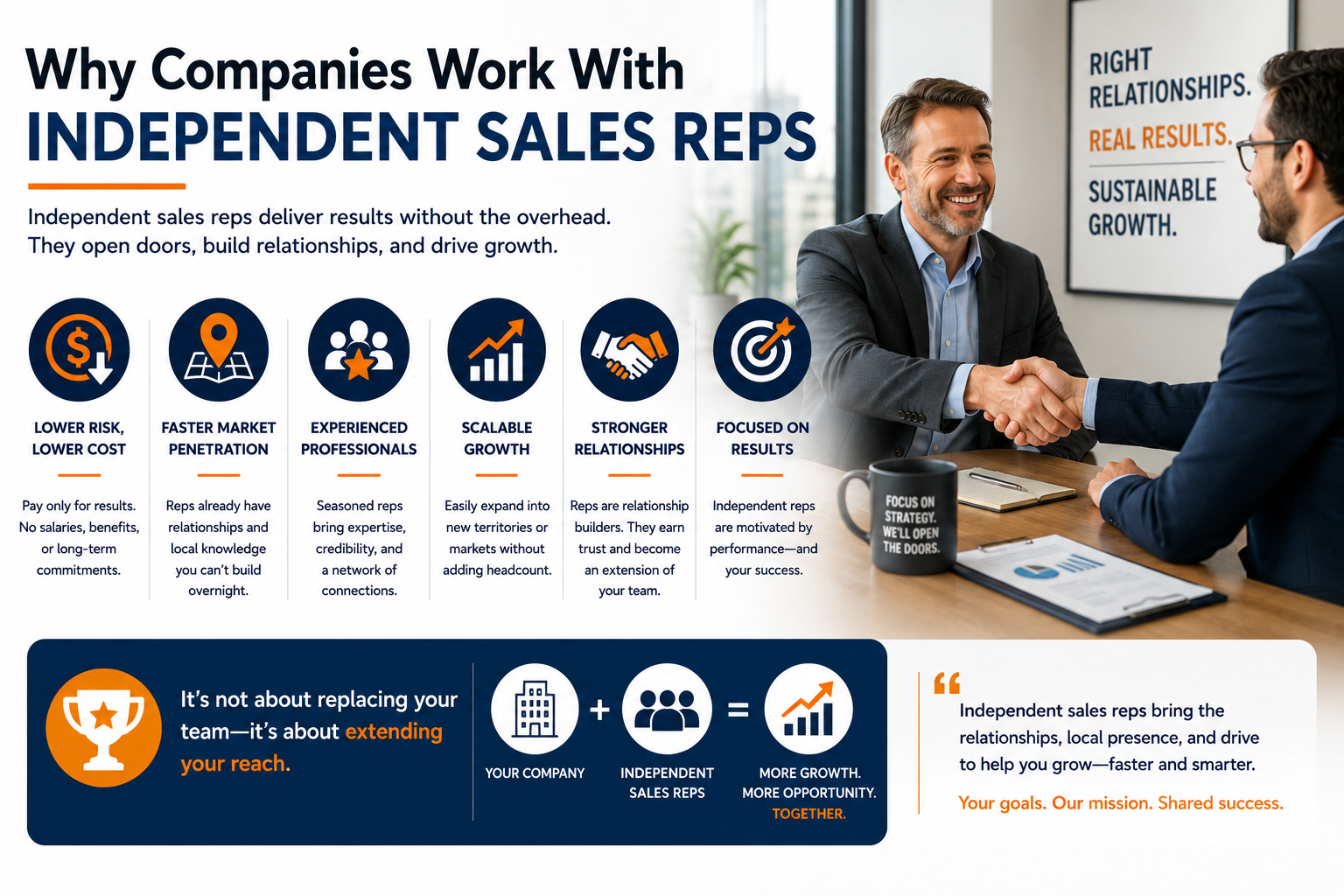
For many companies, the biggest appeal of independent sales reps is not simply reducing salary costs. It is gaining access to existing commercial relationships, industry familiarity, and territory coverage without needing to build everything internally from scratch.
That distinction matters.
A newly hired salesperson may still need months — sometimes years — to fully understand an industry, build trust with buyers, learn territory dynamics, and develop meaningful commercial relationships. Experienced independent reps, on the other hand, may already operate inside that ecosystem every day.
In relationship-driven industries especially, that existing access can be incredibly valuable.
Many companies use independent reps when:
- entering new geographic markets
- expanding internationally
- launching new product lines
- targeting specialized industries
- reducing fixed payroll overhead
- testing new territories before hiring internally
- accelerating growth without building large internal sales teams
The structure itself also changes the commercial economics of expansion.
Traditional hiring creates fixed costs immediately. Salaries, benefits, recruitment expenses, onboarding, management overhead, software subscriptions, and operational infrastructure all begin long before revenue is necessarily generated.
Independent reps operate differently. In most cases, compensation is tied directly to performance. If sales are not generated, the company is usually not carrying the same level of fixed payroll exposure associated with traditional hiring.
That performance-based structure is one reason independent sales ecosystems have remained common across manufacturing, wholesale distribution, industrial services, construction, healthcare, hospitality, and many other sectors where territory relationships and long-term commercial trust matter heavily.
It is also why many companies increasingly view independent reps as part of a broader growth strategy rather than simply outsourced sales labor.
In many industries, experienced reps effectively operate as an extension of a company’s commercial infrastructure. They bring territory knowledge, buyer familiarity, relationship capital, and market access that can otherwise take years for businesses to develop internally.
Of course, independent sales reps are not the right fit for every situation. Some businesses require highly controlled internal sales environments, large account-management structures, or tightly integrated enterprise sales teams.
But for companies looking to expand strategically while remaining leaner operationally, independent reps can offer a very different path to growth than traditional internal hiring alone.
What Are the Advantages of Working With Independent Sales Reps?
Many companies choose to work with independent sales reps because the model can provide access to existing commercial relationships, industry expertise, and market coverage without the fixed overhead associated with traditional hiring.
Some of the most common advantages include:
- Access to established buyer relationships and industry networks
- Lower fixed payroll and recruitment costs
- Faster entry into new territories and markets
- Performance-based compensation structures
- Industry-specific expertise and market knowledge
- Greater flexibility when testing new products or regions
- The ability to scale sales coverage without significantly increasing headcount
For companies operating in relationship-driven industries, the greatest advantage is often not cost reduction but access. Experienced independent sales reps may already know the buyers, distributors, contractors, procurement teams, or decision-makers a company is trying to reach, allowing businesses to accelerate growth without building every relationship internally from scratch.
What Are the Disadvantages of Working With Independent Sales Reps?
While independent sales reps can be highly effective in the right environment, the model is not perfect for every business.
Companies considering independent reps should also understand some of the potential challenges:
- Less direct control compared to salaried employees
- Longer onboarding periods in complex industries
- The need for competitive commission structures
- Reps may represent multiple complementary companies simultaneously
- Success often depends heavily on communication and alignment
- Not all products or industries are suitable for independent representation
Independent reps are entrepreneurs rather than employees. As a result, companies that expect constant supervision, rigid corporate processes, or highly controlled sales environments may find the model challenging. Businesses that succeed with independent reps typically focus on partnership, support, and long-term alignment rather than direct management.
For many companies, the decision is not whether independent reps are better or worse than employees. The question is whether they are the right fit for the specific market, product, territory, and growth strategy being pursued.
Why Do Some Companies Fail With Independent Sales Reps?
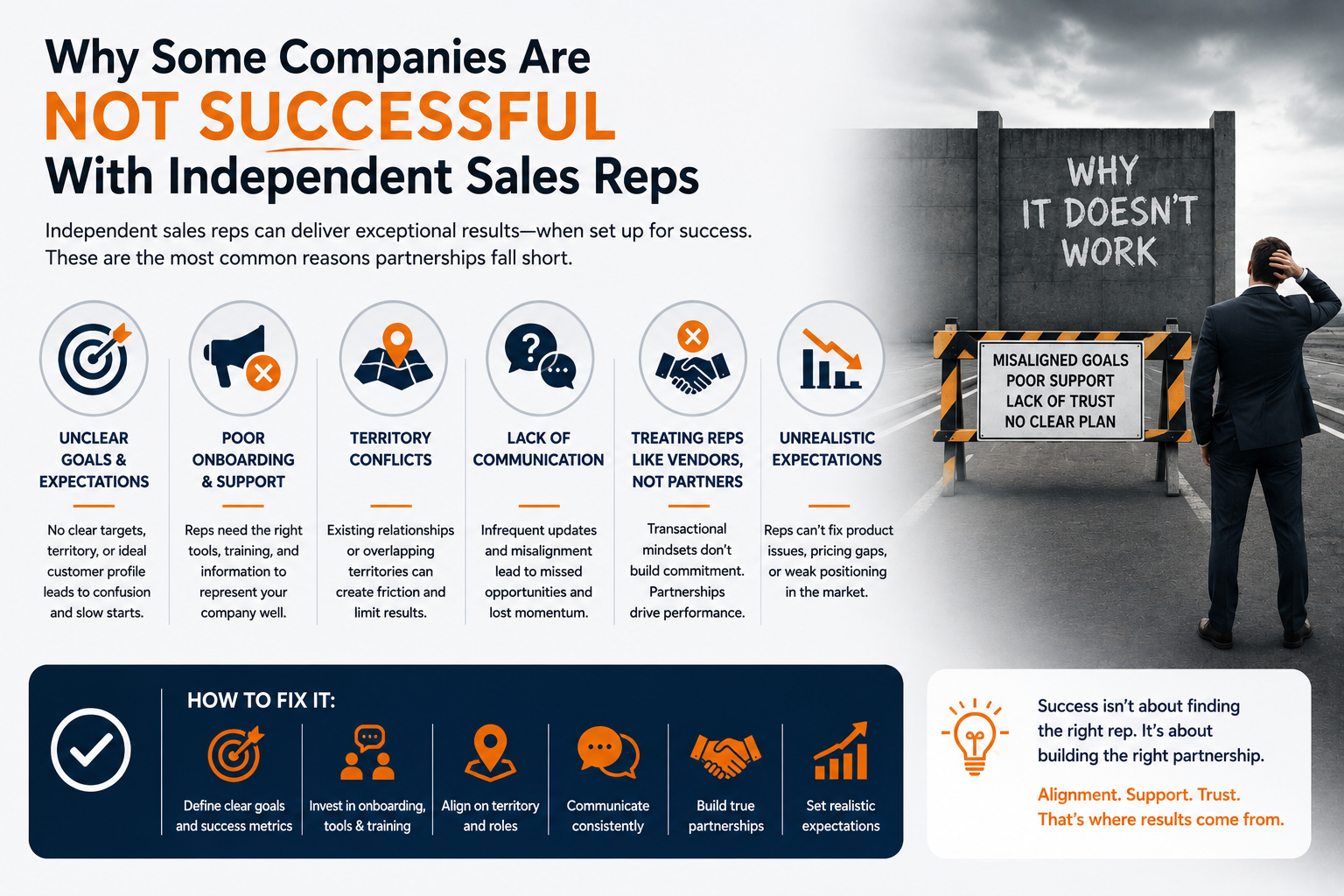
While independent sales reps can be extremely effective in the right environment, not every company succeeds when working with them.
In many cases, the problem is not the rep model itself. The problem is that companies misunderstand how independent reps actually operate.
One of the most common mistakes businesses make is assuming independent reps function exactly like salaried employees — only without the salary.
That approach rarely works well.
Experienced reps are independent businesspeople. They are usually managing multiple relationships, multiple product lines, multiple territories, and ongoing commercial conversations simultaneously. Most are not looking for micromanagement, rigid internal corporate structures, or unrealistic reporting requirements that add complexity without helping them generate revenue.
The strongest independent rep relationships tend to be built around alignment rather than control.
Companies that perform well with independent reps usually provide:
- realistic earning opportunities
- competitive commission structures
- clear onboarding
- strong communication
- responsive operational support
- marketing materials and product training
- transparency around expectations
- patience during relationship development
The opposite is often true when partnerships fail.
Some businesses expect immediate results despite entering complex industries with long buying cycles. Others provide little onboarding, weak sales support, unclear commission structures, or products that are difficult to position competitively within the market.
In some situations, companies underestimate how relationship-driven many independent sales ecosystems actually are.
An experienced rep may spend years building trust with buyers inside a territory. That trust is valuable and carefully protected. As a result, most successful reps are highly selective about the companies they choose to represent because attaching the wrong product or service to their network can damage relationships they may have spent decades developing.
This is one reason the best independent rep partnerships often feel less transactional and more collaborative over time.
The company brings a strong product, operational support, and a long-term opportunity. The rep brings relationships, market access, industry familiarity, and commercial experience. When those pieces align properly, the relationship can become extremely powerful for both sides.
But like any partnership-driven growth model, success usually depends heavily on communication, trust, and commercial alignment from the beginning.
Why Is Relationship Capital Important in Independent Sales?

One of the biggest misunderstandings companies have about independent sales reps is assuming the primary value comes from reducing hiring costs.
In reality, the real asset is often relationship capital.
In many B2B industries, sales are not driven purely by advertising, outbound prospecting, or product specifications alone. Trust plays a major role. Buyers often prefer working with people they already know, people who understand the industry, or people who have spent years operating inside the same commercial ecosystem.
That dynamic becomes even more important in industries with long buying cycles, technical products, large contract values, repeat purchasing behavior, regulated environments, or highly relationship-driven procurement processes. In these markets, access matters. And meaningful access is rarely built overnight.
An experienced independent rep may already spend years calling on the exact buyers a company is trying to reach. They may already understand who the real decision-makers are, how procurement conversations typically unfold, which distributors influence purchasing decisions, and which competitors already dominate certain territories.
That familiarity can dramatically shorten the time it takes for companies to begin meaningful commercial conversations inside a new market.
A newly hired salesperson may still be learning the industry itself. An established independent rep may already understand the personalities, relationships, commercial politics, and buying dynamics shaping that territory.
That does not guarantee sales, of course. Relationships alone are not enough if the product, pricing, support, or market fit are weak.
But in many industries, relationships create access. And access creates opportunity.
As industries become increasingly saturated with automated outreach, AI-generated messaging, and high-volume prospecting, genuine commercial trust often becomes even more valuable. Buyers are increasingly overwhelmed with emails, cold calls, LinkedIn outreach, and automated sales messaging every day — something broader sales industry research increasingly reflects.
In response, many decision-makers become increasingly selective about who they engage with and who they trust.
This is one reason experienced relationship-driven reps continue to hold significant value across many sectors.
They are not simply selling products. In many cases, they are leveraging years of accumulated trust, market familiarity, commercial credibility, and long-term buyer relationships developed through consistent interaction inside a specific industry over long periods of time.
In many ways, that trust becomes part of the commercial infrastructure itself.
Will AI Replace Independent Sales Reps?

AI and automation are rapidly changing large parts of the sales process, with major consulting firms like McKinsey increasingly documenting how AI is reshaping commercial operations globally.
Prospecting and lead generation can now be automated. Outreach sequences can be generated instantly. CRM workflows, lead scoring, research, reporting, and administrative tasks increasingly require less human involvement than ever before.
But while technology continues to improve sales efficiency, it does not replace trust, reputation, industry familiarity, or long-standing commercial relationships.
In some ways, the opposite may actually be happening.
As outbound messaging becomes easier and more automated, buyers are becoming increasingly overwhelmed with generic outreach. Decision-makers receive endless cold emails, LinkedIn messages, automated sequences, and AI-generated prospecting campaigns every week. As a result, attention becomes harder to earn and trust becomes more valuable.
That shift plays directly into the strengths of many experienced independent reps.
In relationship-driven industries especially, reps often succeed because they already possess:
- established buyer relationships
- industry credibility
- territory familiarity
- commercial trust
- existing networks
- years of market experience
Those advantages are difficult to automate.
An AI tool may help generate outreach faster, but it cannot instantly recreate years of relationship-building within a specialized market. It cannot replicate the trust developed through repeated interactions, successful projects, industry reputation, trade events, referrals, and long-term commercial familiarity.
This is one reason many companies are beginning to rethink what actually creates competitive advantage in modern sales environments.
For years, scale was often associated with building larger internal teams and increasing outbound activity. Today, relationship access, credibility, and trust may become even more important as automation commoditizes more of the sales process itself.
That does not mean AI will replace independent reps. Nor does it mean independent reps operate separately from technology. In reality, many experienced reps increasingly use automation, CRM systems, AI tools, and digital communication platforms to improve efficiency within their own businesses.
But technology tends to amplify existing commercial relationships rather than replace them entirely.
In many industries, the companies and sales professionals who combine technology with genuine market trust may ultimately hold the strongest long-term advantage.
Should You Use Independent Sales Reps or Build an In-House Sales Team?
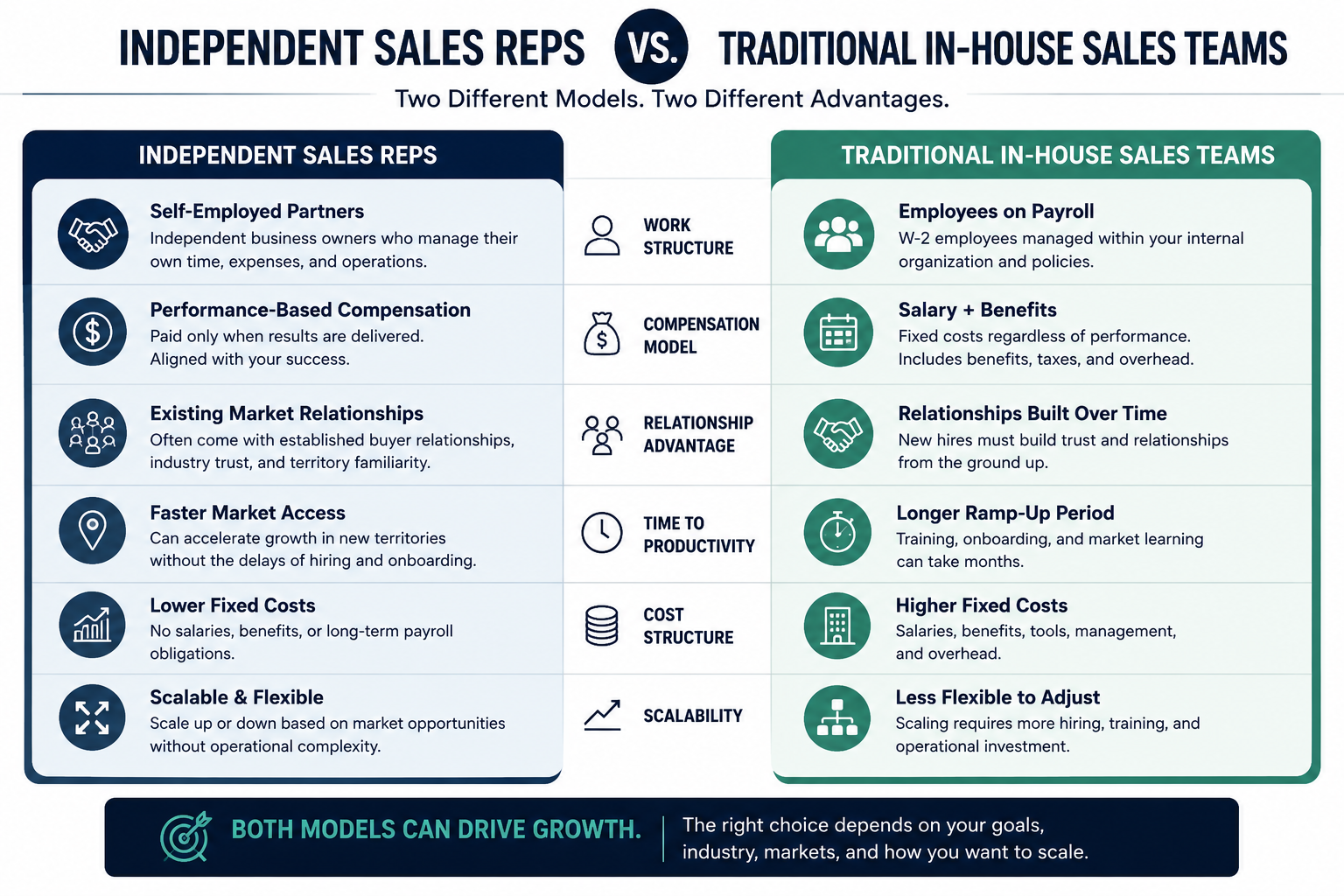
For decades, building an internal sales team was considered the default path to company growth. If a company wanted more revenue, it hired more salespeople and spent more on Advertising and Marketing. If it wanted to expand geographically, it opened offices, recruited regional staff, and increased internal headcount.
That model still works well in many situations. But it also comes with significant operational costs and management complexity.
Internal sales teams typically require:
- salaries
- employee benefits
- payroll taxes
- recruitment costs
- onboarding and training
- sales management
- CRM infrastructure
- software subscriptions
- reporting structures
- ongoing operational overhead
Those costs begin immediately, often long before meaningful revenue is generated.
In many industries, new sales hires also require months to become fully productive while they learn the market, build relationships, understand territory dynamics, and establish credibility with buyers.
Independent sales reps operate very differently.
Rather than functioning as salaried employees inside a centralized sales organization, independent reps usually operate as self-employed commercial partners whose compensation is directly tied to performance. Most manage their own schedules, expenses, prospecting activities, travel, and day-to-day sales operations independently.
That structure changes the economics of expansion considerably.
For many companies, the appeal is not simply lower fixed overhead. It is the possibility of accessing existing market relationships, industry familiarity, and territory coverage without needing to build every commercial connection internally from scratch.
This does not mean one model is universally better than the other.
Many successful businesses ultimately use hybrid structures that combine internal teams with independent sales infrastructure depending on the industry, territory strategy, account complexity, and stage of growth.
But for companies looking to expand carefully, enter new markets, or scale revenue without dramatically increasing fixed operational overhead, independent reps can offer a fundamentally different approach to growth than traditional hiring alone.
What Is Portfolio Selling and Why Does It Make Independent Sales Reps More Effective?
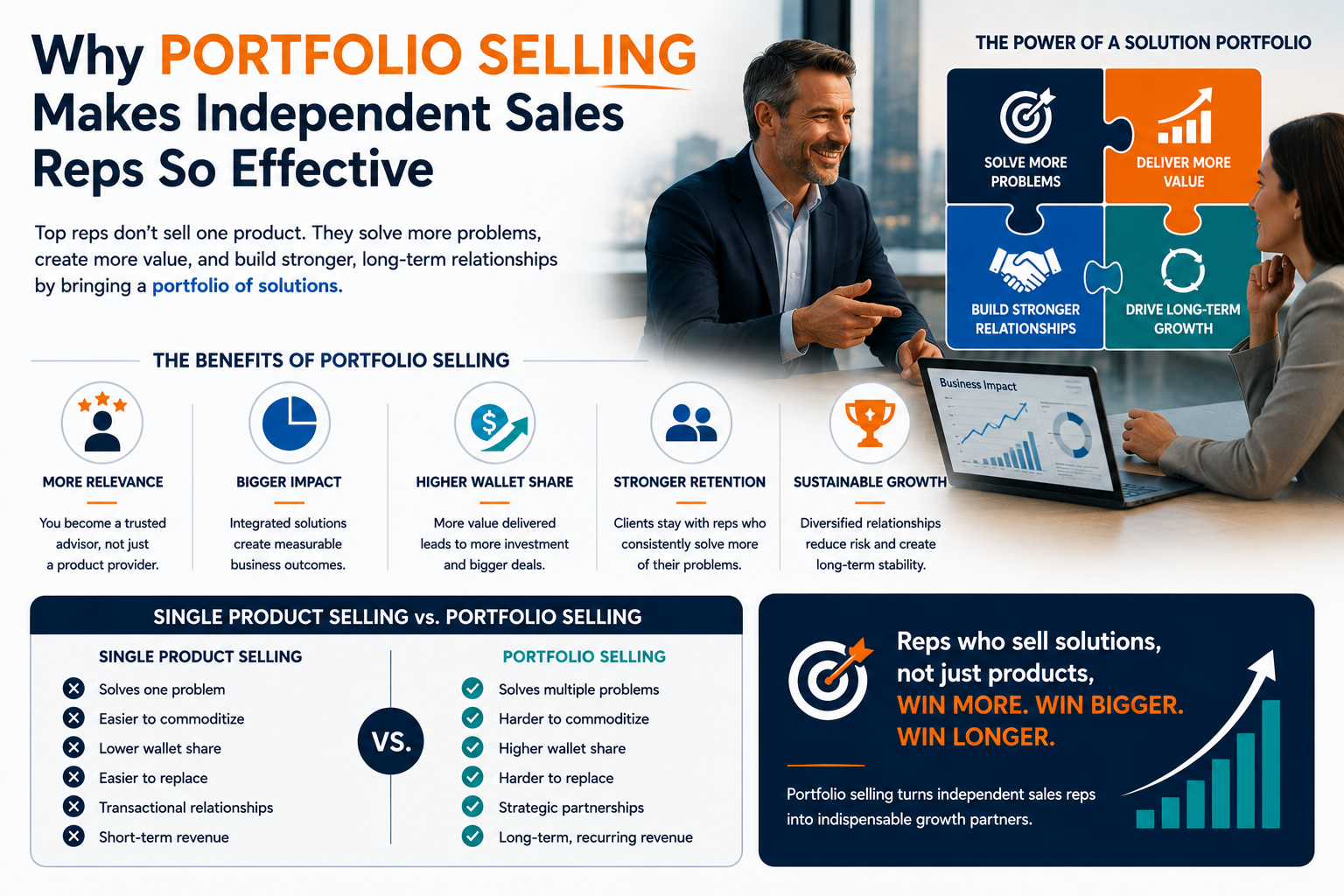
One of the most unique aspects of the independent sales rep model is something many companies outside the ecosystem rarely encounter: portfolio selling.
Unlike traditional employees who typically represent a single company full-time, independent reps often carry multiple complementary product lines or services simultaneously. Those portfolios are usually built carefully around the industries, territories, and buyer relationships the rep already understands well.
Why Do Independent Sales Reps Represent Multiple Products?
For example, an independent rep selling into industrial manufacturing may represent several non-competing companies at the same time. One product line may involve industrial pumps, another filtration systems, another control valves, and another maintenance-related services — all sold into many of the same buyers, facilities, or procurement departments.
From the outside, this can initially seem unusual to companies unfamiliar with the model.
In reality, it is often one of the reasons independent reps become highly effective inside relationship-driven industries because they are not attempting to create entirely new relationships every time they represent a new company. Instead, they are often leveraging existing commercial access across multiple complementary products or services within the same buyer network.
How Does Portfolio Selling Increase Sales Efficiency?
That structure creates efficiency for everyone involved.
The rep benefits because every sales conversation becomes more commercially valuable. A single meeting may create opportunities across several product categories rather than only one.
The company benefits because the rep already has a reason to be inside that market, speaking with those buyers, understanding territory dynamics, and maintaining ongoing relationships within the industry.
In many ways, portfolio selling transforms independent reps from isolated salespeople into long-term commercial operators embedded inside a broader business ecosystem.
How Do Independent Sales Reps Choose Which Companies to Represent?
This is one reason experienced reps tend to be highly selective about the products and services they agree to represent.
Most successful independent reps are not trying to carry random unrelated products. They are usually building carefully aligned portfolios that fit naturally within the industries they already understand and the buyers they already interact with regularly.
A rep selling industrial equipment may not want to suddenly represent unrelated consumer products. A hospitality-focused rep may build an entirely different portfolio around hotels, restaurants, tourism groups, or leisure operators. In healthcare, reps may specialize deeply within particular medical sectors, procurement environments, or distribution structures.
Over time, many independent reps effectively build entire businesses around the relationships and territories they know best.
That ecosystem-driven approach is one reason portfolio selling has remained such a powerful model across manufacturing, wholesale distribution, industrial services, commercial equipment, healthcare, hospitality, and many other B2B sectors for decades.
Which Industries Use Independent Sales Reps?

Independent sales ecosystems are far more common than many businesses initially realize.
While the structure may feel unfamiliar to companies encountering it for the first time, independent reps have operated across many industries for decades — particularly in sectors where relationships, territory knowledge, technical understanding, and long-term buyer trust play an important role in the sales process.
Do Manufacturing Companies Use Independent Sales Reps?
Manufacturing is one of the most established industries for independent reps, particularly in North America and Europe.
Many manufacturers use independent manufacturer's reps to expand territory coverage without needing to build large regional sales teams internally. Reps operating in industrial sectors often carry complementary product lines that sell into the same facilities, distributors, contractors, engineering firms, or procurement departments.
Common examples include:
- industrial equipment
- pumps and valves
- filtration systems
- electrical components
- HVAC equipment
- safety products
- packaging machinery
- automation systems
In many industrial sectors, buyers already expect to work with independent territory reps as part of the normal purchasing ecosystem.
Do Healthcare Companies Use Independent Sales Reps?
Healthcare is another industry where relationship-driven selling remains extremely important.
Independent reps may operate across medical devices, healthcare equipment, diagnostics, specialist products, procurement systems, or regional healthcare distribution networks. In many cases, long-term trust and familiarity within the sector play a major role in purchasing decisions.
Do Hospitality, Construction, and Commercial Service Companies Use Independent Sales Reps?
Independent reps are also common across hospitality, commercial services, construction, and building-related industries.
A rep may already maintain relationships with hotel groups, contractors, developers, architects, facilities managers, procurement buyers, restaurant operators, or commercial property businesses within a specific region.
For companies entering these industries, existing territory familiarity can significantly reduce the time required to begin building commercial traction.
Do SaaS and Technology Companies Use Independent Sales Reps?
While software companies have historically relied heavily on internal sales teams, many SaaS and technology businesses increasingly explore partnership-based and performance-based sales structures as customer acquisition costs continue rising.
Independent sales agents, channel partners, and commission-only sales professionals can sometimes help software companies enter niche industries or highly specialized verticals where existing relationships and market familiarity are difficult to build quickly from scratch.
Why Are Independent Sales Reps More Common in Certain Industries?
Independent rep structures tend to thrive most strongly in industries where:
- relationships influence buying decisions
- territories matter
- repeat purchasing is common
- technical expertise is valuable
- trust takes time to develop
- distribution networks already exist
- expansion costs can become significant
In those environments, experienced reps often operate as part of the commercial infrastructure itself rather than simply acting as external sales contractors.
Why Would an Independent Sales Rep Reject a Company?
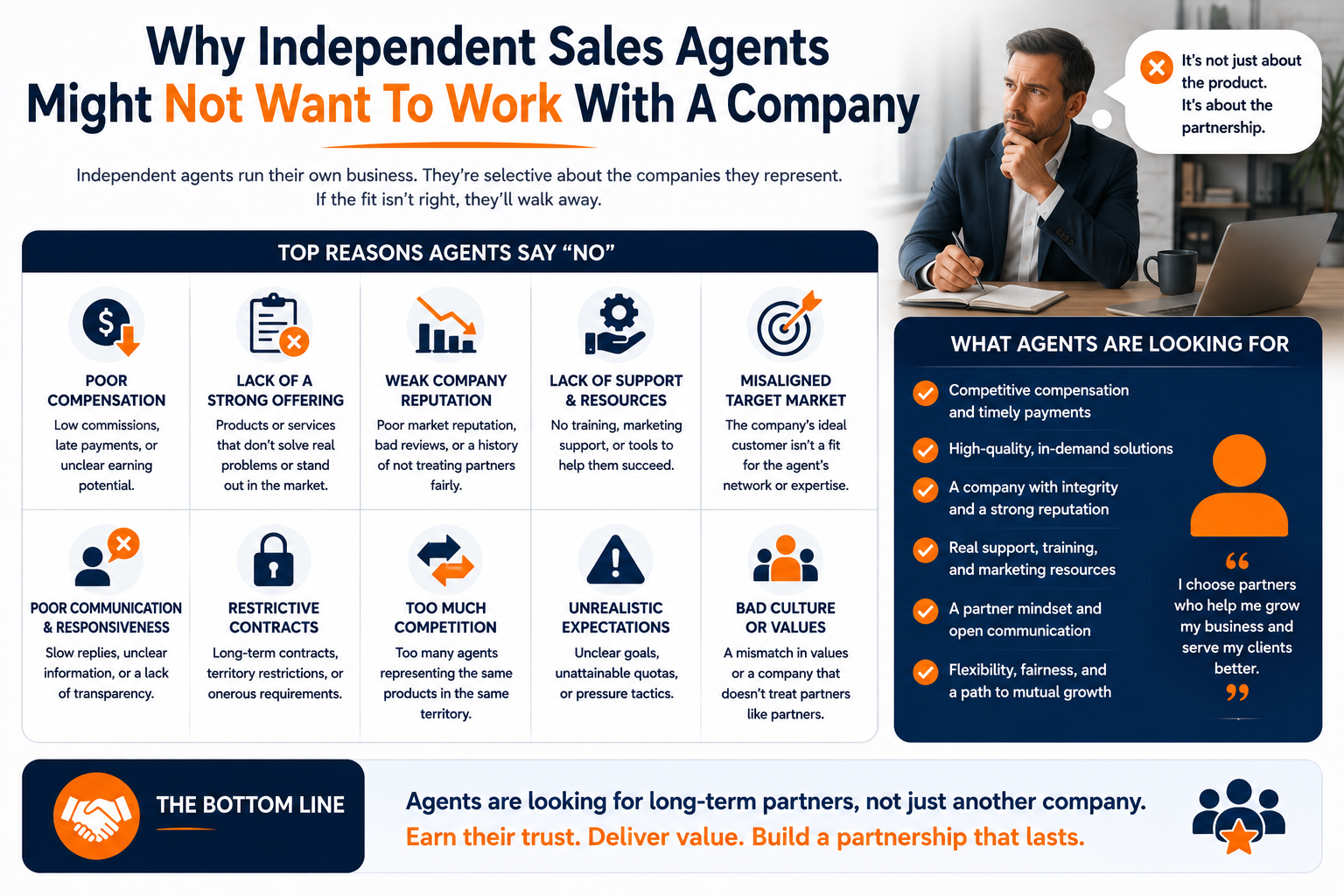
One of the biggest misunderstandings many companies have about independent sales reps is assuming reps are simply looking for any commission opportunity available.
In reality, experienced independent sales agents often have the luxury of being highly selective about the companies, products, and services they choose to represent.
That selectiveness exists for a reason.
Most established reps have spent years — sometimes decades — building trust, credibility, and long-term relationships inside a particular industry or territory. Those relationships are valuable commercial assets. Attaching the wrong company, weak product, or unrealistic opportunity to that network can damage trust they may have spent years developing.
As a result, experienced reps usually evaluate opportunities carefully before agreeing to represent a business.
One of the first things many reps look for is evidence of genuine product-market fit.
Unless a product or service is genuinely groundbreaking, highly differentiated, or first-to-market, most experienced reps are not looking to "test" whether a market exists for the company. They typically want to see signs that the business already has traction, customer demand, competitive positioning, or some level of commercial validation before investing their own time and relationships into selling it.
That mindset makes sense when you understand how independent reps operate commercially.
Unlike salaried employees, independent reps absorb their own operational risk. They invest their own time, travel, prospecting efforts, industry relationships, and reputation into the companies they represent. If the opportunity fails to generate sales, the rep often absorbs that loss personally.
This is also why residual or recurring commission structures are often extremely attractive to experienced reps.
Many independent reps are not simply looking for one-off transactional commissions. They are often building long-term recurring income streams across their portfolio of companies and customer relationships.
For example:
- SaaS companies may offer recurring monthly commissions tied to ongoing subscriptions
- manufacturers may pay repeat commissions on ongoing product reorders
- commercial services businesses may generate recurring contract revenue
- distributors may place ongoing repeat purchase orders over time
That recurring structure can make a huge difference because the rep continues benefiting from the long-term value of relationships they helped create.
Strong commission structures alone, however, are usually not enough.
Experienced reps also tend to look closely at:
- product quality
- market demand
- competitive positioning
- operational support
- communication quality
- onboarding
- pricing competitiveness
- leadership responsiveness
- long-term growth potential
In many ways, independent reps evaluate companies similarly to how investors evaluate businesses. They are deciding where to invest their time, relationships, reputation, and commercial energy.
This is one reason the strongest independent rep partnerships often emerge when both sides view the relationship as a genuine long-term commercial partnership rather than simply outsourced sales labor.
Should Companies Use a Hybrid Sales Model?
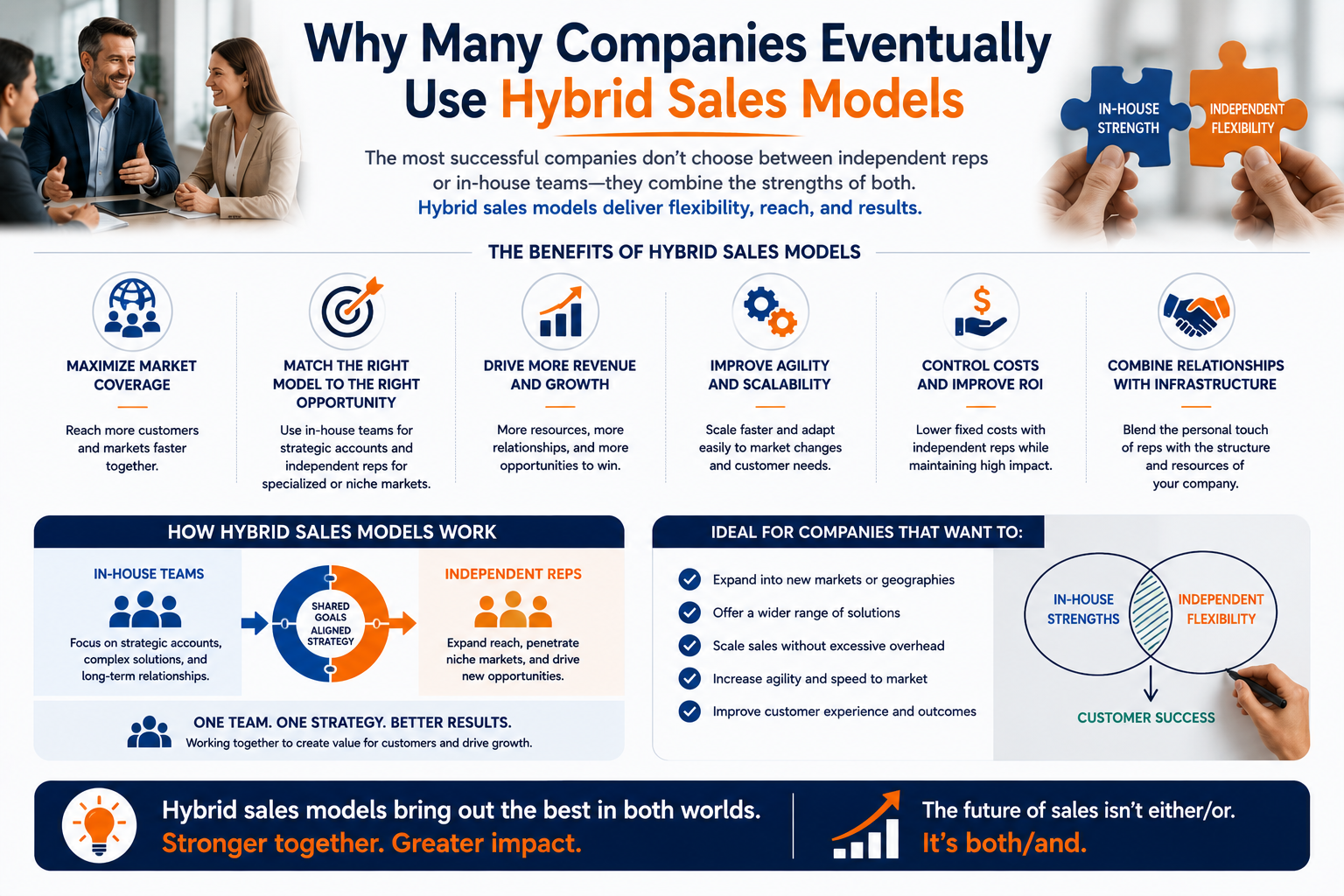
As companies grow, many eventually discover that sales expansion does not always need to follow a single structure.
Some opportunities may be better suited to internal teams. Others may be better suited to independent reps, distributors, channel partners, or territory specialists already operating inside a particular market.
This is one reason many successful businesses eventually adopt hybrid sales models rather than relying entirely on either internal employees or independent sales infrastructure alone.
A company may use:
- internal account managers for key strategic customers
- independent reps for regional expansion
- distributors for international fulfillment
- channel partners for niche verticals
- internal sales development teams for inbound opportunities
- territory reps for relationship-driven industries
That flexibility allows businesses to scale more strategically depending on the type of market they are entering and the level of control, specialization, or relationship access required.
For example, a manufacturer may maintain an internal leadership team while simultaneously working with independent territory reps across multiple states or countries. A SaaS company may operate an internal onboarding and customer success team while partnering with independent sales agents who already understand a highly specialized vertical market.
In many cases, hybrid structures emerge naturally over time because different sales environments require different types of commercial infrastructure.
Highly transactional sales environments may benefit from centralized internal processes and automation. Relationship-driven industries often benefit from local trust, territory familiarity, and existing buyer networks that independent reps may already possess.
This is also why independent reps are not necessarily competing against internal sales teams.
Very often, they complement them.
For businesses exploring scalable growth strategies, the question increasingly becomes less about choosing a single sales structure and more about understanding which combination of commercial models best fits the company’s industry, buyers, territory strategy, and stage of growth.
That shift in thinking is important because it moves the conversation away from simply "hiring salespeople" and toward designing a more flexible commercial growth system overall.
Are Independent Sales Reps a Better Alternative to Hiring Salespeople?
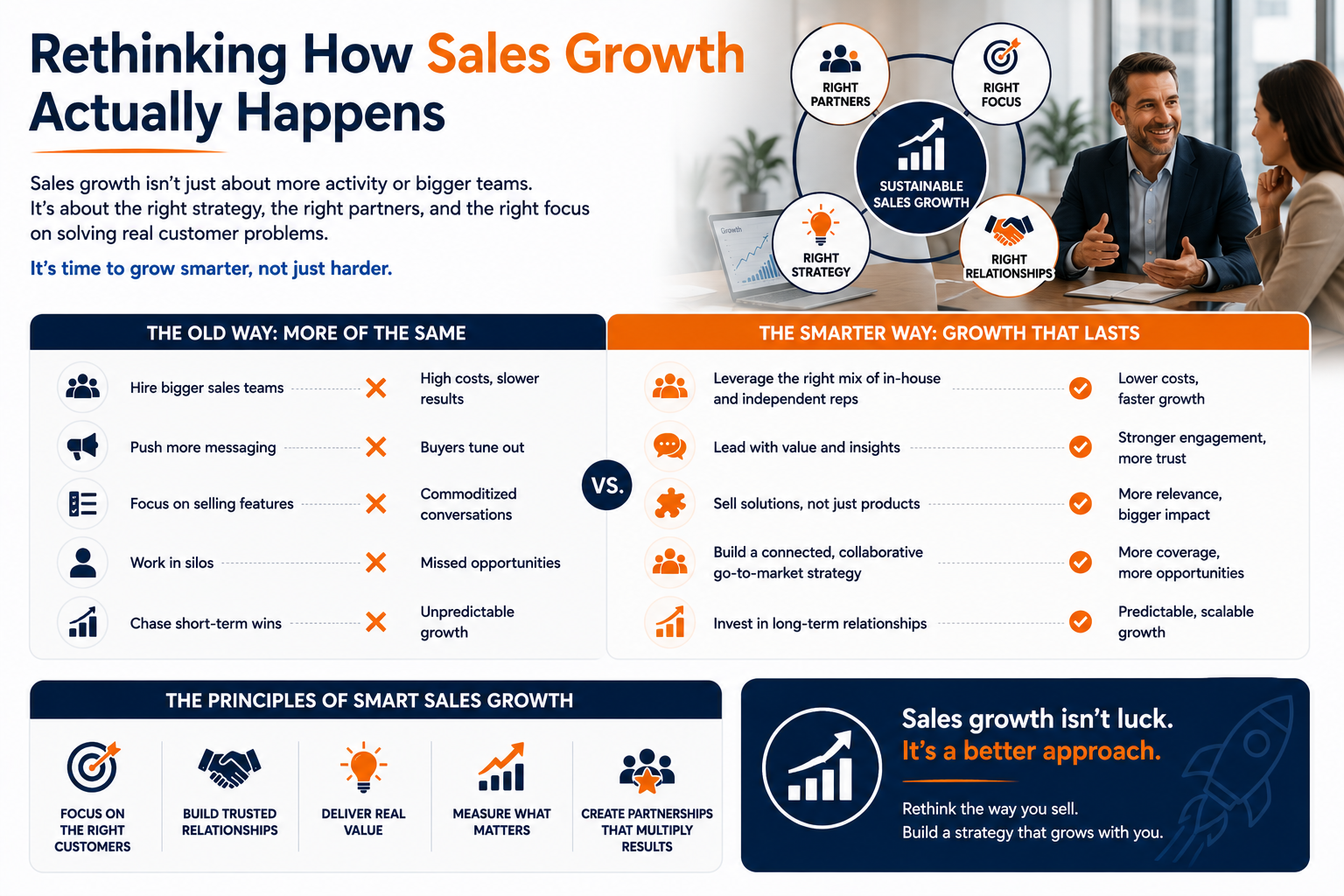
For decades, many businesses have approached sales growth in essentially the same way: hire more people, expand internal departments, increase payroll, open regional offices, and slowly build commercial infrastructure from the inside out.
That model still works.
But it is no longer the only path available.
Across manufacturing, industrial sales, healthcare, hospitality, commercial services, construction, SaaS, wholesale distribution, and many other industries, entire ecosystems of independent sales reps already exist operating inside established buyer networks, territories, and commercial relationships that have often taken years — sometimes decades — to build.
Most companies simply never realize this hidden part of the business world exists.
That is what makes independent sales ecosystems so interesting.
The value is not simply lower payroll overhead or performance-based compensation structures. The real value is access: access to relationships, access to territories, access to industry familiarity, and access to commercial trust that may otherwise take years for businesses to develop internally from scratch.
In many industries, relationships are still the infrastructure underneath how business actually gets done.
And while AI and automation continue reshaping prospecting, outreach, research, and sales operations, trust remains far harder to automate. Buyers are becoming increasingly overwhelmed with generic messaging, automated sequences, and high-volume outreach campaigns. As a result, genuine credibility, familiarity, and relationship access may become even more valuable over time rather than less.
This is one reason independent sales reps continue playing such an important role across many sectors despite how dramatically technology continues evolving.
They are not simply selling products.
Very often, they are operating inside ecosystems of long-term commercial trust built through years of consistent interaction within a particular market, territory, or industry.
That does not mean independent reps are the perfect solution for every business. Many companies will continue relying heavily on internal sales teams, customer success departments, channel partnerships, and hybrid commercial structures depending on their goals and operating model.
But understanding that these independent sales ecosystems already exist can fundamentally change the way companies think about growth itself.
Instead of viewing expansion purely through traditional internal hiring structures, businesses begin realizing that commercial infrastructure may already exist outside the organization.
And sometimes, the fastest path to growth is not always building every relationship internally from the ground up.
Sometimes, it is learning how to plug into networks that are already there.
How Do Companies Find Independent Sales Reps?
Historically, independent sales ecosystems operated largely through referrals, trade associations, regional territory networks, industry events, and long-standing commercial relationships. As a result, many companies simply never encountered experienced independent reps unless they already operated inside industries where the model was common.
That lack of visibility is one reason many businesses continue defaulting toward traditional hiring structures even when independent sales infrastructure may already exist within the markets they are trying to enter.
For companies unfamiliar with the ecosystem, finding experienced reps was often fragmented and time-consuming. Businesses typically relied on word-of-mouth introductions, distributor recommendations, trade shows, manufacturing associations, or local industry contacts to identify potential sales partners.
Today, that process is becoming far more accessible.
Specialized platforms like CommissionCrowd have helped make independent sales ecosystems more visible by connecting companies with experienced commission-only sales reps, manufacturers’ agents, territory specialists, and independent sales agencies operating across multiple industries globally.
This increased visibility is important because many companies are now beginning to rethink how sales expansion actually works. Instead of assuming growth always requires building large internal sales teams from scratch, businesses can increasingly explore existing relationship-driven sales networks that may already operate inside their target industries and territories.
For companies looking to scale strategically while remaining operationally lean, that shift can fundamentally change the speed, flexibility, and economics of expansion.
Frequently Asked Questions About Independent Sales Reps
What is an independent sales rep?
An independent sales rep is a self-employed sales professional or sales agency that represents one or multiple companies on a commission-only basis rather than working as a salaried employee. Independent reps typically operate their own businesses and are paid based on the revenue they generate for the companies they represent.
Are independent sales reps employees?
No. Independent sales reps are usually independent contractors or self-employed business operators rather than employees. They generally manage their own schedules, territories, expenses, prospecting activities, and client relationships independently.
How do independent sales reps get paid?
Most independent sales reps earn commissions based on the sales revenue they generate. Some commission structures involve one-time payments, while others include recurring or residual commissions tied to ongoing customer revenue, repeat orders, subscriptions, or long-term accounts.
What is the difference between a manufacturers’ rep and a distributor?
A manufacturers’ rep typically sells products on behalf of a manufacturer without purchasing inventory directly. Distributors, on the other hand, often buy, stock, warehouse, and resell products themselves. Manufacturers’ reps usually operate more as relationship-driven sales partners within a territory.
Why do companies work with independent sales reps?
Many companies work with independent reps to expand into new territories, access existing buyer relationships, reduce fixed payroll overhead, enter specialized industries, or scale revenue without building large internal sales teams from scratch.
What industries commonly use independent sales reps?
Independent sales reps are common across manufacturing, industrial equipment, healthcare, hospitality, wholesale distribution, commercial services, construction, logistics, SaaS, agriculture, and many other B2B industries where relationships and territory familiarity play an important role in sales.
What is portfolio selling?
Portfolio selling refers to the practice of independent reps representing multiple complementary product lines or services simultaneously. Many reps build carefully aligned portfolios around the industries and buyer relationships they already understand, allowing them to create more value from existing commercial relationships.
Why are experienced independent sales reps selective about the companies they represent?
Experienced reps often spend years building trust and credibility inside a territory or industry. Representing weak products, unrealistic opportunities, or poorly managed companies can damage those relationships, so many reps evaluate commercial opportunities very carefully before agreeing to work with a business.
Do independent sales reps only work with physical products?
No. While independent reps are extremely common in manufacturing and industrial sales, many also represent SaaS companies, commercial services, hospitality businesses, healthcare solutions, logistics providers, and other B2B service-based businesses.
Can independent sales reps help companies expand internationally?
Yes. Many businesses use independent reps or territory specialists to enter new geographic markets without needing to immediately build full internal regional sales teams. Experienced reps may already possess local market knowledge, buyer relationships, and industry familiarity within specific territories.
Are independent sales reps replacing internal sales teams?
Not necessarily. Many businesses use hybrid sales models that combine internal teams with independent reps, distributors, channel partners, or regional sales specialists depending on the company’s goals, industry, and territory strategy.
What do independent sales reps typically look for in a company?
Experienced reps often look for realistic earning potential, strong product-market fit, competitive commission structures, operational support, responsive communication, long-term growth opportunities, and companies that treat reps like strategic commercial partners rather than outsourced labor.

More articles from CommissionCrowd
World-Class Software Engineering Sales Opportunity - 35% Commission + Residuals
World-Class Software Engineering Sales Opportunity - 35% Commission + Residuals
Why You'll Never Find Great Self-Employed Sales Professionals on Gumtree or
Why You'll Never Find Great Self-Employed Sales Professionals on Gumtree or Generic Job Websites