
Alternatives to Hiring Salespeople: How Growing Companies Scale Revenue Without Massive Payroll Costs
Why More Businesses Are Exploring Independent Sales Reps, Channel Partnerships, and Performance-Based Sales Models
For many businesses, growth creates a strange paradox.
The more successful the company becomes, the more expensive growth itself starts becoming. More customers often require more staff. More sales usually means more hiring. More hiring creates more management complexity, operational overhead, onboarding pressure, software costs, payroll commitments, and financial risk.
At first, this feels normal. Scaling a business has traditionally been tied closely to scaling headcount. But eventually, many companies start asking the same difficult question:
How do you continue growing revenue without continuously expanding fixed costs at the same pace? That question has become increasingly important in modern business.
Customer acquisition costs are rising. Hiring is expensive. Experienced sales talent is competitive. International expansion requires local relationships and market familiarity. And in many industries, building an effective sales organization takes far longer — and costs far more — than companies initially expect.
As a result, many founders and commercial leaders are beginning to realize something important:
Hiring In-House Employees Is Not The Only Way Companies Grow Sales.
Across manufacturing, industrial equipment, logistics, commercial services, SaaS, wholesale distribution, and many other B2B sectors, businesses have been scaling through alternative commercial models for decades. Some rely on distributors. Others use channel partnerships, referral ecosystems, independent sales agencies, or self-employed sales professionals operating on a performance basis rather than through traditional employment structures.
Yet despite how established these ecosystems are, many companies never seriously encounter them during their growth journey.
Most businesses are still taught to think about expansion through a traditional lens: hire more salespeople, increase payroll, build larger internal teams.
But in reality, entire commercial infrastructures already exist outside that model — infrastructures built around relationships, territories, industry specialization, and performance-based growth.
And for companies trying to scale carefully, enter new markets, reduce fixed overhead, or grow without building massive internal sales departments, understanding how these ecosystems work can fundamentally change the way they think about expansion itself.

Table of Contents
- The Rising Cost of Traditional Sales Hiring
- How Companies Actually Scale Revenue
- The Overlooked Growth Model: Independent Sales Reps and Commission-Only Sales
- Why Experienced Sales Professionals Choose Independence
- Why Performance-Based Sales Models Are Growing Again
- Where Commission-Only Sales Works Best
- Common Misconceptions About Commission-Only Sales
- Why Many Companies Never Consider This Option
- How Platforms Like CommissionCrowd Changed Accessibility
- Conclusion
- FAQ's
The Rising Cost of Traditional Sales Hiring
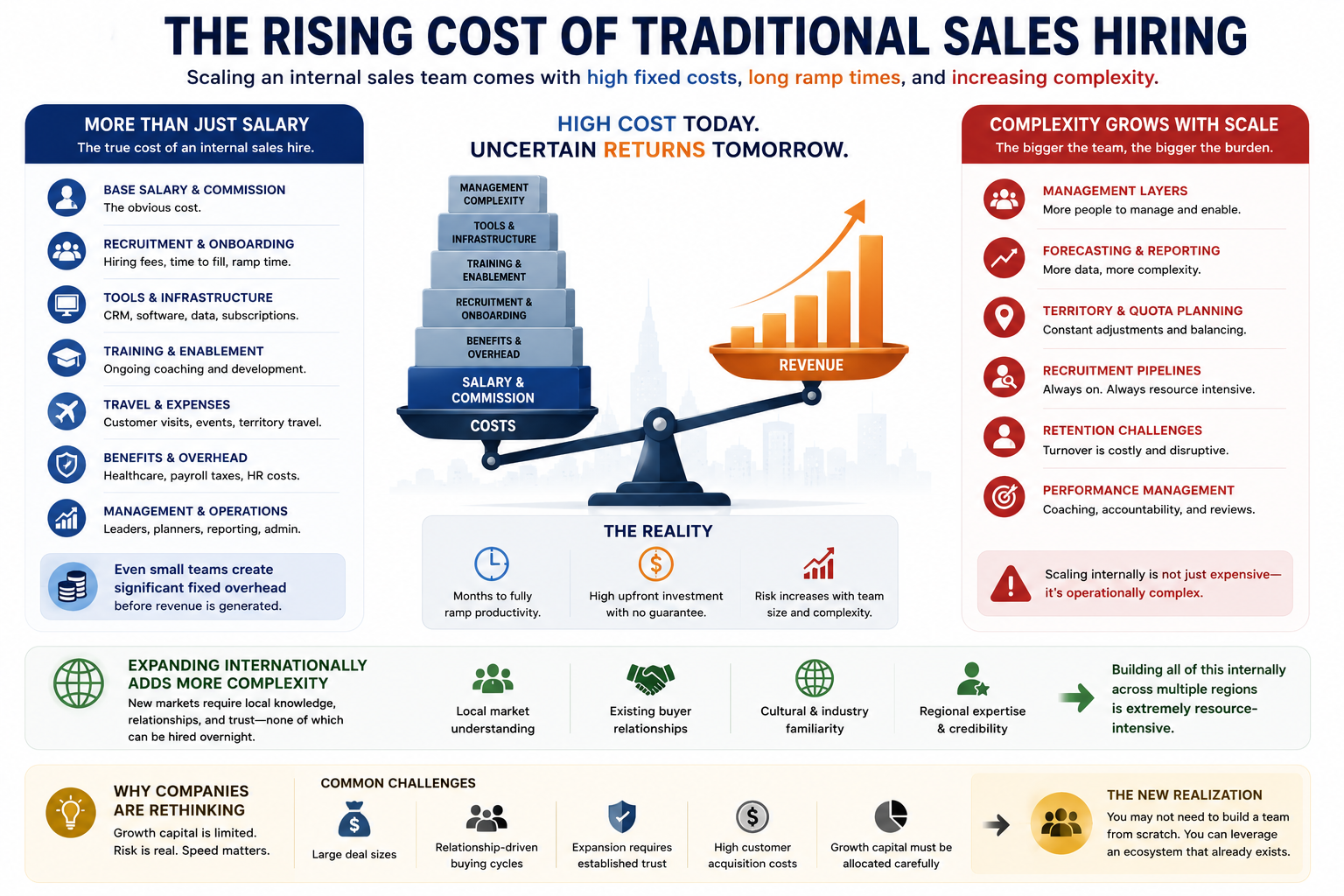
For decades, building an internal (in-house) sales team was considered the default path to growth.
If a company wanted more revenue, it hired more salespeople. If it wanted to expand geographically, it opened offices or recruited regional staff. Sales growth and headcount growth were often treated as directly connected.
That model still works in many situations. But it has also become increasingly expensive to sustain.
Modern sales organizations carry significant operational costs beyond salary alone. Recruitment fees, onboarding, CRM infrastructure, training, management layers, software subscriptions, benefits, travel expenses, and sales enablement tools all contribute to the total cost of acquisition. Even relatively small teams can create substantial fixed overhead long before meaningful revenue materializes.
For startups and SMEs, this creates a particularly difficult balancing act.
Hiring too slowly can stall growth. Hiring too aggressively can create financial pressure long before a new sales team becomes productive.
The challenge is compounded by the fact that sales performance is rarely immediate. New hires often require months to fully ramp up. In technical or relationship-driven industries, the timeline can be even longer. During that period, companies are carrying payroll costs without necessarily seeing corresponding revenue generation.
International expansion introduces another layer of complexity.
Entering new territories typically requires local market understanding, cultural familiarity, buyer relationships, and regional industry knowledge. Building those capabilities internally can be extremely resource-intensive, particularly for businesses attempting to scale across multiple regions simultaneously.
This is one reason many companies discover that scaling sales is not simply a hiring problem. It is an infrastructure problem.
The larger an internal sales organization becomes, the more management complexity increases alongside it. Forecasting, reporting, coaching, territory planning, compensation structures, recruitment pipelines, retention challenges, and performance management all become operational disciplines of their own.
For some businesses, building that infrastructure makes strategic sense. For others, especially companies seeking leaner growth models, the economics become harder to justify.
This is particularly true in industries where:
- deal sizes are large
- buying cycles are relationship-driven
- expansion into new markets requires established trust
- customer acquisition costs are already high
- growth capital must be allocated carefully
In-House Sales Hiring vs Independent Sales Reps: Comparing the Costs
One of the biggest reasons companies begin exploring alternative sales models is simple:
Traditional sales hiring has become extremely expensive.
In the United States, the average base salary for a B2B salesperson is often between $60,000–$90,000+ per year before commissions, benefits, payroll taxes, recruitment costs, management overhead, software, travel expenses, and onboarding are even considered.
For experienced enterprise sales professionals, total compensation packages can easily exceed six figures annually.
And importantly, those costs begin immediately — long before a new hire necessarily generates meaningful revenue.
Many B2B sales hires also require months before becoming fully productive, particularly in relationship-driven or technical industries where trust and market familiarity take time to develop.
By contrast, experienced independent sales reps typically work on a pure performance basis.
There is usually:
- no salary
- no employee benefits
- no payroll burden
- no long-term employment obligation
- no fixed compensation before revenue is generated
Instead, the rep earns commissions directly from the business they generate.
At first glance, some businesses mistakenly interpret this as simply “cheaper sales.”
In reality, the economics are far more sophisticated than that.
Experienced independent reps are often not starting from zero.
Many already maintain:
- established buyer relationships
- active territory coverage
- existing industry networks
- commercial credibility
- regional market familiarity
- portfolios of complementary products and services
In many industries, independent reps may have spent years — sometimes decades — building trust with the exact buyers a company is trying to reach.
That relationship access can be enormously valuable.
A newly hired internal salesperson may still need to build relationships, learn territory dynamics, establish credibility, and develop industry familiarity from scratch.
An established independent rep may already operate inside that ecosystem every day.

This does not mean independent reps replace internal sales teams entirely.
Many businesses ultimately use hybrid models combining internal staff with external sales infrastructure depending on territory strategy, market maturity, and account complexity.
But for companies trying to scale carefully, enter new markets, or reduce fixed overhead during expansion, the economic difference between these models can be substantial.
As a result, many businesses have started reevaluating a fundamental assumption:
Does scaling sales always require building a large internal sales team?
Increasingly, the answer is no.
Many companies are now exploring alternative growth models that allow them to expand revenue capacity without taking on the full operational burden of traditional hiring. Some pursue channel partnerships. Others work with distributors or strategic affiliates. And many industries continue relying heavily on independent sales ecosystems that operate outside the standard employee-employer structure altogether.
For businesses unfamiliar with these models, the realization can be surprisingly significant.
Because once companies understand that entire networks of independent sales professionals already exist — many with established buyer relationships, territory expertise, and years of industry experience — the conversation around growth begins to change.
How Companies Actually Scale Revenue
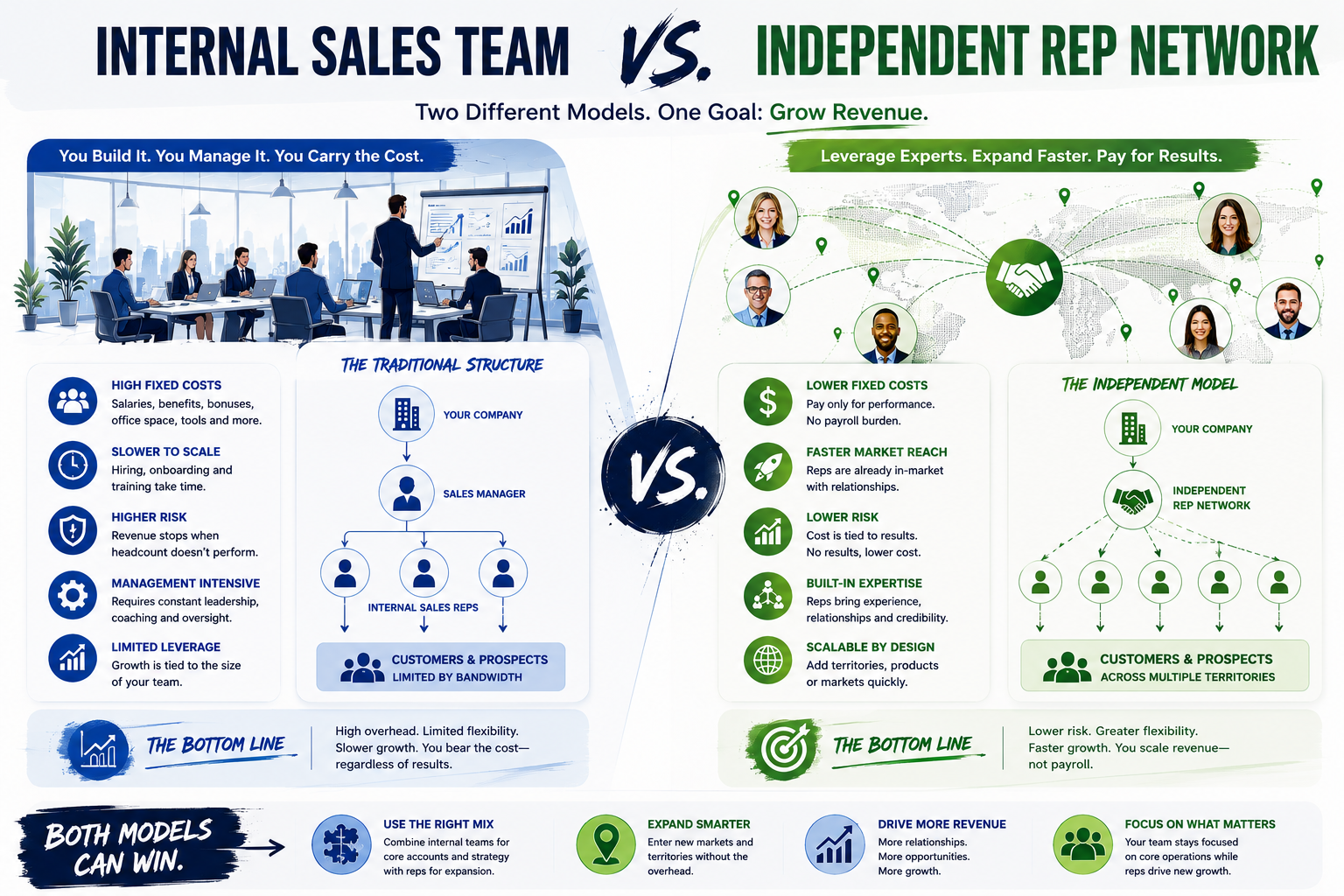
One of the biggest misconceptions in business growth is the belief that revenue must always scale alongside headcount. In reality, many companies are not limited by a lack of salespeople. They are limited by a lack of market access, buyer relationships, and commercial infrastructure.
In reality, companies scale sales through a wide range of commercial models depending on:
- industry structure
- margins
- territory coverage
- customer acquisition costs
- relationship dynamics
- product complexity
- operational resources
Some businesses build large internal sales organizations. Others rely heavily on distribution networks, channel partnerships, strategic alliances, or franchise-style expansion. Many use hybrid approaches that combine internal account management with external sales channels operating independently in different markets or industries.
In manufacturing, for example, it has long been common for companies to expand into new territories through independent manufacturers’ representatives rather than opening regional offices. In software and technology, partner ecosystems and reseller channels frequently drive international growth faster than direct hiring alone. Commercial service companies often use referral networks or independent business development partners to access industries where relationships already exist.
These models are not fringe strategies. In many sectors, they are normal commercial infrastructure. Many businesses spend years trying to internally build commercial networks that independent reps may have already spent decades developing.
The reason is simple. In relationship-driven industries, access is often more valuable than activity.
A company may have an excellent product, strong operations, and a capable leadership team, but still struggle to enter a new market because it lacks trusted relationships with buyers in that territory. Building those relationships internally can take years. By contrast, external sales partners, independent reps, or specialized agencies may already spend every day speaking with the exact decision-makers the company is trying to reach.
This is particularly common in B2B industries where purchasing decisions are heavily relationship-driven.
Plant managers, procurement directors, distributors, contractors, healthcare buyers, hospitality groups, logistics firms, and industrial operators often buy from people they already know and trust. In these environments, sales is rarely just about lead generation. It is about credibility, familiarity, timing, and long-term relationship development.
That reality is one reason independent sales ecosystems have remained relevant for decades despite massive changes in technology and communication.
While many modern growth conversations focus heavily on digital marketing, automation, AI, and outbound systems, relationship-based sales infrastructure still plays a major role in how companies actually expand commercially.
And importantly, not all of this infrastructure operates through traditional employment.
Many businesses work with:
- independent sales agencies
- self-employed sales professionals
- commission-based channel partners
- territory representatives
- strategic referral partners
- industry specialists with existing buyer networks
Some represent one company exclusively. Others carry multiple complementary products or services simultaneously, introducing solutions into accounts they already manage relationships with.
For companies unfamiliar with these ecosystems, this can initially seem unusual.
But from the perspective of the sales professional, the model often makes strong economic sense.
An independent rep selling industrial filtration systems to manufacturing plants, for example, may also represent complementary product lines such as pumps, valves, sensors, or maintenance services targeting the same buyers. Every customer interaction creates multiple revenue opportunities. Instead of rebuilding relationships from scratch for every product, the rep monetizes an existing network across several compatible solutions.
This is one reason experienced independent sales professionals can sometimes open doors significantly faster than newly hired internal teams.
They are not starting from zero. That changes the economics of growth dramatically because many companies are not trying to build sales teams from scratch.
They are trying to build trust from scratch.
B2B commission-based sales reps** may already:**
- know your potential buyers
- understand the procurement cycles
- have industry credibility
- understand regional dynamics
- attend the relevant trade events
- maintain existing commercial relationships within the target market
For businesses exploring growth strategies, this changes the conversation considerably.
Instead of viewing sales expansion purely as a hiring challenge, companies begin viewing it as an access and distribution challenge:
- Who already has relationships in this market?
- Who already understands these buyers?
- Who already operates in these industries?
- Who already has commercial infrastructure in place?
That shift in thinking is important because it opens the door to entirely different approaches to growth.
Rather than building every sales capability internally from day one, businesses can sometimes expand through existing networks, independent partnerships, and performance-based sales ecosystems that are already operating within their target industries.
Among the most established — and most misunderstood — of these models is the world of independent sales reps and commission-only sales professionals.
The Overlooked Growth Model: Independent Sales Reps and Commission-Only Sales
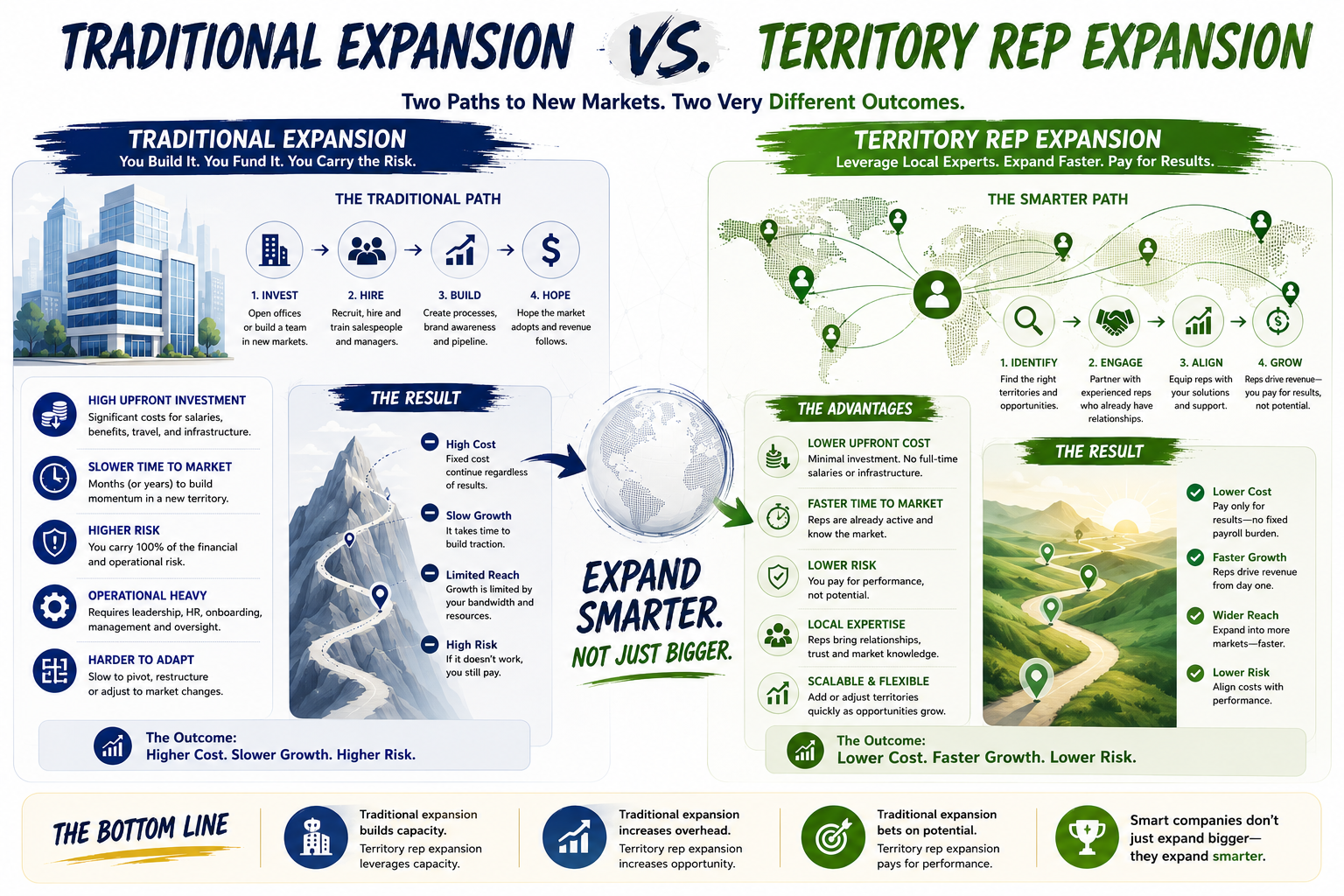
For many companies, the phrase “commission-only sales” immediately brings to mind aggressive cold calling, entry-level sales jobs, or high-turnover recruitment environments.
That perception is one of the main reasons many businesses overlook an entire category of highly experienced independent sales professionals already operating across global B2B industries.
In reality, the commission-only sales ecosystem is far broader, more established, and more commercially sophisticated than many founders initially realize.
Across sectors such as manufacturing, industrial equipment, construction, logistics, commercial services, wholesale distribution, and increasingly SaaS and technology, independent sales reps have operated successfully for decades. The most important thing is for a company to truly understand why top sales professionals become self-employed in the first place.
These professionals are typically self-employed. They are not salaried employees. They often work independently or as part of small agencies, representing multiple non-competing companies simultaneously within defined industries or territories.
In manufacturing, they are commonly referred to as:
- manufacturers’ reps
- manufacturers’ agents
- independent sales representatives
- territory reps
But the underlying commercial model is similar across industries.
The company gains access to industry relationships, market knowledge, and sales capability without necessarily building a large internal team from scratch. The rep earns commissions based on performance and revenue generation rather than fixed salary.
Importantly, this is not simply outsourced lead generation.
Experienced independent reps often function as long-term commercial partners within specific industries or territories. Many spend years — sometimes decades — building relationships with buyers, distributors, contractors, procurement teams, or operators inside highly specialized markets.
That relationship capital is one of the biggest reasons the model continues to survive and evolve.
A manufacturer attempting to enter a new region, for example, may struggle to gain traction simply because buyers have never heard of the company before. An independent rep already operating in that territory may have existing relationships with those exact purchasing departments and decision-makers.
The value is not just sales activity. It is access.
This becomes especially important in industries where:
- trust develops slowly
- procurement cycles are long
- technical understanding matters
- relationships influence purchasing decisions
- buyers prefer established contacts
In these environments, building a sales infrastructure entirely internally can take significant time and capital.
Independent reps already operating within those ecosystems can dramatically accelerate market entry.
Another important aspect of the model is portfolio selling.
Many independent reps carry several complementary products or services at the same time. A rep calling on manufacturing facilities, for example, might represent:
- industrial pumps
- filtration systems
- valves
- automation components
- maintenance services
All targeting similar buyers.
From the rep’s perspective, this creates efficiency. Every customer interaction can potentially generate multiple revenue opportunities across different product lines.
From the company’s perspective, it means their offering may gain access to buyers the rep is already visiting regularly.
This is one reason the model has historically been so effective in manufacturing and industrial sales environments. The rep’s economic incentives align naturally with maintaining strong industry relationships and maximizing the value of every account interaction.
Why Experienced Sales Professionals Choose Independence
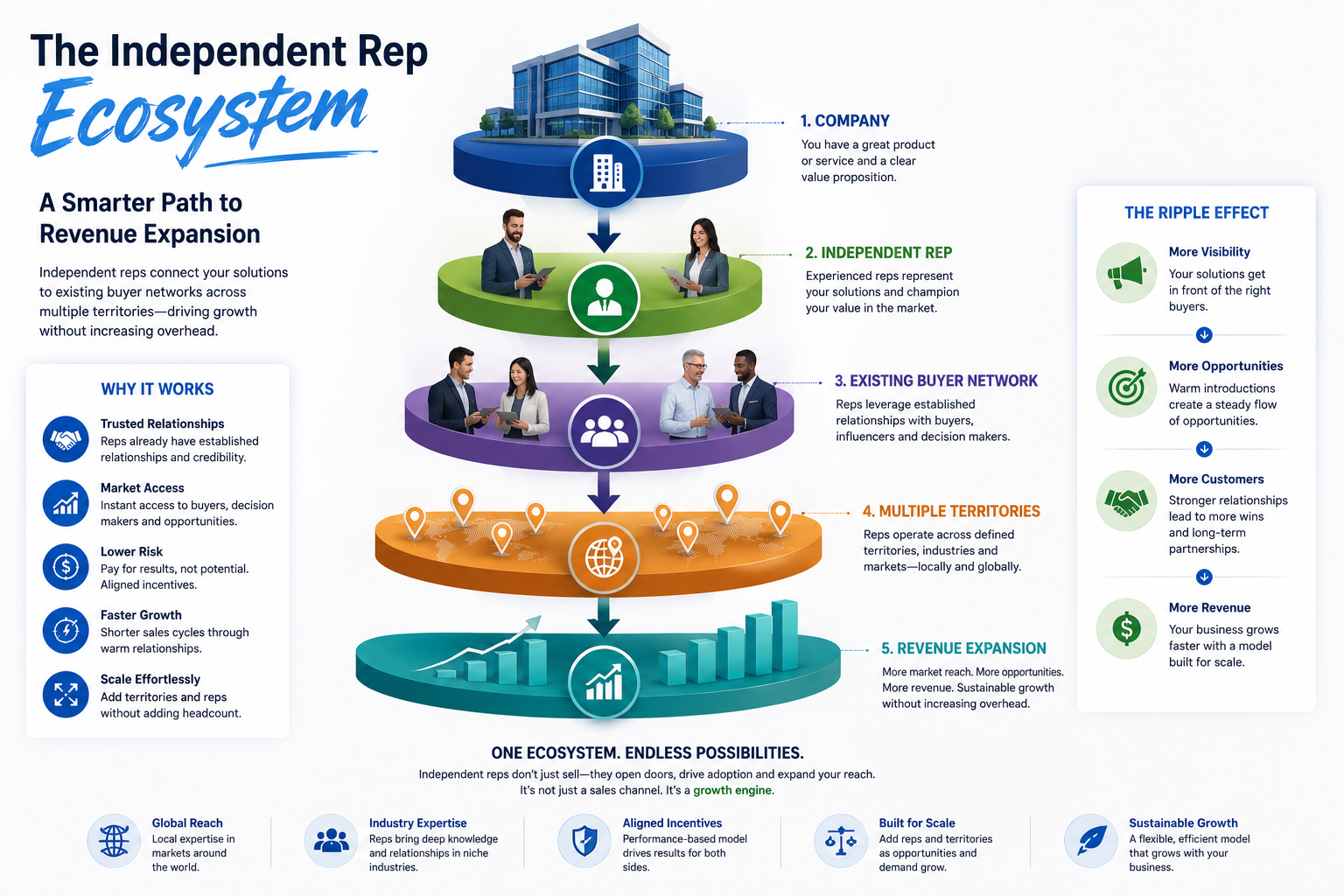
One of the biggest questions companies ask when they first encounter independent sales ecosystems is straightforward:
Why would an experienced salesperson choose to work independently instead of taking a salaried role?
For businesses unfamiliar with commission-based sales models, the assumption is often that independent reps are simply people unable to secure traditional employment. In reality, many experienced sales professionals choose independence deliberately because the economics, flexibility, and long-term upside can be significantly more attractive than corporate structures.
In many B2B industries, top-performing salespeople already operate with a high degree of autonomy even inside traditional organizations. They manage territories, maintain client relationships, travel independently, build industry networks, and generate business largely through their own reputation and relationships.
Over time, some begin questioning the tradeoff.
If they are already functioning independently while generating substantial revenue, why remain tied to a single employer, capped compensation structure, or geographically restricted role?
For experienced reps with established networks, independence can create several advantages.
Uncapped Earning Potential
Traditional salaried sales roles often include:
- fixed compensation bands
- territory restrictions
- capped commissions
- internal politics
- restructuring risk
- compensation plan changes
Independent reps, by contrast, typically earn directly from the revenue they generate. Strong performers can build multiple income streams across complementary product lines and territories simultaneously.
In industries with long-term repeat business, the upside can become substantial.
A rep with deep relationships across a sector may continue generating commission earnings from accounts developed over many years while adding new product lines into the same buyer network.
Portfolio Efficiency
One of the most important — and least understood — aspects of independent sales is portfolio selling.
An internal employee usually represents one company.
An independent rep may represent several complementary companies targeting the same buyers.
This creates powerful commercial efficiency.
For example, a rep already calling on:
- manufacturing plants
- procurement departments
- contractors
- distributors
- healthcare facilities
- hospitality groups
can potentially introduce multiple compatible solutions during the same relationship cycle.
Every customer interaction becomes more economically valuable.
This is one reason many experienced independent reps become highly specialized within particular industries. The deeper their relationships and market understanding become, the more efficiently they can expand their portfolio and revenue opportunities.
Relationship Ownership
In many relationship-driven industries, sales professionals spend years building trust with buyers.
Some eventually prefer operating independently because it gives them greater control over:
- client relationships
- territory development
- product selection
- earning structure
- long-term commercial strategy
Rather than relying entirely on one employer, they build their own commercial ecosystem around the industries and buyers they know best.
For highly networked professionals, those relationships can become significantly more valuable than any individual salaried position.
Flexibility and Autonomy
Independence also appeals to many experienced sales professionals because it allows them to structure their work differently.
Instead of operating within rigid corporate systems, independent reps often have greater control over:
- schedules
- territories
- client focus
- travel
- growth strategy
- product specialization
Some operate solo businesses. Others build regional agencies or small independent teams.
Many intentionally choose this path because they prefer entrepreneurship over corporate hierarchy.
Why This Matters for Companies
Understanding why experienced reps choose independence is important because it fundamentally changes how businesses approach commission-only sales.
Companies unfamiliar with the ecosystem sometimes assume they are offering an opportunity to salespeople.
In reality, experienced independent reps are often evaluating companies just as carefully.
Because their income depends entirely on performance, they typically look for businesses with:
- strong products
- reliable operations
- competitive commissions
- realistic market demand
- clear differentiation
- responsive communication
- long-term partnership potential
Their reputation is tied directly to the companies they represent.
If a product underperforms, fulfillment fails, or commissions become unreliable, the rep risks damaging relationships they may have spent years building.
As a result, many established independent sales professionals are selective about who they work with.
This dynamic is one reason the ecosystem can function very differently from traditional employment-driven recruitment.
The strongest partnerships often emerge when:
- the company understands the value of the rep’s network and relationships
- the rep believes in the commercial viability of the product or service
- both parties are aligned around long-term revenue growth
At that point, the relationship becomes less about “hiring salespeople” and more about building performance-based commercial partnerships.
And for businesses trying to expand strategically without building massive internal sales organizations, that distinction can be extremely important.
Why Performance-Based Sales Models Are Growing Again
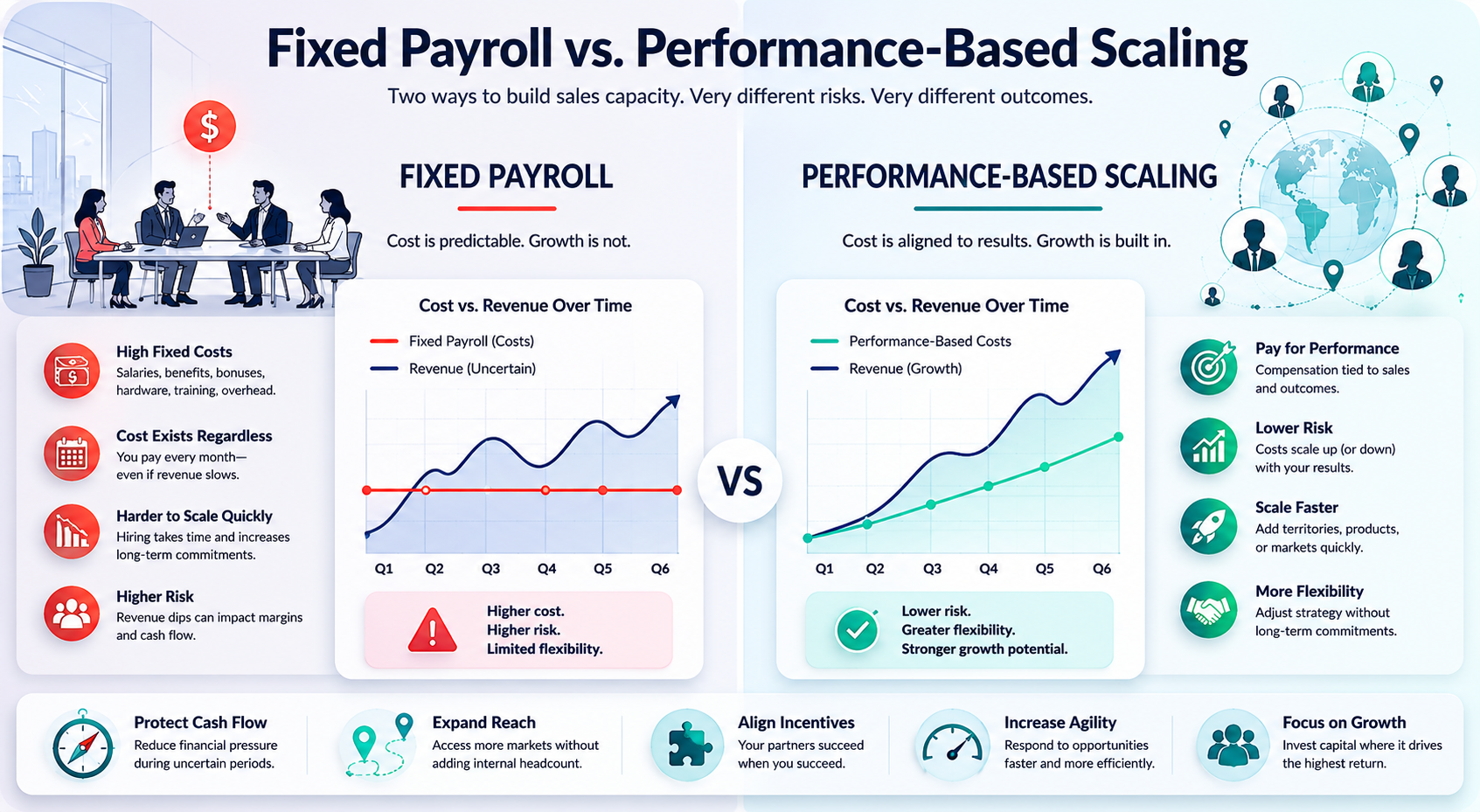
For a period of time, many businesses moved heavily toward centralized internal sales organizations.
Advances in CRM systems, outbound automation, digital advertising, and remote communication made it easier for companies to build internal teams capable of managing large volumes of sales activity from centralized locations. Venture-backed growth models, particularly in technology, often prioritized rapid headcount expansion as a sign of scale.
But over the last several years, the economics of growth have started shifting again.
Rising customer acquisition costs, pressure on margins, remote work, global competition, and increasing uncertainty around hiring have forced many businesses to reevaluate how they expand revenue efficiently.
As a result, performance-based sales models are regaining attention across multiple industries.
This does not mean internal sales teams are disappearing. Many companies will always require dedicated in-house commercial teams. But increasingly, businesses are becoming more open to hybrid growth structures that combine internal capabilities with external sales infrastructure, strategic partnerships, and independent commercial networks.
Several broader trends are contributing to this shift.
Lean Growth Has Become a Priority
Many companies are now far more cautious about fixed overhead than they were during periods of cheap capital and aggressive expansion.
Building large internal sales departments creates long-term operational commitments:
- salaries
- management layers
- software infrastructure
- recruitment pipelines
- benefits
- office costs
- training
- retention challenges
For businesses attempting to scale carefully, performance-based models can offer more flexibility because a greater portion of commercial cost is tied directly to revenue generation.
This changes the financial profile of expansion.
Instead of carrying large payroll obligations before results materialize, businesses can sometimes grow through structures where compensation scales alongside actual sales performance.
That dynamic is particularly attractive during periods of economic uncertainty.
Remote Work Changed Commercial Infrastructure
Remote work normalized distributed teams and decentralized business operations across nearly every industry.
As companies became more comfortable operating without centralized offices, the idea of working with independent external sales professionals also became more commercially acceptable.
In many industries, buyers themselves became increasingly remote and geographically distributed. This accelerated the importance of relationships, local market familiarity, and territory specialization — areas where independent reps have historically performed well.
The result is that many businesses are now more open to flexible commercial structures than they were a decade ago.
AI and Automation Are Reshaping Sales Roles

AI and automation are dramatically changing parts of the sales process:
- prospecting
- research
- outbound messaging
- CRM workflows
- lead scoring
- administrative tasks
But relationship-driven sales environments still depend heavily on trust, industry familiarity, timing, and human credibility.
In highly relationship-oriented industries, independent reps often remain valuable because they already possess:
- buyer access
- industry trust
- commercial relationships
- local market understanding
AI can automate prospecting however, it cannot automate years of industry credibility, buyer trust, and relationship capital built over decades.
In some ways, AI may actually increase the value of experienced relationship-based sellers by automating lower-value administrative work while leaving high-trust commercial relationships even more important. As automation commoditizes outreach, human trust may become even more valuable.
International Expansion Is More Accessible Than Ever
Many companies today have the ability to sell internationally far earlier than businesses could historically.
Ecommerce, SaaS delivery models, remote onboarding, and global communication tools have lowered barriers to entering new markets.
However, selling internationally still creates practical challenges:
- market familiarity
- cultural differences
- local buyer behavior
- industry relationships
- distribution access
- trust
Independent sales reps and regional agencies already operating inside those markets can sometimes accelerate expansion significantly faster than attempting to build local teams from scratch.
For businesses exploring international growth, this can create a compelling alternative to opening offices or recruiting large regional sales departments immediately.
The Workforce Itself Is Becoming More Independent
The broader workforce is also shifting toward greater independence across multiple industries.
Fractional executives, consultants, independent creators, specialized contractors, and freelance operators have become increasingly common in modern business environments. Many experienced professionals now prefer flexible, performance-based, or portfolio-driven careers over traditional long-term employment structures.
Sales is no exception.
For some highly experienced commercial professionals, independence offers:
- greater upside
- greater autonomy
- more flexibility
- diversified income
- ownership over relationships and territories
As a result, the talent pool participating in independent sales ecosystems continues evolving beyond outdated stereotypes around commission-only work.
Why This Matters
Together, these trends are changing how many businesses think about growth.
Instead of assuming expansion must always follow a linear pattern of:
- hire employees
- increase payroll
- build larger internal departments
companies are increasingly exploring more flexible commercial models that allow them to:
- test markets
- expand strategically
- reduce fixed overhead
- access existing relationships
- scale more gradually
- align cost more closely with performance
Independent sales reps, manufacturers’ agents, channel partners, and commission-based sales ecosystems fit naturally into this broader shift toward more flexible and performance-oriented growth structures.
And for companies that have never seriously explored these models before, understanding where they work — and where they do not — becomes increasingly important.
Where Commission-Only Sales Works Best
One of the reasons commission-only sales is often misunderstood is because businesses sometimes treat it as a universal solution.
It is not.
Like any commercial model, independent sales ecosystems work exceptionally well in some environments and poorly in others. Understanding that distinction is important because it separates realistic strategic expansion from unrealistic expectations.
The companies that succeed with independent sales reps are usually not looking for “someone to magically generate revenue.” They are typically businesses with products, services, or market positioning that already make commercial sense but need broader market access, stronger industry relationships, or additional sales reach.
In other words, commission-only sales tends to amplify existing commercial potential rather than compensate for weak fundamentals.
Industries Where Independent Reps Commonly Thrive
Historically, independent sales reps have been especially common in:
- manufacturing
- industrial equipment
- commercial construction
- logistics
- wholesale distribution
- business services
- medical products
- hospitality supply
- commercial technology
- SaaS partnerships
- specialty products
These industries often share several characteristics:
- relationship-driven buying
- repeat business potential
- clearly defined buyer groups
- relatively high deal values
- long-term account opportunities
- territory specialization
In these environments, relationship access can be far more valuable than raw outbound volume.
A rep who already knows the procurement managers, contractors, distributors, operators, or decision-makers inside a target industry may create momentum much faster than a newly hired internal salesperson starting with no established network.
High-Ticket and Repeat Sales Business Models
Commission-based sales structures generally work best when the economics allow both the company and the rep to benefit meaningfully from successful deals.
Products or services with:
- strong margins
- repeat orders
- recurring revenue
- lifetime customer value
- larger contract sizes
tend to align naturally with independent sales models.
This is one reason manufacturing has relied so heavily on manufacturers’ reps for decades. A rep who develops a strong account relationship may continue generating repeat commission income from ongoing orders for years.
Similarly, SaaS companies with strong recurring revenue structures increasingly explore channel partnerships and independent sales models because customer lifetime value can justify long-term commission relationships.
Defined Buyer Groups and Specialized Industries
Independent reps are often most effective when they operate within clearly defined commercial ecosystems.
For example:
- industrial reps selling into manufacturing plants
- healthcare reps calling on clinics and procurement departments
- hospitality specialists working with hotel groups
- construction-focused reps selling into contractor networks
In these environments, the rep’s existing relationships and industry familiarity create significant leverage.
The more specialized the market becomes, the more valuable long-term relationships and industry trust often become as well.
Companies With Strong Operational Foundations
One of the biggest misconceptions about commission-only sales is the idea that companies can compensate for operational weaknesses simply by adding independent reps.
In reality, experienced reps are usually highly selective.
Most established independent sales professionals want to represent businesses with:
- reliable fulfillment
- competitive products
- strong support
- realistic pricing
- clear differentiation
- professional communication
- stable operations
Because their reputation is tied directly to the companies they represent, they are generally reluctant to introduce weak products or unreliable businesses into their buyer networks.
As a result, companies with solid operational foundations often attract significantly stronger independent sales partnerships.
Where Commission-Only Sales Often Struggles
Just as importantly, there are situations where the model is much harder to execute successfully.
For example, commission-only sales can become difficult when:
- margins are extremely low
- commissions are unclear or unattractive
- products lack market demand
- onboarding is poor
- sales cycles are very short and transactional
- the company expects immediate results with no support
- there is no clear target market
- the product requires extensive technical implementation without infrastructure
Similarly, businesses entering highly competitive markets with little differentiation may struggle to attract experienced reps because independent sales professionals generally evaluate the commercial viability of an opportunity before committing time and relationship capital.
This is an important reality many companies initially underestimate.
Independent reps are not simply “available sales labor.” They are commercial operators making strategic decisions about where to invest their time, reputation, and relationships.
The Most Successful Independent Sales Partnerships
The strongest commission-only partnerships tend to emerge when:
- the company understands its market clearly
- the value proposition is strong
- commissions are meaningful
- expectations are realistic
- communication is responsive
- onboarding is organized
- both parties view the relationship long-term
At that point, the relationship becomes less transactional and more collaborative.
The company gains access to industry relationships and commercial reach. The sales rep gains additional viable commission revenue streams within markets they already understand.
When those incentives align properly, independent sales ecosystems can become highly scalable growth channels that operate very differently from traditional internal hiring models.
And for businesses exploring alternatives to building large in-house sales organizations, understanding where these models genuinely fit — rather than assuming they fit everywhere — is one of the most important parts of the conversation.
Common Misconceptions About Commission-Only Sales
Despite how established independent sales ecosystems are in many industries, commission-only sales is still widely misunderstood — especially by companies encountering the model for the first time.
Much of that confusion comes from the fact that the term “commission-only” is used to describe very different types of sales environments.
At one end of the spectrum are highly professional independent sales agencies, manufacturers’ representatives, and specialized B2B commercial partnerships operating inside mature industries.
At the other are poorly structured opportunities with weak products, unrealistic expectations, and little operational support.
For companies exploring the model seriously, understanding the difference is essential.
“Why Would Someone Work Without a Salary?”
This is usually the first question businesses ask.
The assumption is understandable because most traditional employment structures are built around fixed compensation.
But experienced independent reps often think differently about earnings.
Many are not looking for salary security in the traditional sense. They are looking for:
- stronger upside potential
- independence
- portfolio flexibility
- recurring commission streams
- control over their territories and relationships
A highly networked rep with established buyer relationships may prefer a performance-based structure because it removes income ceilings tied to traditional employment.
In some industries, successful independent reps can earn significantly more than they would in salaried roles precisely because they are not restricted to representing only one company.
The key difference is that they are not simply selling products. They are monetizing years of accumulated relationships, industry knowledge, and market access.
“Do Commission-Only Sales Reps Actually Work?”
In many industries, they already do.
Manufacturing is one of the clearest examples. Independent manufacturers’ reps have been part of industrial sales infrastructure for decades across sectors such as:
- industrial equipment
- construction products
- electrical components
- medical supplies
- hospitality equipment
- commercial technology
Many companies expand territories almost entirely through independent rep networks rather than through large internal field teams.
The model persists because, in the right environments, it works economically for both sides.
Companies gain scalable market access without carrying the full fixed cost of large regional sales organizations. Reps gain income opportunities tied directly to the business they generate.
“Is This Just Outsourced Cold Calling?”
Not usually.
In professional independent sales environments, the value is often relationship access rather than raw outbound activity.
Experienced reps may already know:
- buyers
- distributors
- procurement teams
- contractors
- operators
- decision-makers within a target industry
That is fundamentally different from generic outsourced lead generation.
In many B2B industries, trust and familiarity play major roles in purchasing decisions. Companies are often leveraging existing industry relationships rather than simply outsourcing prospecting volume.
“Are Independent Reps Employees?”
Typically, no.
Independent reps are usually self-employed contractors or independent agencies operating their own businesses.
They often:
- manage their own schedules
- control their own territories
- represent multiple companies
- cover their own expenses
- structure their own workflows
This independence is one of the defining characteristics of the model.
For companies, this also means the relationship is often closer to a commercial partnership than a traditional employer-employee structure.
“Why Do Reps Sell Multiple Products and Services?”
For many businesses unfamiliar with the ecosystem, this initially sounds counterintuitive.
But from the rep’s perspective, portfolio selling creates efficiency.
A rep already calling on manufacturing facilities, hotel groups, contractors, or healthcare buyers can potentially introduce several complementary solutions into the same account relationships.
Instead of starting new sales cycles from zero for every product, the rep increases the value of existing buyer access.
This model is especially common in manufacturing and industrial sectors where multiple compatible products may serve the same customer base.
Importantly, experienced reps usually avoid directly competing product lines because doing so would damage credibility and create conflicts within their accounts.
“Do Companies Lose Control Over Sales?”
This depends heavily on how the relationship is structured.
Businesses that succeed with independent sales ecosystems typically maintain strong internal operational processes around:
- onboarding
- pricing
- communication
- product support
- account management
- commission structures
- territory clarity
Independent reps extend market reach, but the company still plays a critical role in operational execution and partnership support.
The strongest outcomes usually occur when both sides operate collaboratively rather than transactionally.
“Is Commission-Only Sales Only for Startups?”
No. In fact, many large and highly established companies use independent rep networks extensively.
Manufacturing has historically relied heavily on independent territory reps. Many industrial sectors continue using hybrid structures combining internal teams with external sales representation across different regions and industries.
What changes between companies is not whether the model exists, but:
- how it is structured
- where it is deployed
- what types of products it supports
- how strategically it is managed
Why These Misconceptions Matter
Many businesses dismiss commission-only sales before fully understanding how independent sales ecosystems actually operate.
That often happens because the phrase itself carries assumptions shaped by low-quality sales environments rather than by the professional B2B infrastructure that exists across many industries.
Once companies understand:
- why experienced reps choose independence
- how portfolio selling works
- why manufacturers have relied on reps for decades
- how relationship-based industries operate
the conversation tends to change.
Instead of viewing commission-only sales as an unusual hiring tactic, businesses begin recognizing it as one of several legitimate commercial models companies use to expand into new markets, industries, and territories without building massive internal sales organizations from scratch.
You can read more on the topic here: Debunking the myths of commission-only and manufacturer's rep sales
Why Many Companies Never Consider This Option
One of the most interesting aspects of independent sales ecosystems is not that they exist.
It is that so many businesses remain completely unaware of them until much later in their growth journey.
Despite decades of use across manufacturing, industrial sales, commercial services, and distribution-driven industries, many founders and leadership teams still default almost entirely to traditional hiring models when thinking about expansion.
That is not necessarily because alternative sales ecosystems are ineffective. In many cases, it is simply because most businesses are never exposed to them.
Modern business culture trains companies to think almost exclusively in terms of internal hiring. As a result, many businesses never realize alternative commercial ecosystems already exist around them.
Companies are taught to scale by:
- hiring employees
- opening new offices
- building departments
- expanding management structures
- creating internal teams for every function
Business schools, startup ecosystems, recruitment industries, and even most growth content online tend to reinforce the idea that sales expansion primarily happens through hiring.
As a result, many companies never seriously explore other commercial infrastructures already operating around them.
This is especially true outside traditional manufacturing and channel-sales industries.
For decades, manufacturers’ reps and independent territory agents often operated through private industry networks and relationship-driven referrals. Many businesses entering those industries learned about the ecosystem naturally over time because it was already embedded into how the market functioned.
But companies outside those environments — particularly startups, software businesses, and newer online-first companies — were often far less likely to encounter the model unless someone inside leadership already had exposure to it.
In many cases, businesses simply do not know:
- where independent reps are found
- how the model works
- how commissions are structured
- which industries rely on it
- how partnerships are managed
- why experienced reps choose independence
As a result, the ecosystem can remain surprisingly invisible despite how commercially significant it actually is.
Another reason many businesses overlook commission-only sales is because the terminology itself creates misconceptions.
The phrase “commission-only” often sounds transactional or low-level when removed from the context of professional B2B industries.
But within many sectors, independent reps are not viewed as temporary sales labor. They are viewed as commercial operators with established buyer relationships, territory knowledge, and industry credibility.
The distinction matters.
Companies unfamiliar with the ecosystem sometimes assume:
“We would need to convince people to work for us.”
Whereas established independent reps often think more like:
“Which companies are worth adding to our portfolio?”
That mindset shift changes the entire dynamic.
In many industries, independent sales professionals are effectively running their own businesses. They evaluate opportunities based on:
- market demand
- commission potential
- operational reliability
- long-term viability
- relationship fit
- industry alignment
Understanding that helps explain why the ecosystem behaves differently from traditional recruitment markets.
There is also a visibility problem.
Compared to internal hiring, independent sales ecosystems historically lacked centralized infrastructure. Companies often relied on trade shows, referrals, distributors, or existing industry contacts to locate reps. That made the ecosystem feel fragmented and difficult to access, particularly for businesses entering it for the first time.
As a result, many companies concluded the model was either outdated or inaccessible simply because they did not know where to start.
That has started changing significantly in recent years.
As more commercial activity moved online, platforms and marketplaces began emerging to make independent sales ecosystems more discoverable and easier to navigate. Businesses no longer needed to rely entirely on private industry introductions or trade-event networking to connect with experienced independent reps and agencies.
This shift is one reason more companies are beginning to revisit performance-based sales models today.
Businesses facing rising payroll costs, uncertain economic conditions, and increasing pressure to scale efficiently are becoming more open to exploring alternatives to large internal sales organizations. At the same time, many experienced sales professionals continue moving toward independent and portfolio-driven careers.
Those trends are gradually making independent sales ecosystems more visible to companies that historically may never have encountered them at all.
And once businesses realize these infrastructures already exist — often populated by experienced professionals with years of established industry relationships — the conversation around sales growth can start to look very different.
How Platforms Like CommissionCrowd Changed Accessibility
Historically, one of the biggest barriers to working with independent sales reps was simply access. Platforms like CommissionCrowd emerged to modernize how companies and independent sales professionals connect.
The ecosystem existed, but it was often difficult for companies to navigate unless they were already embedded within industries where manufacturers’ reps and independent agents were common.
Many businesses relied on:
- trade shows
- referrals
- personal introductions
- distributor relationships
- regional industry networks
- word-of-mouth connections
to locate experienced sales reps.
For established manufacturers operating inside traditional industrial sectors, this was often manageable because the ecosystem was already woven into the industry itself.
But for newer businesses, startups, international companies, SaaS providers, or organizations entering unfamiliar markets, independent sales infrastructure could feel fragmented and opaque.
Companies frequently encountered the same challenges:
- Where do you find legitimate independent reps?
- How do you know which industries they specialize in?
- How are commission structures typically handled?
- How do you reach reps outside your existing network?
- How do you evaluate opportunities and territories?
- How do independent sales partnerships actually begin?
In many cases, businesses simply defaulted back to traditional hiring because it felt more familiar and accessible, even when it was significantly more expensive.
Over the last several years, however, that accessibility gap has started changing.
Rather than relying entirely on offline industry relationships, businesses can now access global networks of:
- independent sales reps
- manufacturers’ agents
- commission-only sales professionals
- territory reps
- sales agencies
- channel partners
through centralized online platforms.
This has made independent sales ecosystems significantly more visible to companies that previously may never have explored them.
For businesses, the advantages are not simply about finding “salespeople.”
The larger shift is that platforms create infrastructure around:
- discovery
- communication
- opportunity visibility
- geographic reach
- industry specialization
- relationship building
A company in Europe can now potentially connect with experienced independent reps in North America, the Middle East, Asia, or other international markets without needing pre-existing local networks.
Similarly, independent sales professionals can evaluate opportunities across industries and regions far more efficiently than through traditional referral-only systems.
This increased accessibility is helping bring a historically relationship-driven ecosystem into a more modern commercial environment.
Importantly, this does not replace the human interaction in B2B independent sales.
Relationships, trust, industry knowledge, and commercial credibility still matter enormously. Experienced reps still evaluate companies carefully before deciding which opportunities to represent. Successful partnerships still depend heavily on product quality, operational reliability, communication, and long-term alignment.
What changed is the visibility and accessibility of the ecosystem itself.
Businesses that previously may never have encountered independent sales infrastructure now have far greater ability to:
- explore the model
- understand how it works
- connect with experienced reps
- test new territories
- expand into unfamiliar markets
- build performance-based commercial partnerships
without needing decades of existing industry connections to get started.
For many companies, this realization changes the way they think about scaling entirely.
Instead of viewing growth only through the lens of:
- hiring employees
- increasing payroll
- opening offices
- building larger internal departments
they begin recognizing that multiple commercial expansion models already exist — many of them built around independent relationships, specialized expertise, and performance-based growth structures that have been operating successfully for decades.
And in an environment where businesses are increasingly focused on flexibility, efficiency, and scalable growth, those alternative sales ecosystems are becoming harder to ignore.
Conclusion
For many businesses, scaling sales has traditionally been treated as a straightforward equation: more revenue requires more employees.
Hire more salespeople. Build larger teams. Increase payroll. Expand internal infrastructure.
And in some cases, that approach makes complete strategic sense.
But it is not the only way companies grow.
Across manufacturing, industrial markets, commercial services, logistics, wholesale distribution, and increasingly technology and SaaS, businesses have been expanding through independent sales ecosystems for decades. Many rely on manufacturers’ reps, commission-only sales professionals, channel partnerships, distributors, and performance-based commercial relationships to enter new markets and scale revenue without building massive internal sales organizations from scratch.
For companies unfamiliar with these models, the realization can be significant.
Because once businesses understand that experienced independent sales professionals already exist — often with established buyer relationships, territory expertise, and deep industry knowledge — the conversation around growth starts to change.
Sales expansion becomes less about:
- “How many employees do we need to hire?” and more about:
- “What commercial infrastructure already exists within our target market?”
That shift in perspective is increasingly relevant in today’s business environment.
Rising payroll costs, economic uncertainty, international expansion opportunities, remote work, AI-driven operational changes, and growing interest in lean business models are all pushing companies to rethink how they scale efficiently.
Independent sales ecosystems are not a perfect fit for every business. Strong products, clear market demand, realistic commissions with residuals, operational reliability, and long-term partnership thinking still matter enormously.
But for the right companies, commission-only sales and independent rep networks can offer something many traditional growth models struggle to provide:
- scalable market access
- relationship-driven expansion
- geographic flexibility
- lower fixed overhead
- performance-aligned incentives
without requiring immediate investment into large internal sales infrastructures.
Perhaps the most surprising part is not that these ecosystems exist.
It is that so many businesses still have no idea they do.
As more businesses begin questioning whether scaling sales always requires scaling payroll at the same pace, independent sales ecosystems are becoming increasingly difficult to ignore. Because in many industries, some of the most powerful sales networks in the world were never built inside corporate offices at all. They were already out in the market — hidden inside relationships, territories, buyer trust, and commercial networks that experienced independent reps have spent years building.
Frequently Asked Questions
What are alternatives to hiring more salespeople?
Many companies grow revenue through alternative commercial models such as channel partnerships, distributors, independent sales reps, referral networks, strategic alliances, and commission-based sales partnerships rather than relying entirely on internal hiring.
How do companies scale sales without building large internal teams?
Some businesses expand through independent sales ecosystems that already contain established buyer relationships, territory expertise, and industry networks. This allows companies to increase market reach without immediately building large internal sales departments.
What are low-risk ways to grow a business?
Many companies reduce growth risk by using performance-based commercial models where a larger portion of sales cost is tied directly to revenue generation rather than fixed payroll. Examples include channel sales, independent reps, distributors, and commission-based partnerships.
How do manufacturers grow without opening new offices?
Manufacturers have historically expanded through independent manufacturers’ reps and territory sales agents who already operate within target markets and maintain relationships with distributors, contractors, procurement departments, and industrial buyers.
Is hiring employees the only way to grow sales?
No.
Many companies scale through hybrid commercial models that combine internal teams with external sales infrastructure such as independent reps, distributors, strategic partnerships, affiliates, and channel sales networks.
What are performance-based sales models?
Performance-based sales models are structures where compensation is tied primarily to sales results rather than fixed salary. These models are commonly used in independent sales ecosystems, channel partnerships, affiliate programs, and commission-based sales structures.
How do companies expand into new markets without large overhead costs?
Some businesses enter new territories through independent sales reps, distributors, or channel partners who already understand the local market and maintain existing buyer relationships. This can reduce the operational cost of building regional infrastructure from scratch.
What is commission-only sales?
Commission-only sales is a performance-based sales model where sales professionals earn income through commissions generated from successful sales rather than receiving a fixed salary. In many B2B industries, independent sales reps operate as self-employed professionals or agencies representing one or multiple companies.
What is an independent sales rep?
An independent sales rep is a self-employed sales professional who represents companies on a commission basis rather than as a salaried employee. Many independent reps specialize in specific industries or territories and often maintain long-term relationships with buyers, distributors, contractors, or procurement teams.
Are commission-only sales reps employees?
Typically, no.
Independent sales reps are usually contractors or self-employed professionals operating their own businesses. They often control their own schedules, territories, workflows, and expenses while earning commissions based on the business they generate.
Why do companies use independent sales reps?
Many companies use independent sales reps to:
- expand into new markets
- reduce fixed payroll costs
- access existing buyer relationships
- test new territories
- scale revenue more flexibly
- increase sales reach without building large internal teams
The model is especially common in manufacturing, industrial sales, commercial services, and relationship-driven B2B industries.
Why would experienced salespeople work commission-only?
Many experienced sales professionals choose independence because it can provide:
- uncapped earning potential
- greater flexibility
- ownership over client relationships
- multiple income streams
- territory control
- portfolio-selling opportunities
In many industries, top-performing independent reps can earn significantly more than traditional salaried sales employees.
What industries commonly use independent sales reps?
Independent sales reps are especially common in:
- manufacturing
- industrial equipment
- logistics
- construction
- wholesale distribution
- medical products
- hospitality supply
- commercial services
- B2B technology
- SaaS partnerships
These industries often rely heavily on relationships, repeat business, and territory specialization.
What is the difference between a distributor and an independent sales rep?
A distributor typically purchases and resells products directly to customers while managing inventory and fulfillment.
An independent sales rep usually focuses on generating sales opportunities and maintaining customer relationships on behalf of the manufacturer or company without purchasing inventory themselves.
Is commission-only sales cheaper than hiring employees?
In many cases, commission-only sales can reduce fixed overhead because compensation is tied more directly to revenue generation rather than fixed payroll.
However, successful commission-only partnerships still require:
- competitive commissions
- operational support
- onboarding
- communication
- long-term relationship management
The goal is not simply to reduce costs, but to create performance-aligned growth structures.
Does commission-only sales work for every business?
No.
Independent sales ecosystems tend to work best for businesses with:
- strong products or services
- clear market demand
- meaningful commissions
- repeat business potential
- relationship-driven industries
- defined buyer groups
Companies with weak differentiation, poor onboarding, unclear commissions, or low-margin products may struggle to attract experienced independent reps.
Why do independent reps sell multiple products?
Many independent reps represent multiple complementary product lines targeting the same buyers.
For example, a rep already selling into manufacturing facilities may represent compatible industrial products serving the same customer base. This increases efficiency because the rep can generate multiple revenue opportunities through existing buyer relationships.
How do companies find independent sales reps?
Historically, businesses found independent reps through:
- trade shows
- industry referrals
- distributors
- personal networks
Today, platforms like CommissionCrowd help companies connect with independent sales reps, manufacturers’ agents, sales agencies, and commission-only professionals across multiple industries and territories.
Can SaaS companies use commission-only sales reps?
Yes, although the structure often differs from traditional manufacturing rep models.
Many SaaS companies use:
- channel partnerships
- referral partnerships
- independent sales agencies
- commission-based business development professionals
This can work particularly well for SaaS businesses with:
- strong recurring revenue
- clear differentiation
- defined target markets
- high customer lifetime value
Why are independent sales reps common in manufacturing?
Manufacturing has relied on manufacturers’ reps for decades because many industrial markets are heavily relationship-driven.
Independent reps often maintain long-standing relationships with:
- procurement departments
- distributors
- contractors
- plant managers
- industrial buyers
This allows manufacturers to expand into territories and industries without building large regional sales organizations from scratch.
Do companies lose control when using independent reps?
Not necessarily.
Successful partnerships usually involve strong internal operational support around:
- communication
- pricing
- onboarding
- product training
- territory clarity
- commission structures
Independent reps extend market reach, but the company still plays a critical role in operational execution and customer support.
What is portfolio selling?
Portfolio selling refers to independent reps representing multiple complementary products or services simultaneously.
Instead of selling only one company’s offering, reps introduce several compatible solutions into the same buyer network. This model is especially common in manufacturing and industrial sales environments where multiple products may serve the same customer base.
Related Articles
B2B Lead Generation Services Are Solving the Wrong Problem
How Independent Sales Reps Turn One Client Into Multiple Commission Streams
How To Onboard and Train Remote Working Independent Sales Reps For Success

More articles from CommissionCrowd
World-Class Software Engineering Sales Opportunity - 35% Commission + Residuals
World-Class Software Engineering Sales Opportunity - 35% Commission + Residuals
Why You'll Never Find Great Self-Employed Sales Professionals on Gumtree or
Why You'll Never Find Great Self-Employed Sales Professionals on Gumtree or Generic Job Websites