
Why Experienced Sales Professionals Become Independent Sales Reps, Agents, and Entrepreneurs
Most successful businesses start the same way.
Someone spends years developing expertise, building confidence, learning the nuances of an industry, and building relationships with customers, suppliers, and colleagues. Eventually, they reach a point where they begin to wonder whether they could build something of their own.
An accountant starts a practice. A consultant launches a consultancy. A developer creates a software company. A marketer starts an agency.
And in many cases, an experienced salesperson becomes an independent sales rep, sales agent, manufacturers' representative, or commission-only professional.
At first glance, these career paths may appear very different. In reality, they are remarkably similar. Each involves an individual taking the knowledge, relationships, experience, and credibility they have accumulated throughout their career and using those assets to build an independent business.
In many ways, becoming an independent sales rep is simply another form of entrepreneurship. The products may be different, but the underlying journey is remarkably similar. Just as consultants, accountants, and agency owners eventually build businesses around their expertise, independent sales professionals build businesses around relationships, trust, and market access.
After all, every entrepreneur is effectively commission-only.
There is no employer guaranteeing them a salary, no fixed income arriving regardless of performance, and no safety net separating effort from reward. Whether someone owns a manufacturing company, a software business, a consultancy, or operates as an independent sales agent, the underlying principle remains the same: revenue only exists when customers buy.
This helps explain why so many experienced sales professionals eventually choose independence. The decision is rarely driven by frustration with employment or a desire to escape corporate life. More often, it is the natural result of growing confidence, expanding networks, deepening industry expertise, and recognising that the trust, reputation, and relationships they have spent years building may hold value far beyond a single employer.
For entrepreneurial individuals, that realisation can be transformative because it changes the question from "Could I ever work for myself?" to "What could I build with everything I've already created?"
At CommissionCrowd, we've spent years working with independent sales reps, manufacturers' representatives, sales agents, and commission-only professionals across a wide range of industries. While every career path is different, the underlying themes that drive successful professionals toward independence are remarkably consistent.
In this article, we'll explore why so many experienced sales professionals eventually choose independence, why entrepreneurship and sales are more closely connected than most people realise, and how independent sales reps, 1099 sales agents, freelance sales professionals, and manufacturers' representatives build businesses around one of the most valuable assets in any industry: trust.
Do Most Independent Sales Reps Start Their Careers as Employees?

Very few successful independent sales reps begin their careers as independent reps.
Most start within traditional sales organisations, where they learn the fundamentals of business development, account management, prospecting, negotiation, customer relationships, and commercial strategy. These early years provide far more than just sales experience. They expose professionals to real-world buying processes, customer challenges, market dynamics, and the commercial realities of running a business.
For many salespeople, that experience proves invaluable.
Good employers provide structure, training, mentorship, products, marketing support, and access to customers that would be difficult to replicate independently. They create an environment where sales professionals can develop their skills, build confidence, and learn what it takes to consistently generate results. In many respects, employment serves as the foundation upon which future success is built.
That is why so many of today's successful independent sales reps, freelance sales agents, 1099 sales professionals, and manufacturers' representatives spent years working for employers before ever considering self-employment. They weren't rushing towards independence from day one. They were building the experience, knowledge, and relationships that would eventually make independence possible.
The transition itself rarely happens overnight. More often, it occurs gradually as a salesperson gains confidence in their abilities and begins to recognise that the value they have created extends beyond the products they sell or the company they represent. Over time, they realise they have built something of their own: industry expertise, commercial relationships, and a reputation that customers trust.
For entrepreneurial sales professionals, that realisation can be the beginning of a very different career journey.
Why Do Successful Sales Professionals Eventually Build Trust, Relationships, and Reputation?
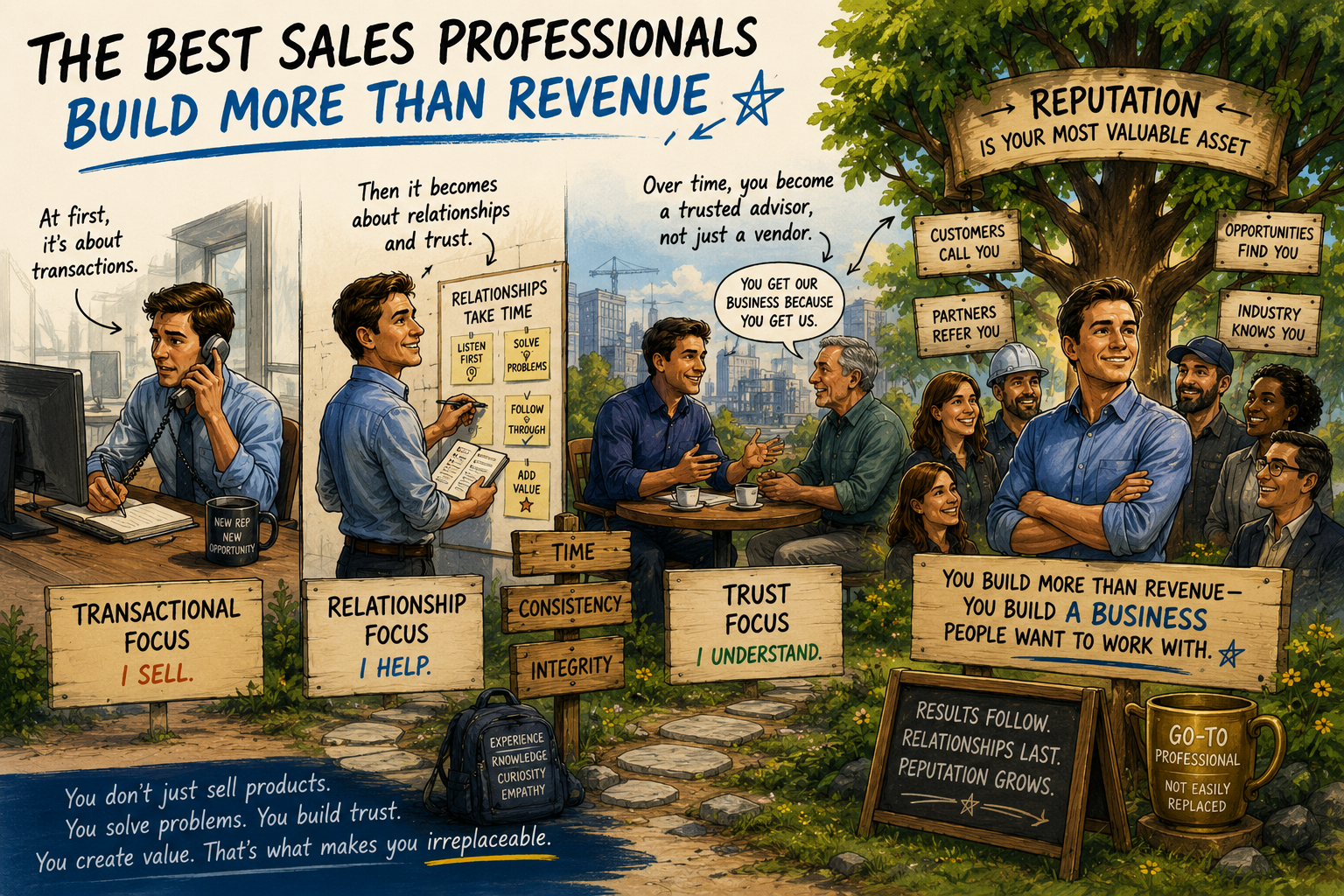
The most successful sales professionals eventually become known for far more than the products they sell. Over time, trust, expertise, relationships, and reputation often become their most valuable assets.
As salespeople gain experience, something interesting begins to happen. Their value starts becoming less dependent on the company they work for and more dependent on the relationships, expertise, and credibility they have built for themselves.
Early in a sales career, success often comes from learning products, understanding processes, following proven sales methodologies, and benefiting from the support structures provided by an employer. The company's brand opens doors, marketing generates awareness, and established systems provide a framework for success.
Over time, however, the strongest sales professionals begin developing assets that cannot easily be replicated. They build trust with customers. They develop deep industry knowledge. They gain a genuine understanding of how their market operates and become known by buyers, distributors, procurement teams, contractors, business owners, and other decision-makers within their industry.
As those relationships mature, something subtle but important starts to change. Customers no longer see them simply as a representative of a particular company. Instead, they become a trusted advisor, a source of expertise, and someone whose opinion carries weight. In many cases, buyers continue following their careers, seek their advice when evaluating new opportunities, and actively look to maintain relationships regardless of where they work.
That is why many experienced sales professionals eventually discover that customers are buying from them as much as they are buying from the company itself. While the product, service, and brand still matter, trust often becomes the deciding factor.
And once a salesperson begins to recognise the value of that trust, the way they think about their career can change dramatically. The question is no longer limited to what they can achieve within a single organisation. Instead, they begin to recognise that the relationships and credibility they have spent years building may have value far beyond any one employer.
This is often the moment when entrepreneurship starts to feel like a realistic possibility rather than a distant ambition.
How Do Sales Professionals Turn Relationships Into Commercial Assets?
Almost every successful salesperson has experienced this at some point in their career.
A customer changes companies but makes a point of staying in touch. A buyer asks where you've moved after leaving an employer because they would prefer to continue working with you. A former client reaches out years later looking for advice, recommendations, or introductions. A distributor opens a new door simply because they trust your judgement and believe you'll bring value to the relationship.
At first glance, these interactions may seem insignificant. In reality, they reveal something incredibly important. The relationship itself has value.
Not because it can be exploited or monetised directly, but because trust is one of the hardest things to build in business and one of the easiest things to lose. In many industries, meaningful relationships take years to develop. They are built through hundreds of conversations, successful projects, solved problems, honest advice, and consistent follow-through. Every positive interaction strengthens credibility, while every promise kept reinforces trust.
Over time, that trust begins to function as a form of commercial capital. Just as a business can invest in equipment, technology, or intellectual property, sales professionals gradually accumulate relationship capital through the connections and reputation they build within their market.
This is one of the reasons so many independent sales reps, sales agents, manufacturers' representatives, and 1099 sales professionals eventually choose independence. They begin to recognise that the relationships they have spent years developing may be among the most valuable assets they own.
Products evolve. Employers come and go. Markets shift and industries change. Yet the trust earned through years of helping customers solve problems often endures long after individual products, companies, and commercial trends have disappeared.
For entrepreneurial sales professionals, that realisation can be transformative. Once they recognise that the network they have built carries genuine value, they begin to see opportunities that extend far beyond the boundaries of a single employer.
When Do Salespeople Start Thinking Like Business Owners?
Many experienced sales professionals spend years perfectly happy working within traditional employment structures. They enjoy the products they represent, value the support their employer provides, and build successful careers without ever seriously considering self-employment.
Over time, however, their perspective often begins to change. As their confidence grows and their network expands, they start to recognise that much of the value they create is not solely tied to the company they work for. The relationships they have built, the industry knowledge they have accumulated, and the trust they have earned with customers are assets they have developed through years of personal effort and experience.
Instead of viewing themselves purely as employees responsible for achieving targets and generating revenue, they begin to see themselves as professionals with expertise, credibility, and commercial relationships that extend beyond a single organisation. They start recognising opportunities not just within the business they work for, but within the wider market they have spent years getting to know.
For many entrepreneurial sales professionals, this is the point where independence begins to feel achievable rather than aspirational. Not because they suddenly want to leave their job or abandon the company they work for, but because they start to understand the value of what they have already built.
Once that shift in thinking occurs, entrepreneurship no longer feels like a leap into the unknown. It starts to feel like a natural extension of the experience, relationships, and reputation they have spent years developing.
Why Do Experienced Sales Professionals Become Independent Reps?

For many sales professionals, independence is not something they actively pursue at the beginning of their careers. Most enter the profession looking for an opportunity to learn, develop their skills, earn a good living, and gain experience within an established company. For many sales professionals, the attraction is not simply higher earnings. It is the opportunity to move from building someone else's business to building their own.
For years, that structure often works extremely well. A good employer provides training, support, mentorship, products, marketing resources, and access to customers. It allows salespeople to focus on developing their craft while learning how their industry operates, how buying decisions are made, and what separates average performers from exceptional ones.
As experience accumulates, however, something begins to change.
Successful sales professionals gradually start building assets that extend far beyond their employer. Their network expands, their reputation strengthens, and the trust they have earned within their market continues to grow. Customers begin reaching out to them directly, industry contacts become long-term professional relationships, and opportunities start appearing because of the credibility they have built rather than simply because of the company name on their business card.
This is often the point where independence starts becoming attractive.
The question is no longer whether they can sell. Years of experience have already answered that. Instead, they begin asking themselves a different question: what could they build if they applied those same skills, relationships, and industry insights to something of their own?
For entrepreneurial sales professionals, that shift in thinking can be incredibly powerful. They begin to recognise that the relationships, expertise, and reputation they have spent years developing are not just helping them succeed within someone else's business. They may also provide the foundations for building one of their own.
In short, experienced sales professionals are often attracted to independence because it allows them to leverage the expertise, relationships, reputation, and industry knowledge they have accumulated throughout their careers to build a business of their own.
Do Independent Sales Reps Have More Control Over Their Income?
One of the strongest motivations behind independence is the desire for greater control over earning potential.
Within traditional employment, compensation is typically tied to a single company, a defined territory, and a commission structure that has been designed by someone else. While many sales professionals earn excellent incomes in these environments, there is often a limit to how much influence they have over the products they sell, the opportunities they pursue, and ultimately the revenue streams available to them.
Rather than relying on a single employer for their income, independent sales reps, manufacturers' representatives, and freelance sales agents have the ability to build multiple sources of revenue simultaneously. They can choose which companies they represent, which industries they focus on, and which opportunities align best with their experience, network, and long-term goals.
As a result, their earning potential becomes increasingly linked to the value they create within their market rather than the commercial strategy of a single organisation. The stronger their relationships become and the more opportunities they can generate, the greater their ability to influence their own financial outcomes.
For entrepreneurial sales professionals, that level of control can be incredibly appealing. Rather than building a career around a single company, they have the opportunity to build a business around the expertise, relationships, and reputation they have spent years developing.
How Do Independent Sales Reps Build Multiple Commission Streams?
Multiple commission streams occur when an independent sales professional generates income from several complementary products, services, or companies rather than relying on a single commission source.
Most successful business owners do not depend on a single customer. Likewise, many independent sales professionals eventually decide they do not want to depend on a single company.
One of the unique advantages of independent selling is the ability to represent multiple complementary products or services that solve different problems for the same customer base.
A manufacturers' representative might carry several non-competing product lines that all serve the same industry. A sales agent may introduce different solutions to the same buyers they already know and trust. An independent rep operating in a specialist market may discover that every conversation creates opportunities across multiple companies rather than just one.
Over time, this creates something powerful: diversification.
Instead of relying on a single commission source, successful reps often build portfolios of relationships, products, and recurring revenue streams that continue growing alongside one another.
For a deeper look at this model, see our guide on how independent sales reps turn one client into multiple commission streams.
How Do Independent Sales Reps Generate Residual Income?
Another reason many experienced sales professionals are drawn toward independence is the opportunity to build recurring income in the form of residual sales commissions.
Not all commission structures are equal. Some generate a one-time payment when a sale closes and then disappear forever. Others continue generating revenue for months or even years after the initial transaction has taken place. This is known as residual sales commission.
Software subscriptions, recurring service contracts, consumable products, maintenance agreements, and repeat-order businesses all create opportunities for ongoing commissions.
When combined with portfolio selling, recurring income can fundamentally change the economics of a sales career. Instead of beginning every month from zero, previous successes continue contributing to future earnings, creating a level of leverage that many traditional compensation plans struggle to match.
Can Commission-only Sales Reps Choose Which Companies They Represent?
Perhaps the most overlooked benefit of independence is choice.
Employees are generally assigned products, territories, compensation plans, management teams, and corporate strategies. Independent professionals operate differently. They have the ability to decide which companies they represent, which industries they focus on, and which opportunities deserve their attention.
Ironically, the more successful a sales professional becomes, the more selective they often become.
Experienced independent, commission-only sales reps understand that every company they represent becomes associated with their personal reputation. Every recommendation reflects on the trust they have spent years building. As a result, many carefully evaluate products, services, management teams, commission structures, and long-term market potential before agreeing to represent a business.
At that stage, they are no longer simply thinking like salespeople. They are thinking like business owners.
Can Independent Sales Reps Earn More Than Employees?
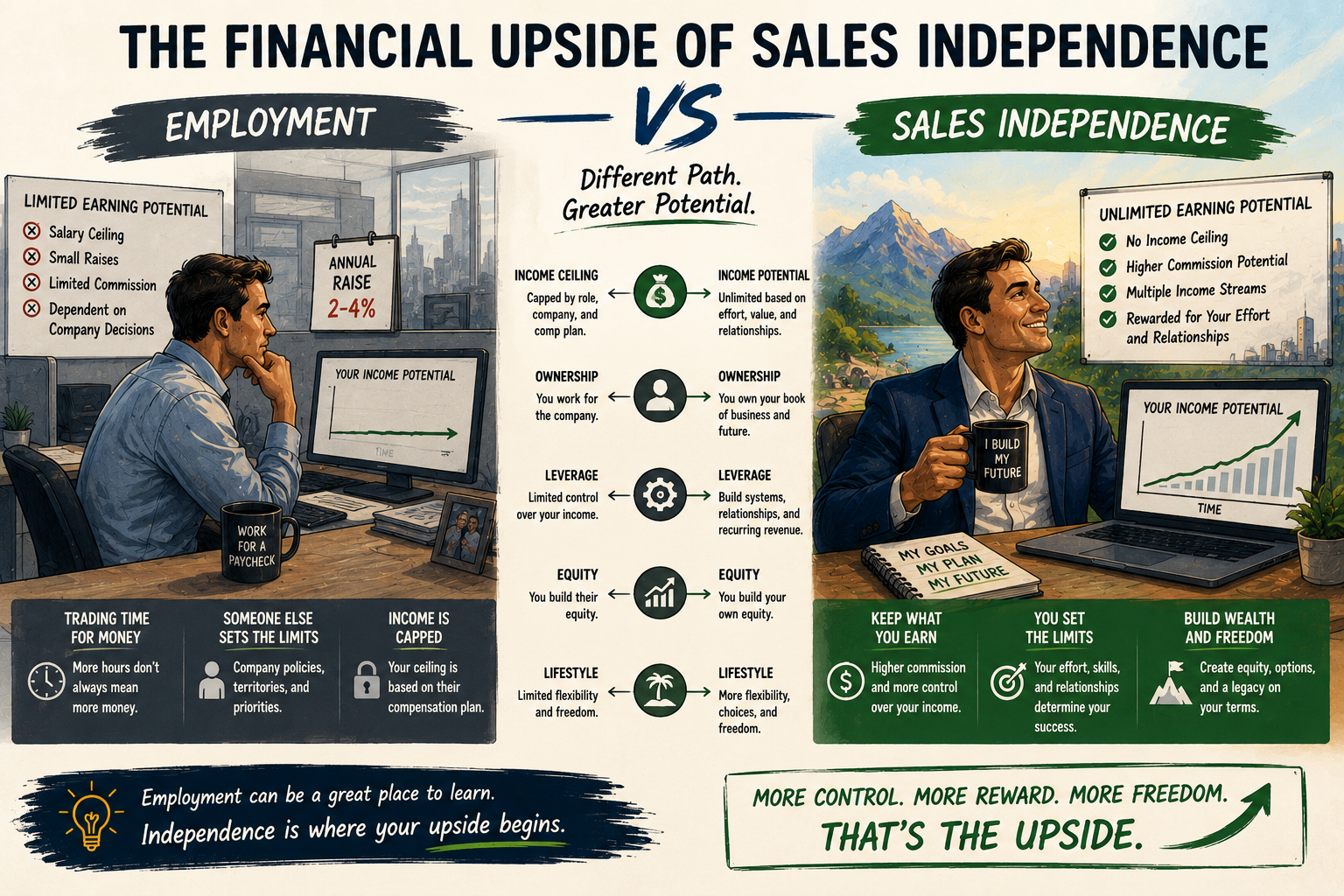
For many sales professionals, the decision to pursue independence is not solely about freedom, flexibility, or entrepreneurship. Financial considerations often play an important role as well.
Traditional employment provides stability and predictability. In exchange for a salary and benefits, a salesperson agrees to dedicate their time, expertise, relationships, and efforts to a single organisation. For many people, that arrangement works extremely well, particularly during the early stages of a career when experience, training, and mentorship are often more valuable than maximising earnings.
As careers progress, however, some professionals begin to view the equation differently.
A salary effectively places a ceiling on how many opportunities an individual can pursue. No matter how extensive their network becomes or how many relationships they develop within their industry, their efforts remain focused on helping a single company grow. The employer receives the benefit of that exclusivity, while the salesperson receives the security and predictability that employment provides.
Independent sales professionals make a different trade-off.
Rather than exchanging their expertise and relationships for a guaranteed income, they choose to build businesses around those assets. This allows them to leverage the same network across multiple complementary opportunities instead of a single employer. A manufacturers' representative may represent several non-competing product lines. A sales agent may introduce multiple solutions to the same customer base. An independent professional can often create value for several businesses through the same relationships they have spent years developing.
This fundamentally changes the economics of selling.
Instead of relying on a single commission plan or one source of income, successful independent sales professionals can build diversified revenue streams around the markets they know best. Every customer relationship becomes more valuable because it can potentially generate opportunities across multiple products, services, and companies rather than a single offering.
Of course, greater opportunity comes with greater responsibility. Independence removes the certainty of a salary and replaces it with the need to consistently create results. Not everyone finds that trade-off appealing, which is one of the reasons many talented salespeople remain happily employed throughout their careers.
For entrepreneurial sales professionals, however, the upside can be significant. They are no longer limited by the earning potential of a single company, territory, or compensation plan. Instead, they have the opportunity to build a business whose growth is directly linked to the value they create, the relationships they develop, and the opportunities they uncover within their market.
You may also find this article interesting: Why independent sales reps earn more than employees
Why Don't More Sales Professionals Become Independent?
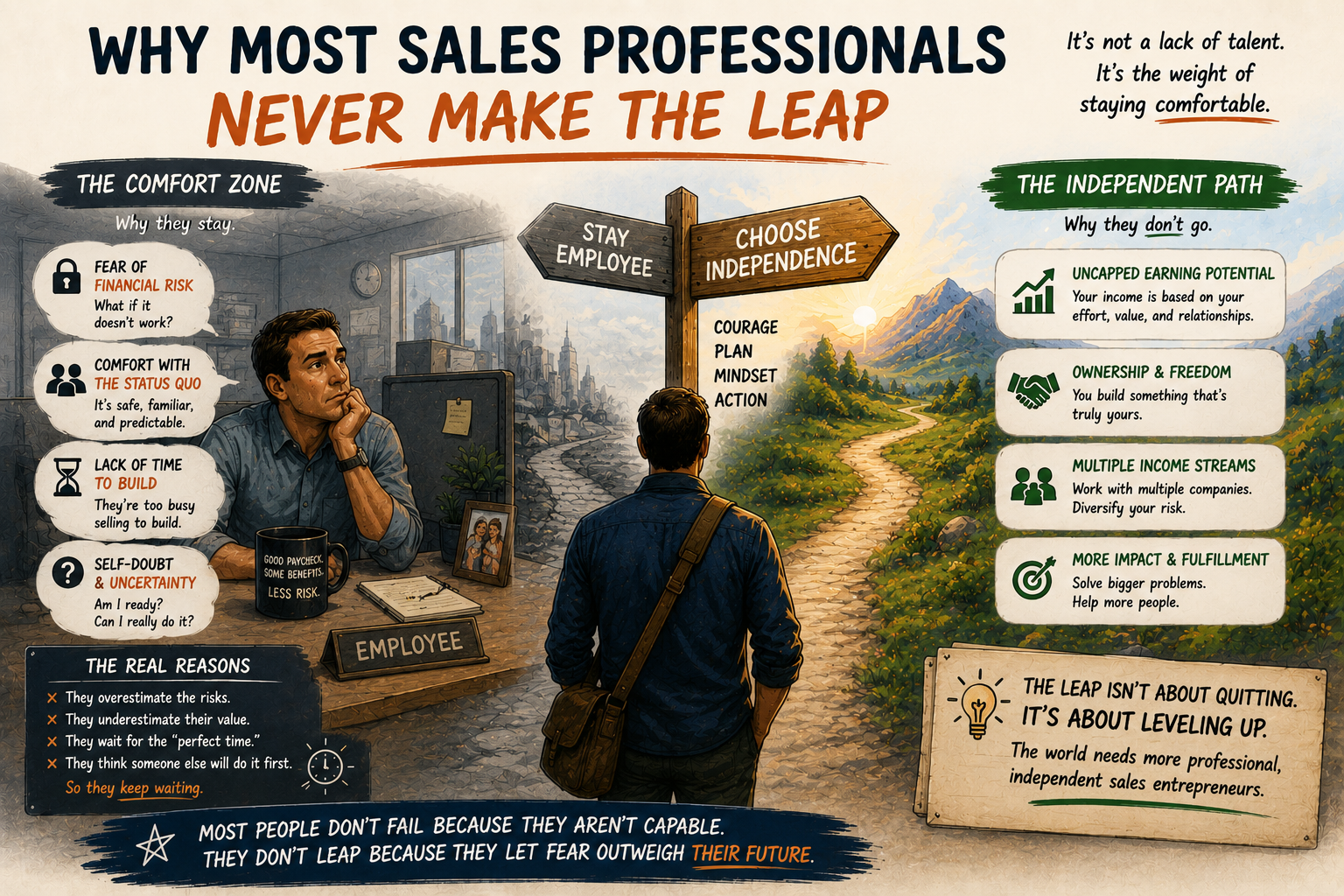
If independence offers greater earning potential, more flexibility, multiple revenue streams, and the opportunity to build a business of your own, it raises an obvious question: why doesn't everybody do it?
The answer is that independence is not for everyone. Independent sales professionals are entrepreneurs.
While many sales professionals are attracted to the idea of working for themselves at some point in their careers, far fewer are willing to embrace the uncertainty and responsibility that comes with it. The reality is that independence requires a very different mindset from employment, even when the day-to-day activities may appear similar on the surface.
When you're employed, much of the infrastructure already exists. The company provides the products, invests in marketing, develops systems and processes, and absorbs the operational costs required to keep the business running. Even in highly commission-driven environments, there is often a level of support and stability operating in the background that many people take for granted.
An independent sales professional is not just responsible for generating revenue. They are responsible for building and maintaining the entire business around that revenue. Every opportunity must be created, every relationship must be nurtured, and every commercial decision carries consequences. There is no management team to blame when results fall short, and there is no employer absorbing the financial risk during quieter periods.
For some people, that level of responsibility feels uncomfortable. They prefer the structure, predictability, and support that traditional employment provides, and there is absolutely nothing wrong with that.
For others, however, that responsibility is precisely what makes independence attractive. They enjoy the challenge of building something for themselves, making their own decisions, and taking ownership of both the rewards and the risks that come with entrepreneurship.
Ultimately, the question is not whether one path is better than the other. The question is whether the independence, responsibility, and opportunity associated with running your own business align with the kind of career you want to build.
Why Do Many Salespeople Prefer Employment Over Independence?
One of the biggest reasons many sales professionals remain employees throughout their careers is predictability.
Even in commission-heavy sales roles, there is often a degree of stability that comes from being part of an established organisation. A recognised brand helps open doors, marketing activities generate awareness, and support teams handle many of the operational responsibilities that sit behind the sales process. Most importantly, there is usually a clear framework for success, allowing salespeople to focus primarily on what they do best: selling.
Independence removes many of those safety nets.
Income can fluctuate from month to month, particularly during the early stages of building an independent business. New partnerships take time to establish, trust must be earned, and opportunities that appear promising today may not generate results for months. Unlike employment, where the infrastructure already exists, independent professionals are often building both the business and the revenue stream at the same time.
That level of uncertainty can be difficult to embrace, even for highly capable salespeople. While some are energised by the challenge and freedom that come with entrepreneurship, others understandably prefer the predictability and structure that traditional employment provides.
Neither approach is inherently better than the other. It simply comes down to whether an individual values certainty more than autonomy, or whether they are willing to accept short-term uncertainty in exchange for the possibility of building something they own themselves.
Do Independent Sales Reps Need an Entrepreneurial Mindset?
One of the biggest misconceptions surrounding independent sales reps and sales agents is that they are simply salespeople working without a salary. Independent sales professionals are entrepreneurs.
In reality, the most successful independent professionals tend to think like entrepreneurs first and salespeople second. While selling remains a core part of what they do, they are also responsible for making the same kinds of decisions that every business owner faces.
They constantly evaluate markets, assess opportunities, weigh risk against reward, and decide where their time and resources will generate the greatest return. They think carefully about the companies they represent, the industries they serve, and how each partnership contributes to the long-term growth of their business.
At the same time, they are often focused on building assets that extend beyond the next sale. They consider recurring revenue opportunities, look for ways to diversify their income streams, and pay close attention to how individual decisions might strengthen or weaken the reputation and relationships they have spent years developing.
In many respects, the mindset is no different from that of any other entrepreneur. Whether someone owns a software company, a consultancy, a marketing agency, or an independent sales business, the underlying principles remain remarkably similar. Success depends on making good decisions, creating value for customers, managing risk effectively, and building something capable of generating sustainable growth over the long term.
That is why independence appeals so strongly to entrepreneurial sales professionals. They are not simply looking for a different compensation structure. They are looking for the opportunity to build a business around the skills, relationships, and expertise they have spent years developing.
The skills required to become a successful independent sales professional are remarkably similar to those required to build any successful business. Opportunity identification, relationship building, trust creation, customer acquisition, negotiation, and long-term thinking sit at the heart of both entrepreneurship and independent selling.
How Do Independent Sales Reps Choose Which Companies to Represent?
Another lesson experienced independent sales professionals learn quickly is that not every opportunity deserves their attention.
When working as an employee, there is often little choice about which products or services are sold. The company decides. The salesperson executes.
Independent reps operate differently.
Because their reputation is one of their most valuable assets, they must think carefully about the businesses they choose to represent. A poor product, weak leadership team, unrealistic commission structure, or lack of market demand can waste months of effort and damage relationships that may have taken years to build.
This is one reason experienced manufacturers' reps, sales agents, and commission-only sales agents can appear highly selective when evaluating new opportunities.
They are not simply choosing a product. They are choosing a business partner.
The Rewards Tend to Favour Long-Term Thinkers
Perhaps the biggest challenge with independence is that many of the rewards take time to materialise.
Traditional employment often provides immediate structure, established systems, and a relatively predictable path to earning an income. Entrepreneurship, by contrast, tends to reward patience. The relationships, reputation, industry credibility, and commercial network that underpin a successful independent sales business are rarely built overnight. They develop gradually through consistent effort, successful outcomes, and years of creating value for customers and business partners.
This is one of the reasons independence tends to appeal to long-term thinkers. The most successful independent sales professionals understand that every relationship they build, every customer they help, and every opportunity they create has the potential to generate value far into the future. Over time, those relationships deepen, reputations strengthen, and recurring commission streams can begin to accumulate, creating opportunities that simply didn't exist earlier in their careers.
Of course, not everyone is comfortable waiting for those rewards to compound. Many talented sales professionals prefer the predictability, support, and structure that traditional employment provides, and there is nothing wrong with that. For others, however, the idea of investing in something they own and watching it grow over time is precisely what makes independence so appealing.
Neither path is inherently better than the other. The key is understanding which one aligns most closely with your goals, personality, appetite for risk, and long-term ambitions. For those with an entrepreneurial mindset, the prospect of building an asset that becomes more valuable year after year can be difficult to ignore.
What Is the Difference Between Independent Sales Reps, Sales Agents, 1099 Reps, and Manufacturers' Representatives?
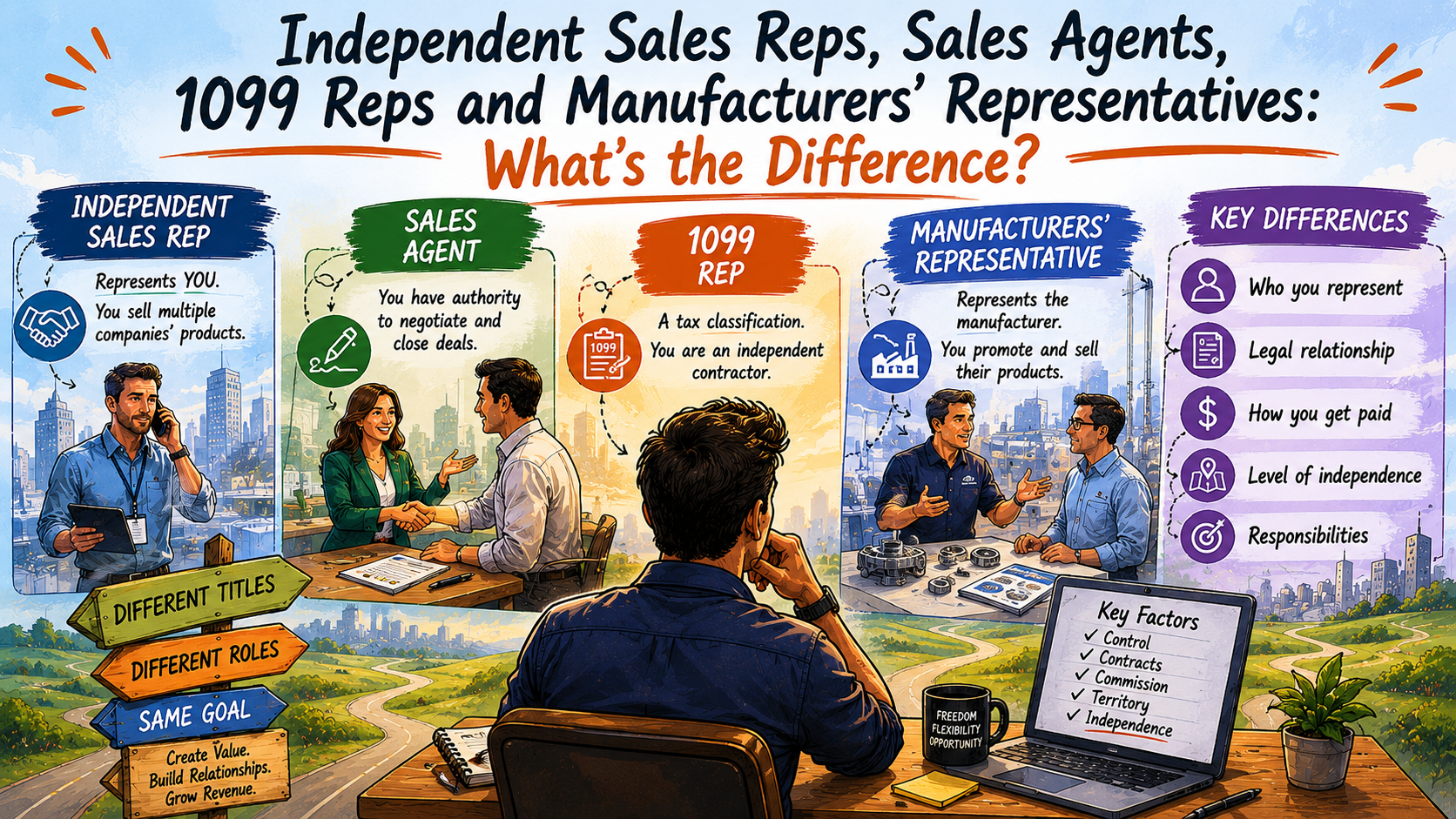
One reason the independent sales industry can feel confusing to newcomers is that there are so many different terms used to describe what are often very similar commercial models.
Depending on the country, industry, and specific arrangement, you may hear people describe themselves as independent sales reps, sales agents, commission-only sales agents, 1099 sales reps, freelance sales agents, territory representatives, manufacturers' representatives, or even business development partners.
To someone unfamiliar with the industry, these titles can sound completely different. In reality, they often share far more similarities than differences.
At their core, all of these professionals operate around the same fundamental principle: they generate revenue for companies in exchange for commission rather than a traditional salary.
The specific structure may vary, but the underlying commercial relationship remains remarkably consistent.
Independent Sales Reps
Independent sales reps are self-employed sales professionals who represent one or more companies on a commission basis. Rather than being employed by a single organization, they operate their own businesses and choose which products, services, or brands they wish to represent.
Many independent reps focus on particular industries where they have already developed expertise and strong commercial relationships. Over time, they often build portfolios of complementary products that allow them to maximize opportunities within their existing network.
For many experienced sales professionals, becoming an independent sales rep represents one of the most natural paths into entrepreneurship because it allows them to leverage the relationships and industry knowledge they have spent years developing.
If you're new to the concept, you may find our guide on what an independent sales rep is helpful.
Sales Agents
Sales agents operate in a very similar way to independent sales reps, although the terminology is often more common in certain industries and regions.
A sales agent typically acts as an independent intermediary between buyers and sellers, helping companies generate new business within specific territories, industries, or customer segments.
In practice, the distinction between a sales rep and a sales agent is often minimal. Many professionals use the terms interchangeably depending on their market, customer base, or personal preference.
What matters far more than the title itself is the fact that these professionals are usually self-employed and compensated based on the business they generate.
1099 Sales Reps
In the United States, the term "1099 sales rep" refers primarily to tax classification rather than job function.
A 1099 sales rep is an independent contractor rather than a W-2 employee. They are responsible for managing their own taxes, expenses, insurance, and business operations.
From a practical perspective, many 1099 reps operate almost identically to independent sales reps or sales agents. The term simply reflects the legal and tax framework under which they conduct business.
As a result, many conversations about independent sales careers in the United States naturally include references to 1099 sales opportunities, 1099 commission-only roles, and independent contractor arrangements.
Manufacturers' Representatives
Manufacturers' representatives occupy one of the oldest and most established segments of the independent sales industry.
Rather than representing a single manufacturer, these professionals often represent several complementary product lines that serve the same customer base. A manufacturer's rep selling industrial equipment, for example, may carry multiple non-competing product lines that all solve related problems for the same buyers.
This model creates efficiency for both the rep and the manufacturer. The rep can maximize the value of each customer interaction, while manufacturers gain access to established industry relationships without having to build large direct sales teams.
Manufacturers' representatives have played a vital role in industries such as industrial equipment, construction products, engineering solutions, electrical products, healthcare, and manufacturing for decades.
The Similarities Matter More Than the Differences
While the terminology may vary, the underlying principles remain remarkably similar.
Whether someone describes themselves as an independent sales rep, sales agent, 1099 contractor, freelance sales professional, or manufacturers' representative, they are ultimately building a business around their ability to create commercial opportunities. The specific industries, products, territories, and compensation structures may differ, but the entrepreneurial foundation remains largely the same.
What these professionals are really leveraging is not simply their ability to sell. They are drawing on years of accumulated expertise, industry knowledge, professional relationships, market access, and trust to create value for both themselves and the companies they represent. In many cases, those assets become far more important than the individual products or services they happen to be selling at any given moment.
This is why the different titles can sometimes be misleading. To an outsider, they may appear to describe completely different career paths. In reality, they are often variations of the same idea: experienced professionals using the relationships, credibility, and commercial knowledge they have developed throughout their careers to build independent businesses of their own.
Once you understand that, the distinctions between the various titles become far less important. What matters is recognising that each of these paths offers an opportunity to transform years of experience and hard-earned expertise into something that can continue creating value long into the future.
For many entrepreneurial sales professionals, that possibility is what makes independence so compelling. They are no longer simply generating revenue on behalf of someone else's business. They are building one of their own.
How Do Independent Sales Reps Build Successful Businesses?
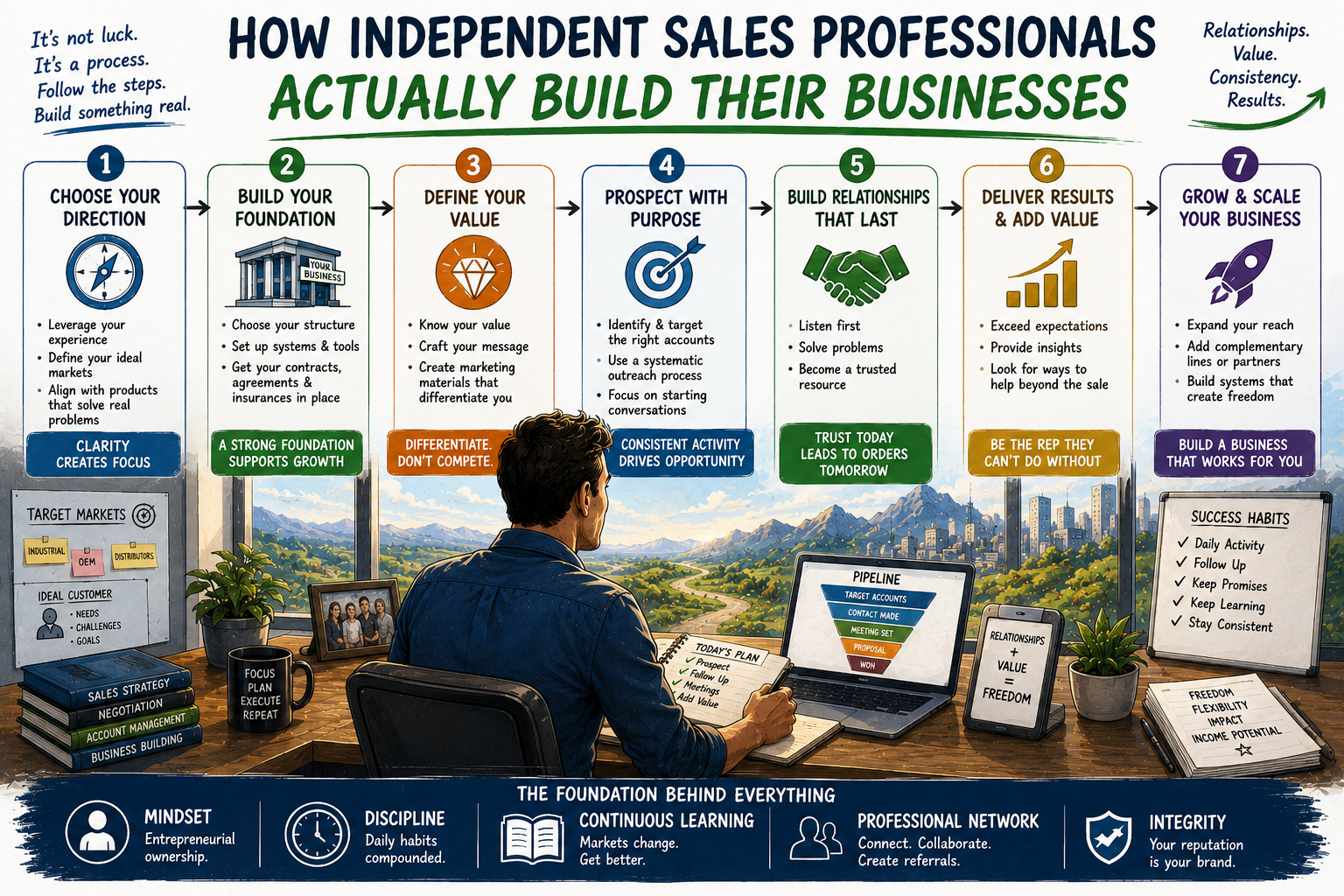
One of the biggest misconceptions about independent sales reps and sales agents is that they simply perform the same role as an employee, only without a salary.
In reality, the most successful independent professionals often approach their work from a completely different perspective. While selling remains a core part of what they do, their focus extends far beyond individual transactions or monthly sales targets. They are constantly thinking about relationships, market positioning, industry trends, commercial partnerships, and how today's activities might create opportunities months or even years into the future.
As their businesses mature, many begin to realise that their most valuable asset is not a particular product or service, but the network they have built around themselves. The trust they have earned, the relationships they have developed, and the reputation they have established within their industry often become the foundation upon which future opportunities are created.
This naturally changes the way opportunities are evaluated and pursued.
Rather than asking whether a particular product is likely to generate a commission next month, experienced independent professionals are often considering broader questions. Does this opportunity strengthen their reputation? Will it create long-term value for their customers? Does it complement the other products, services, or companies they already represent? And most importantly, does it help them build a stronger business over the long term?
That shift in thinking may appear subtle from the outside, but it fundamentally changes how independent sales professionals operate. Over time, they stop focusing solely on selling products and start focusing on building an ecosystem of relationships, opportunities, and partnerships that becomes increasingly valuable as their network continues to grow.
How Important Are Relationships to Independent Sales Success?
Most independent sales businesses begin with a network.
That network may consist of buyers, distributors, contractors, procurement managers, business owners, engineers, consultants, retailers, healthcare professionals, or any other group of decision-makers within a particular market. While the people within the network may vary from one industry to another, the underlying principle remains the same: relationships create access, and trust creates opportunity.
This is one of the reasons experienced sales professionals often have an advantage when transitioning into independence. The trust and credibility developed through years of serving customers can be difficult for competitors to replicate, regardless of the products they sell or the marketing resources available to them.
Importantly, successful independent sales professionals do not view relationships as shortcuts to sales. The strongest networks are rarely built through aggressive prospecting or transactional interactions. Instead, they develop gradually through years of conversations, successful projects, recommendations, introductions, and positive customer experiences.
As those relationships deepen, they often begin creating opportunities that would be difficult to access through traditional sales approaches alone. A customer introduces a new prospect. A distributor recommends a product line. An industry contact shares information about an opportunity before it reaches the wider market. Individually, these moments may seem insignificant. Collectively, they form the foundation upon which many successful independent sales businesses are built.
This is why relationship capital plays such an important role in independent selling. The network itself becomes an asset, creating opportunities that continue generating value long after the original relationship was established.
Should Independent Sales Reps Specialise in One Industry?
Another common characteristic of successful independent sales professionals is specialisation. While some operate across multiple industries, many focus on markets they know exceptionally well and have often spent years working within. They understand the buyers, the terminology, the procurement processes, the competitive landscape, and the day-to-day challenges their customers face.
That depth of knowledge allows them to become far more than a salesperson.
Over time, they develop a level of expertise that customers come to rely on. Buyers seek their advice because they understand the market. Manufacturers value their insights because they have direct visibility into customer needs and industry trends. Industry contacts introduce them to new opportunities because they trust both their judgement and their reputation.
As a result, their value becomes increasingly tied to what they know rather than simply what they sell. The more specialised they become, the harder it is for competitors to replicate the relationships, market knowledge, and credibility they have spent years developing. Over time, that expertise creates leverage that extends far beyond any individual product or company they happen to represent.
What Is Portfolio Selling and Why Does It Work?
Portfolio selling is the practice of representing multiple complementary products or services that serve the same customer base (network).
Perhaps the most powerful aspect of many independent sales businesses is the ability to leverage existing relationships across multiple opportunities.
Rather than representing a single company, experienced independent reps often build carefully selected portfolios of complementary products and services that serve the same customer base. This allows them to create more value for their customers while simultaneously increasing the commercial potential of every relationship they have worked hard to establish.
Consider an independent rep who regularly sells into manufacturing facilities. Those customers may require industrial equipment, safety products, maintenance services, software systems, engineering solutions, and specialist consumables. Instead of approaching the customer with a single offering, the rep can potentially help solve multiple problems across different areas of the business.
This creates advantages for everyone involved. Customers gain access to trusted solutions through someone they already know and respect. Companies gain access to established industry relationships that would otherwise take years to develop. Meanwhile, the independent rep is able to maximise the value of every customer interaction without necessarily increasing the number of sales calls, meetings, or relationships they need to maintain.
It is one of the reasons portfolio selling has remained such a powerful model for independent sales reps and manufacturers' representatives for decades. Rather than constantly starting from scratch, successful professionals learn how to build additional opportunities around the networks they have already created.
This is one of the clearest examples of entrepreneurial thinking within independent sales. Rather than viewing themselves as representatives of a single company, successful professionals look for ways to create additional value within networks they have already spent years building.
This approach is one of the reasons many independent reps are able to build multiple commission streams from the same customer relationships over time.
Why Is Reputation So Important for Independent Sales Reps?
As independent sales professionals gain experience, many eventually reach a point where their reputation becomes their most valuable asset.
Products evolve, companies change direction, and markets continually shift in response to new technologies and customer demands. A strong reputation, however, has the ability to create opportunities long after individual products, employers, or commercial trends have come and gone.
This is why experienced independent reps are often highly selective about the companies they choose to represent. Every recommendation they make reflects on the trust they have spent years building. Every partnership has the potential to strengthen or weaken the credibility they have earned within their market. Protecting that reputation becomes just as important as generating revenue.
From the outside, it can sometimes appear as though successful independent sales professionals are simply selling products. In reality, most are doing something far more significant. They are building businesses around trust, expertise, and relationships that become increasingly valuable over time. The stronger their reputation becomes, the more opportunities naturally flow toward them, creating a powerful competitive advantage that is difficult for others to replicate.
How Do You Transition From Employee to Independent Sales Rep?
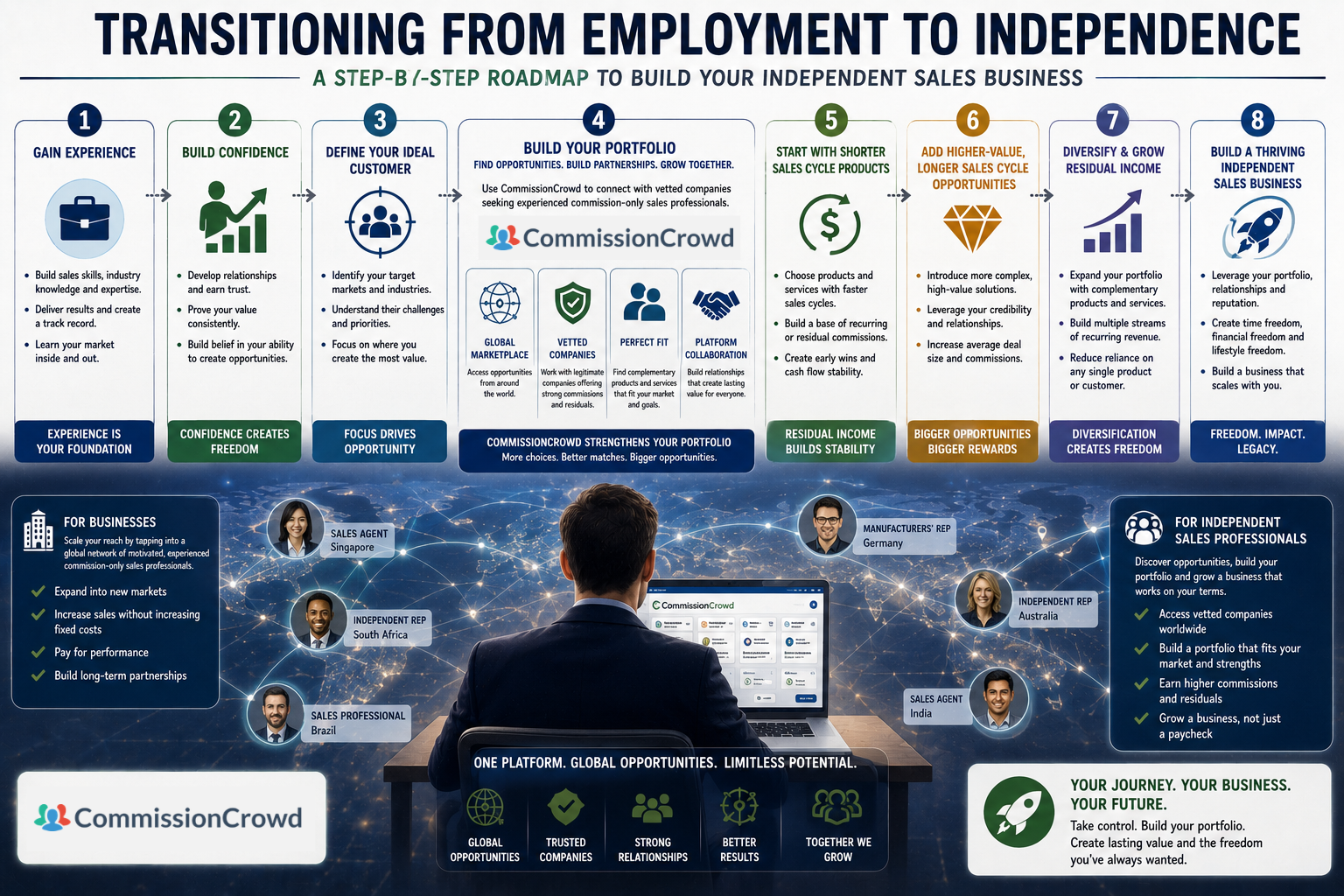
One of the biggest misconceptions surrounding independent sales careers is that people simply wake up one morning, resign from their jobs, and immediately begin operating successful businesses of their own.
In reality, the transition is usually far more gradual.
Most successful independent sales reps, sales agents, manufacturers' representatives, and commission-only professionals spend years building the foundations that eventually make independence possible. Long before they become self-employed, they are developing industry expertise, learning how markets operate, understanding customer needs, building professional relationships, and gaining the confidence that comes from consistently creating results.
During this period, they are doing far more than learning how to sell. They are developing commercial instincts, building credibility within their industry, and gradually accumulating the knowledge and relationships that will later become valuable business assets. In many cases, they do not even realise they are preparing for independence at the time.
That is why the foundations of an independent sales business are often built years before the individual ever leaves employment. By the time independence becomes a serious consideration, much of the groundwork has already been completed through years of experience, relationship building, and professional development. What may appear from the outside to be a sudden career change is often the culmination of a much longer journey.
Independence Is Usually the Result of Accumulated Experience
The transition to independence rarely happens because someone suddenly decides they dislike working for an employer. More often, it is the natural outcome of years spent building expertise, developing industry knowledge, earning trust, and creating professional relationships.
By that stage of their career, many sales professionals have reached a point where they understand their market deeply and feel confident in their ability to create opportunities without relying entirely on an employer's infrastructure. What once seemed risky or uncertain begins to feel achievable because the foundations have already been built.
For entrepreneurial sales professionals, this can be a powerful shift in perspective. Independence no longer feels like a leap into the unknown. Instead, it starts to feel like a logical extension of everything they have spent years creating.
The question gradually changes from "Could I ever work for myself?" to "What could I build if I did?"
When Should You Become an Independent Sales Rep?
One reason some salespeople successfully transition into independence while others never do is confidence. Not confidence in their ability to talk to customers or close deals—most experienced sales professionals already possess those skills. The confidence that matters is the belief that they can create opportunities without relying entirely on an employer's infrastructure.
For many people, that confidence develops gradually rather than arriving all at once. It is built through years of experience, successful customer relationships, and repeated evidence that their value extends beyond the products they sell or the company they happen to work for at the time.
As their careers progress, many sales professionals begin asking themselves different questions. Can they identify attractive opportunities within a market they know well? Can they build enough trust with companies to become a genuine extension of their commercial team? Do they have the industry knowledge, relationships, and credibility required to create value independently? And perhaps most importantly, do they actually want the responsibilities that come with business ownership, where success depends on far more than simply achieving a sales target each month?
Those questions become easier to answer as experience accumulates. The longer someone spends building relationships, understanding their market, and consistently generating results, the clearer it becomes whether independence is a realistic next step or simply an attractive idea.
This is often why independence appeals most strongly to experienced professionals rather than newcomers. They have already spent years testing their abilities in real-world commercial environments. They know what they are good at, understand where they create value, and have a far more realistic view of both the opportunities and challenges that lie ahead.
Eventually, many reach a point where the idea of working independently no longer feels like a leap of faith. Instead, it begins to feel like a logical extension of everything they have spent years building.
The question is not simply whether they can sell. Most experienced sales professionals already know the answer to that. The deeper question is whether they are willing to think and act like business owners, taking responsibility for both the opportunities and challenges that come with building something of their own.
Should Independent Sales Reps Build a Sales Portfolio Instead of Looking for a Job?

One of the biggest mindset shifts new independent sales professionals must make is understanding that they are no longer looking for a job. They are building a portfolio.
Many employees spend their careers representing a single company and a single product line. Independent sales professionals often take a different approach. Rather than relying on one source of income, they gradually build portfolios of complementary products and services that serve the same customer base.
This allows them to create more value for customers while also creating multiple commission streams for themselves. A rep already selling into manufacturing facilities, for example, may represent industrial equipment, maintenance services, safety products, software platforms, engineering services, or specialist consumables. Each solution addresses a different problem, but all serve the same market.
The most successful independent reps rarely choose opportunities based solely on commission percentages. Instead, they evaluate how well a product fits their existing relationships, industry expertise, and long-term business strategy.
Many experienced independent reps deliberately start with products and services that offer shorter sales cycles and recurring commissions. Building a base of residual income can provide stability while their network, reputation, and portfolio continue to grow. Once that foundation is established, they often add higher-value opportunities with longer sales cycles and larger commission payouts, creating a balance between predictable recurring income and significant long-term earning potential.
As their business matures, they often add higher-value opportunities with longer sales cycles and larger commission payouts. Over time, this creates a balanced portfolio that combines immediate income opportunities with significant long-term earning potential.
In many ways, successful independent sales professionals think less like salespeople and more like investors. Rather than building a career around a single employer, they build a carefully selected portfolio of opportunities that can grow in value over time.
What Should New Independent Sales Reps Sell First?
Many new independent sales professionals assume they should pursue the highest commission opportunities available. In reality, experienced reps often take a more strategic approach.
Shorter sales-cycle products and services that generate recurring commissions can help create predictable income while a new independent business is still growing. Software subscriptions, recurring services, maintenance contracts, consumables, and repeat-order products are common examples.
Once a stable foundation of recurring income has been established, many reps begin adding higher-value opportunities with longer sales cycles and larger commission payouts.
In short, many successful independent commission-based sales professionals build residual income first and then layer larger opportunities on top over time.
Use CommissionCrowd To Find the Right Companies to Represent
One of the biggest challenges facing new independent sales reps is identifying companies that offer strong commission structures, realistic earning potential, residual income opportunities, and products that fit their existing network.
Building a strong independent sales portfolio requires access to the right commission-only sales opportunities.
This is one of the reasons many independent sales reps, sales agents, and manufacturers' representatives use CommissionCrowd. Rather than relying solely on personal contacts or chance introductions, they can discover vetted companies actively looking for experienced commission-only sales professionals.
This allows reps to compare opportunities based on factors such as commission structures, residual income potential, product fit, target markets, territory requirements, and long-term earning potential.
Just as importantly, it allows independent professionals to identify complementary products and services that can be added to an existing portfolio without creating conflicts of interest. Over time, this strategic approach often results in stronger customer relationships, more diversified income streams, and a more resilient business.
How Many Companies Should An Independent Sales Rep Represent?
There is no universal answer.
Some independent sales professionals build highly successful businesses around a couple of product or service lines. Others represent several complementary businesses that serve the same customer base.
The key is not the number of companies represented but the strategic fit between the products, services, and relationships involved.
Most experienced reps avoid competing product lines and instead focus on complementary solutions that allow them to create more value for existing customers while building multiple commission streams.
There Is No Single Path to Independence
One of the most fascinating aspects of the independent sales industry is that no two careers look exactly alike. While people often talk about independent sales reps, sales agents, manufacturers' representatives, and commission-only professionals as though they follow a common blueprint, the reality is far more diverse.
Some professionals build successful businesses representing multiple manufacturers within a particular industry. Others focus on a handful of complementary products and services that solve different problems for the same customer base. Many choose to specialise within a specific territory or market niche, while others gradually develop broader networks that span multiple industries and sectors.
The path itself can vary just as much. Some independent sales professionals begin by representing a single company before carefully expanding the number of businesses they work with over time. Others identify an opportunity within a market they know well and build an entire business around that expertise from the outset.
What unites these professionals is not the structure of their business or the products they choose to represent. It is the way they think.
At some point, they stop viewing themselves solely as employees responsible for generating sales on behalf of somebody else's organisation. Instead, they begin thinking like business owners, evaluating opportunities through the lens of long-term growth, reputation, relationships, and value creation.
That mindset shift often matters far more than the specific path they ultimately choose to follow.
Independence Is Not the End Goal
Ironically, the most successful independent sales professionals rarely pursue independence for its own sake.
Very few people spend years building a sales career simply because they dream of becoming self-employed one day. More often, independence becomes attractive because of what it makes possible. It provides greater control over future opportunities, allows professionals to leverage the relationships and expertise they have spent years developing, and creates the freedom to build something that belongs to them rather than contributing solely to someone else's business.
As sales professionals gain experience, many begin to realise that the most valuable assets they have accumulated are not products, territories, or commission plans. They are the relationships they have built, the trust they have earned, and the reputation they have established within their industry. Independence creates an opportunity to build a business around those assets and benefit directly from the value they create.
For some, that means representing multiple complementary companies. For others, it means developing recurring commission streams, expanding into new markets, or creating a business that reflects their own goals and priorities. The specific path may vary, but the underlying motivation is often the same: the desire to have greater influence over the direction of their career and the value they create.
In that sense, independence is rarely the final destination. It is simply the vehicle that allows entrepreneurial sales professionals to build the business, lifestyle, and future they want for themselves.
Most entrepreneurs do not start businesses because they are obsessed with being self-employed. They start businesses because they want the freedom to build something of their own. Independent sales professionals are often motivated by exactly the same desire.
If you're considering that path yourself, our guide on transitioning to commission-only sales explores the process in much greater detail. You may also find our complete guide to becoming a successful independent sales rep or manufacturers' rep useful as you evaluate whether independence is the right fit for you.
Why Are Relationships Becoming More Valuable in Sales?

If there is one theme that runs through every successful independent sales career, it is this: the value of relationships tends to increase over time.
Most sales professionals begin their careers focused on products, targets, territories, and commission plans. As experience accumulates, however, many come to realise that some of the most valuable things they are building cannot be found on a sales report. Trust, credibility, industry knowledge, and professional relationships often become far more durable assets than any individual product, employer, or compensation structure.
This is one of the reasons independence becomes so attractive to entrepreneurial sales professionals. The longer they spend in an industry, the more they begin to recognise that the value they create extends far beyond the transactions they facilitate. Much of that value comes from the reputation they have earned and the network they have spent years developing.
Unlike products, relationships do not become obsolete every few years. Markets evolve, companies change direction, and technologies continue to reshape entire industries. Yet the ability to call someone who knows you, trusts you, and values your expertise remains remarkably powerful.
That has always been true in business. If anything, it may become even more important in the years ahead.
Why Trust Is Becoming More Valuable, Not Less
Every generation experiences technological change that reshapes the way business operates. Today, artificial intelligence is transforming everything from prospecting and customer research to marketing, communication, and sales administration. Tasks that once consumed hours of a salesperson's time can now be completed in minutes, allowing professionals and businesses to operate more efficiently than ever before.
These developments are creating enormous opportunities. The most effective sales professionals are already embracing technology to become more productive, better informed, and more responsive to customer needs. In many respects, AI is making it easier than ever to access information, identify prospects, and communicate at scale.
At the same time, however, this abundance of technology is creating a new challenge.
Buyers are becoming overwhelmed by the sheer volume of information competing for their attention. Decision-makers are bombarded with emails, LinkedIn messages, automated outreach campaigns, AI-generated content, and marketing communications every day. As technology makes it easier to create and distribute information, information itself becomes less valuable. What becomes increasingly scarce is attention.
This is where trust in sales starts to matter even more
In a world where almost anyone can access the same tools, automate the same processes, and generate similar content, trust becomes one of the few meaningful differentiators left. Buyers may have more information than ever before, but when it comes to making important commercial decisions, they still want confidence that they are making the right choice.
That is why relationships continue to play such a critical role in business. People seek recommendations from individuals they respect. They value expertise from people who understand their industry. They place greater weight on advice from someone who has consistently delivered value over time than they do on information generated by an algorithm.
Technology can accelerate awareness, streamline communication, and improve efficiency, but it cannot instantly create credibility. Trust is earned through experience, consistency, and human interaction. It develops gradually through promises kept, problems solved, and relationships nurtured over time.
Ironically, as technology becomes more powerful, the human qualities that underpin trust may become even more valuable. The ability to build genuine relationships, understand customer needs, and earn long-term credibility is becoming increasingly difficult to replicate, which is precisely why it remains such a powerful asset for independent sales professionals and entrepreneurs alike.
Building a Career Around Assets You Own
This is often the point where experienced sales professionals begin thinking differently about their future.
After years spent building a career, many come to realise that the most valuable thing they have created is not a sales pipeline, a territory, or even a particularly attractive commission structure. Those things can change surprisingly quickly. Companies merge, markets evolve, products are discontinued, and compensation plans are regularly revised.
What tends to endure is their reputation.
A strong reputation opens doors that would otherwise remain closed. It creates opportunities, generates referrals, attracts introductions, and builds a level of trust that cannot be replicated by marketing campaigns or sales scripts alone. In many cases, the opportunities that come to experienced professionals are not the result of prospecting at all, but the result of relationships and credibility accumulated over many years.
For employees, those assets often continue creating value within the organisation they work for. For independent sales reps, sales agents, manufacturers' representatives, and other self-employed sales professionals, they can become the foundation of an entire business.
That distinction matters because reputation tends to appreciate over time. Every successful project strengthens credibility, every satisfied customer increases the likelihood of future opportunities, and every relationship built has the potential to create additional value. Unlike products, territories, or commission plans, trust can continue generating opportunities long after the original interaction has ended.
Over time, many independent professionals discover that they are no longer simply building a customer base. They are building a business around the reputation, expertise, and trust they have spent a career creating.
Independence Is Ultimately About Ownership
When people hear the term independent sales rep, they often focus on the word sales. In reality, the word that matters most is independent.
Not because independence guarantees success, and certainly not because employment is somehow inferior. Many sales professionals build exceptional careers working within established organisations and never feel the need to pursue self-employment. The distinction lies elsewhere.
Independence gives professionals the opportunity to build something they genuinely own.
Over the course of a successful sales career, people accumulate far more than product knowledge and selling experience. They build relationships, earn trust, develop expertise, establish a reputation, and create a network of contacts that can take years or even decades to develop. For employees, those assets often create value primarily within the organisation they work for. For independent professionals, they can become the foundation of a business.
That difference is often what attracts entrepreneurial salespeople towards independence.
Rather than tying their future to a single employer, they gain the ability to build around the assets they have personally spent years creating. The relationships belong to them. The expertise belongs to them. The reputation they have earned belongs to them. As those assets continue to grow, so does the value of the business they are building around them.
This is why so many experienced sales professionals eventually choose independence. They are not necessarily running away from employment or searching for a completely different career. More often, they are moving towards ownership and the opportunity to have greater control over the future they are creating.
For those who have spent years building trust within their industry, that can be an incredibly compelling proposition. The ability to turn a lifetime of relationships, knowledge, and credibility into a business of their own is one of the most rewarding opportunities a career in sales can offer.
Are Independent Sales Reps Entrepreneurs?
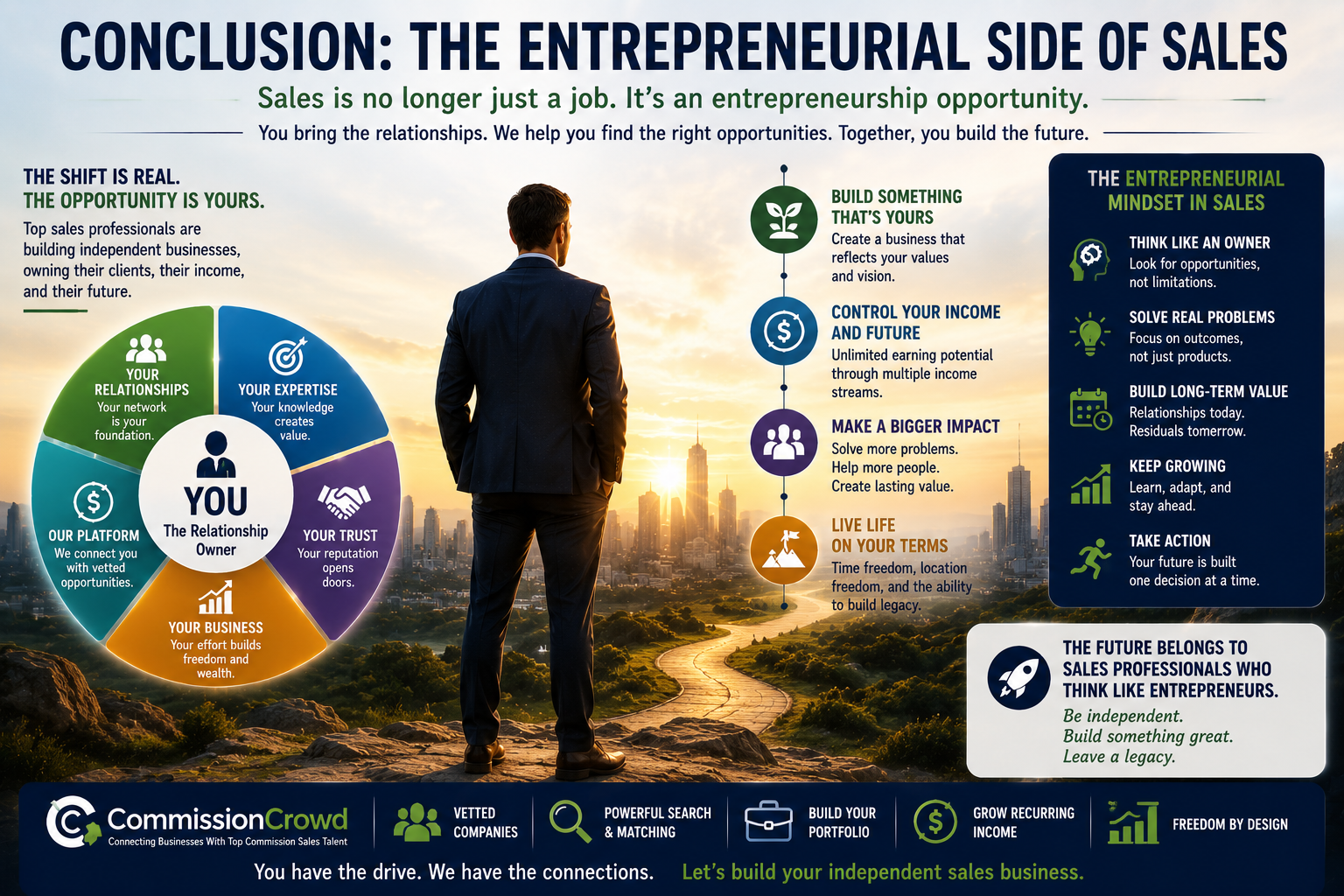
Most sales professionals begin their careers focused on products, targets, territories, commission plans, and learning how to sell effectively. That is perfectly natural. Early success is often determined by developing core sales skills, understanding customer needs, and learning how to consistently create value within an established organisation.
As experience accumulates, however, many begin to recognise that their greatest asset is not the product they sell or even the company they work for. It is the collection of relationships, industry knowledge, credibility, and trust they have spent years building. Those assets have value.
For some people, that value remains within the organisations they work for, and there is absolutely nothing wrong with that path. Many highly successful sales careers are built entirely within traditional employment structures, where experienced professionals continue creating value for both their employer and their customers.
Others eventually arrive at a different conclusion.
As their confidence grows and their network expands, they begin to realise that the relationships they have built, the reputation they have earned, and the expertise they have accumulated could form the foundations of a business of their own. Rather than continuing to build exclusively within someone else's organisation, they see an opportunity to build around assets they have spent years creating themselves.
That is why independent sales reps, sales agents, manufacturers' representatives, freelance sales professionals, and commission-only entrepreneurs exist.
They are not simply salespeople working without a salary. They are entrepreneurs who have chosen to build businesses around trust, expertise, relationships, and market knowledge. Like consultants, accountants, agency owners, and countless other business owners, they have taken the skills developed throughout their careers and transformed them into something they own.
In many ways, every entrepreneur is commission-only.
There is no guaranteed salary. Revenue only exists when customers buy. Whether someone owns a software company, a manufacturing business, a consultancy, or operates as an independent sales rep, the underlying principle remains remarkably similar. Success depends on creating value, building trust, and generating opportunities within the market they serve.
For the right person, that journey can be incredibly rewarding. Not because it is easier, and certainly not because it is safer, but because it offers something many professionals eventually begin seeking: ownership.
The opportunity to take a lifetime of experience, relationships, and credibility and turn it into a business of your own is one of the most entrepreneurial paths a career in sales can offer.
Key Takeaways
- Most successful independent sales reps begin their careers as employees.
- Independence is usually the result of accumulated expertise, relationships, and industry knowledge.
- Many independent sales reps build portfolios of complementary products and services rather than relying on a single company.
- Residual commissions and recurring income can create long-term earning leverage.
- The most valuable asset independent sales professionals build is trust.
Looking for Independent Sales Opportunities?
If you're considering becoming an independent sales rep, sales agent, manufacturers' representative, or commission-only sales professional, one of the biggest challenges is finding quality independent sales opportunities.
CommissionCrowd connects experienced sales professionals with companies actively looking for independent sales partners across a wide range of industries and territories.
Browse current sales opportunities and learn more about building an independent sales business.
Frequently Asked Questions About Becoming an Independent Sales Rep or Sales Agent
What is an independent sales rep?
An independent sales rep is a self-employed sales professional who represents one or more companies on a commission basis rather than working as a salaried employee. Unlike traditional employees, independent reps operate their own businesses and are typically responsible for managing their own expenses, schedules, territories, and client relationships.
Many independent sales reps represent complementary products or services that serve the same customer base, allowing them to build multiple revenue streams from the relationships they have developed throughout their careers.
What is the difference between an independent sales rep and a sales agent?
In many industries, the terms are used interchangeably.
Both independent sales reps and sales agents typically operate as self-employed professionals who generate business for companies in exchange for commission. The specific terminology often depends on geography, industry, or personal preference rather than any major difference in how they work.
What is a 1099 sales rep?
A 1099 sales rep is an independent contractor operating under the U.S. tax system rather than a traditional W-2 employee.
From a practical perspective, many 1099 sales reps operate similarly to independent sales agents or commission-only sales professionals. They manage their own business activities, pay their own taxes, and earn income based on the sales they generate rather than receiving a fixed salary from an employer.
What is a manufacturers' representative?
A manufacturers' representative, often called a manufacturers' rep, is an independent sales professional who represents one or more manufacturers within a specific territory or industry.
Manufacturers' reps are particularly common in sectors such as industrial equipment, engineering, healthcare, construction, electrical products, and manufacturing. Many represent multiple non-competing product lines and leverage established relationships within their market to generate sales for the companies they represent.
Why do experienced sales professionals become independent?
The reasons vary from person to person, but several common themes appear repeatedly.
Many sales professionals eventually develop strong industry expertise, extensive buyer relationships, and a level of confidence that allows them to operate independently. Many independent reps are attracted by the opportunity to earn significantly more than traditional salaried employees.
For many, independence is less about leaving employment and more about embracing entrepreneurship.
Can independent sales reps earn more than employees?
They can, but there are no guarantees.
Independent sales professionals often have significantly higher earning potential because they are not limited to a single employer, product line, or commission structure. Many build multiple revenue streams through portfolio selling, recurring commissions, and long-term client relationships.
However, independence also involves risk. There is no guaranteed salary, and success depends heavily on the individual's ability to generate opportunities and create value consistently.
How do independent sales reps find companies to represent?
Independent sales reps find opportunities through a variety of channels, including industry relationships, referrals, trade associations, networking, trade shows, and specialised platforms.
Today, many companies and sales professionals connect through platforms such as CommissionCrowd, which helps independent reps discover commission-only sales opportunities across multiple industries and territories.
Do independent sales reps work for multiple companies?
Many do.
In fact, one of the most attractive aspects of independence is the ability to represent multiple complementary products or services that serve the same customer base. This approach allows sales professionals to create multiple commission streams while delivering greater value to the customers they already know and trust.
The exact number of companies represented varies depending on the industry, product complexity, and commercial agreements involved.
Is commission-only sales a legitimate career?
Absolutely.
Many highly successful sales professionals, manufacturers' representatives, independent agents, and business development specialists operate entirely on commission. In reality, every entrepreneur is effectively commission-only because their income ultimately depends on generating revenue.
While commission-only sales is not suitable for everyone, it has been a well-established commercial model across numerous industries for decades.
How do independent sales reps build recurring income?
Residual sales commissions are an independent rep's secret weapon. Recurring income typically comes from products and services that generate ongoing revenue after the initial sale.
Examples include software subscriptions, recurring service contracts, maintenance agreements, consumable products, membership programmes, and businesses that generate regular repeat orders.
Many experienced independent sales professionals actively seek opportunities that combine strong commission structures with recurring revenue potential because they allow previous sales efforts to continue generating income over time.
How do I become an independent sales rep?
Most successful independent sales reps begin by gaining experience within traditional sales roles. Over time, they develop industry expertise, customer relationships, commercial confidence, and market knowledge that eventually make independence possible.
If you're considering this path, our guides on transitioning to commission-only sales and becoming a successful independent sales rep or manufacturers' rep provide a much deeper look at the process.
Are independent sales reps employees or business owners?
Legally, independent sales reps are typically self-employed business owners rather than employees.
While their work revolves around sales, most successful independent reps think like entrepreneurs. They manage their own client relationships, choose which companies they represent, control their schedules, and make decisions based on the long-term growth of their business.
That entrepreneurial mindset is one of the biggest differences between traditional employment and an independent sales career.

More articles from CommissionCrowd
World-Class Software Engineering Sales Opportunity - 35% Commission + Residuals
World-Class Software Engineering Sales Opportunity - 35% Commission + Residuals
Why You'll Never Find Great Self-Employed Sales Professionals on Gumtree or
Why You'll Never Find Great Self-Employed Sales Professionals on Gumtree or Generic Job Websites