
Commission-Only Sales: The Complete Guide to Leaving Employment and Starting an Independent Sales Rep Business

Making the move from employment to commission-only sales is one of the biggest decisions a sales professional can make.
For many, it represents freedom, uncapped earning potential, and true independence. For others, it feels risky, uncertain, and overwhelming, especially without a clear understanding of how independent sales actually works in practice.
The truth is this: commission-only sales is not a gamble when approached correctly.
It is a business model. And like any successful business, it requires planning, structure, and an understanding of how experienced independent sales reps build income sustainably over time.
This guide is written for experienced salespeople who are considering moving from salaried employment into commission-only sales. It is not about hype, shortcuts, or influencer-driven promises of quick riches while traveling the world.
Instead, it is a practical, step-by-step blueprint for building a real, sustainable and lucrative independent sales business — one based on diversified income, long-term partnerships, and proven products with genuine market demand.
Throughout this guide, you’ll learn how successful commission-only sales reps structure their transition to ensure success, avoid common mistakes, and build sales portfolios that compound rather than reset each month.
And when you’re ready to take the next step, you’ll also discover how platforms like CommissionCrowd enable entrepreneurial sales agents to build your dream sales portfolio by selling for industry leading, vetted companies, who pay the highest commissions in their industries.
You’re Not Changing Jobs — You’re Starting an Independent Sales Business
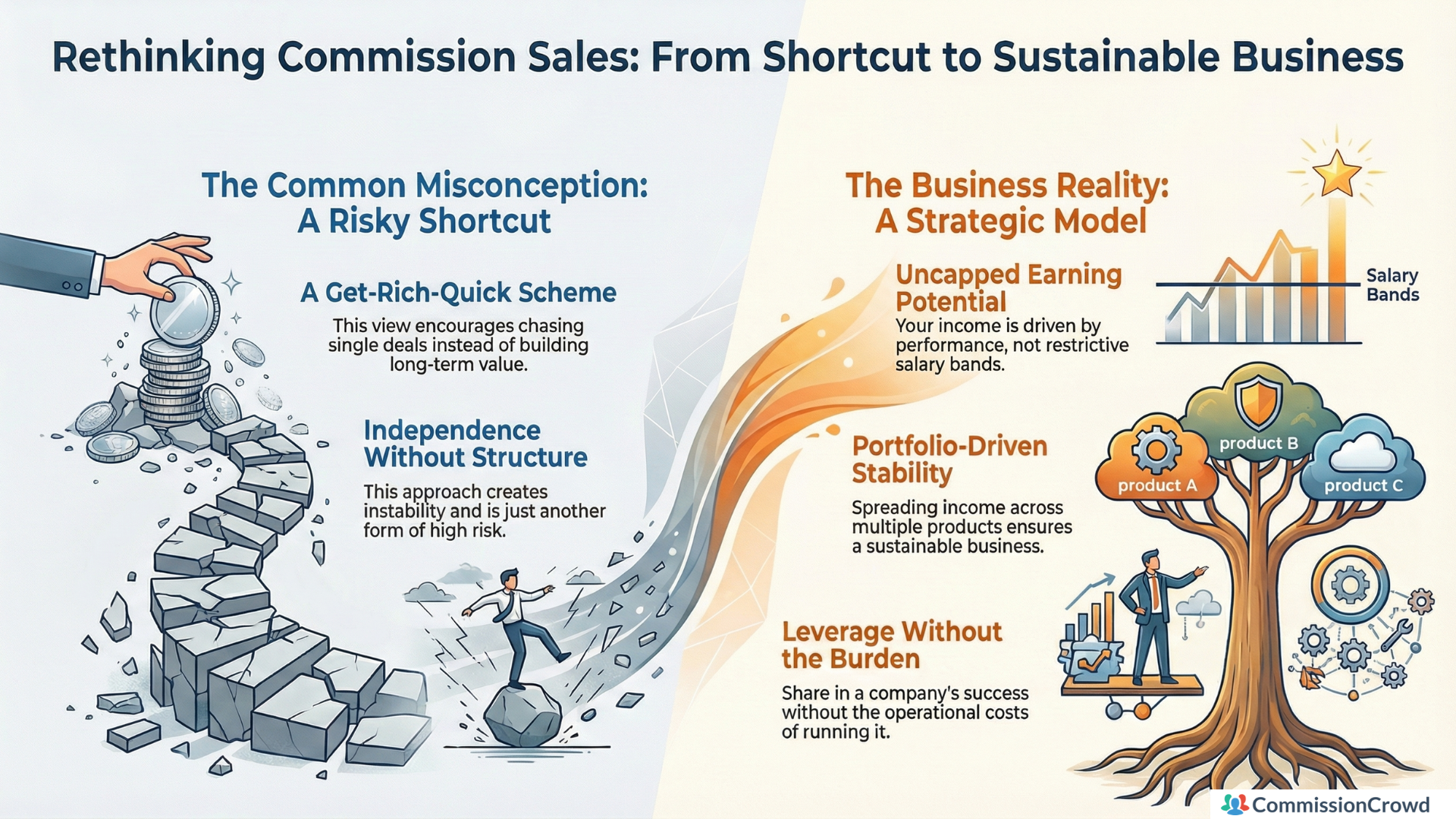
One of the most important mindset shifts when moving into commission-only sales is understanding that you are not taking a new job. You are starting a business.
In simple terms, every business owner operates on a commission-only basis.
If a business owner doesn’t sell their product or service, they don’t get paid. There is no guaranteed salary, no safety net, and no income without revenue.
The only difference is that in a traditional startup, the company owner must also produce, deliver, support, and scale whatever they sell.
As an independent sales professional, you are choosing a more focused and lower-risk form of entrepreneurship.
Instead of building a company around a single product or service, you are building a sales business around relationships, revenue generation, and partnerships.
You participate in growth without taking on the operational burden of manufacturing products, delivering services, hiring teams, or funding infrastructure.
This distinction becomes even more powerful when you compare independent sales to traditional startups.
Studies consistently show that:
- Around 20% of startups fail within their first year (source: Growth list)
- Roughly 50% fail within the first five years (source: Commerce Institute)
- Around 75% of businesses fail within ten years (source: Visual Capitalist)
The reasons are well known: lack of product-market fit, cashflow issues, operational complexity, scaling too early, or simply running out of time and capital.
Independent sales reps are in a uniquely advantaged position because they can bypass many of these risks entirely.
Rather than betting everything on a single idea, product, or market, commission-only sales agents are able to:
- Partner with established companies that already have product-market fit
- Sell proven products or services with existing demand
- Take on zero financial risk related to product development or delivery
- Avoid dependence on a single revenue source by building a diversified sales portfolio
This is a crucial lightbulb moment for aspiring independent sales reps.
A startup founder typically puts all their time, money, and energy into one product, hoping the market responds.
An independent sales professional can build their “ideal company” by representing multiple non-competing products and services, all aligned to the same buyer profile. If one product slows down, others continue to generate income. Risk is spread by design.
This is why commission-only sales is not unemployment, and it is not a downgrade from employment. It is a form of entrepreneurship where sales is the core service you provide, and diversification is built into the model.
When you leave employment, you stop being:
- An employee tied to one company
- A salesperson limited to one, or a small basket of products or services
- A participant in someone else’s business model
You become:
- A long-term revenue partner
- A sales professional free to choose who your represent
- A diversified business owner without the risks and overheads of traditional ownership
The real advantage entrepreneurial sales professionals have is flexibility. You can decide:
- Which industries you operate in
- Which problems you help solve
- Which products and services you represent
- How your income is distributed across short-term stability and long-term growth
Just like any business owner, the structure you build early on determines whether your income is fragile or resilient, stressful or sustainable.
Choosing the right mix of products, sales cycles, and partnerships is the difference between constantly chasing deals and building something that compounds over time.
This article exists because commission-only sales is often misunderstood as a role, rather than what it truly is: a real business with real strategic choices.
Approached correctly, it allows experienced sales reps to create long-term, scalable income while sharing in the success of multiple established companies — without ever having to produce, manufacture, or deliver what they sell.
Understanding this shift from “job” to “business” is the foundation everything else in this guide is built on.
Why Transitioning to Commission-Only Sales Feels Risky (and How to Reduce That Risk)
Leaving a salaried role removes certainty. Monthly paychecks disappear, and responsibility shifts entirely onto you. This is where many sales agents hesitate.
Common concerns include:
- How long it will take to close deals
- Whether income will be consistent
- Fear of burning savings too quickly
These concerns are valid. However, most people fail in commission-based sales roles not because they lack sales ability, but because they chase high upside before building stability.
The goal of a successful transition is not immediate high income. It is building enough momentum and consistency to stay in the game long-term.
Why Commission-Only Sales Works Best in B2B, Not B2C
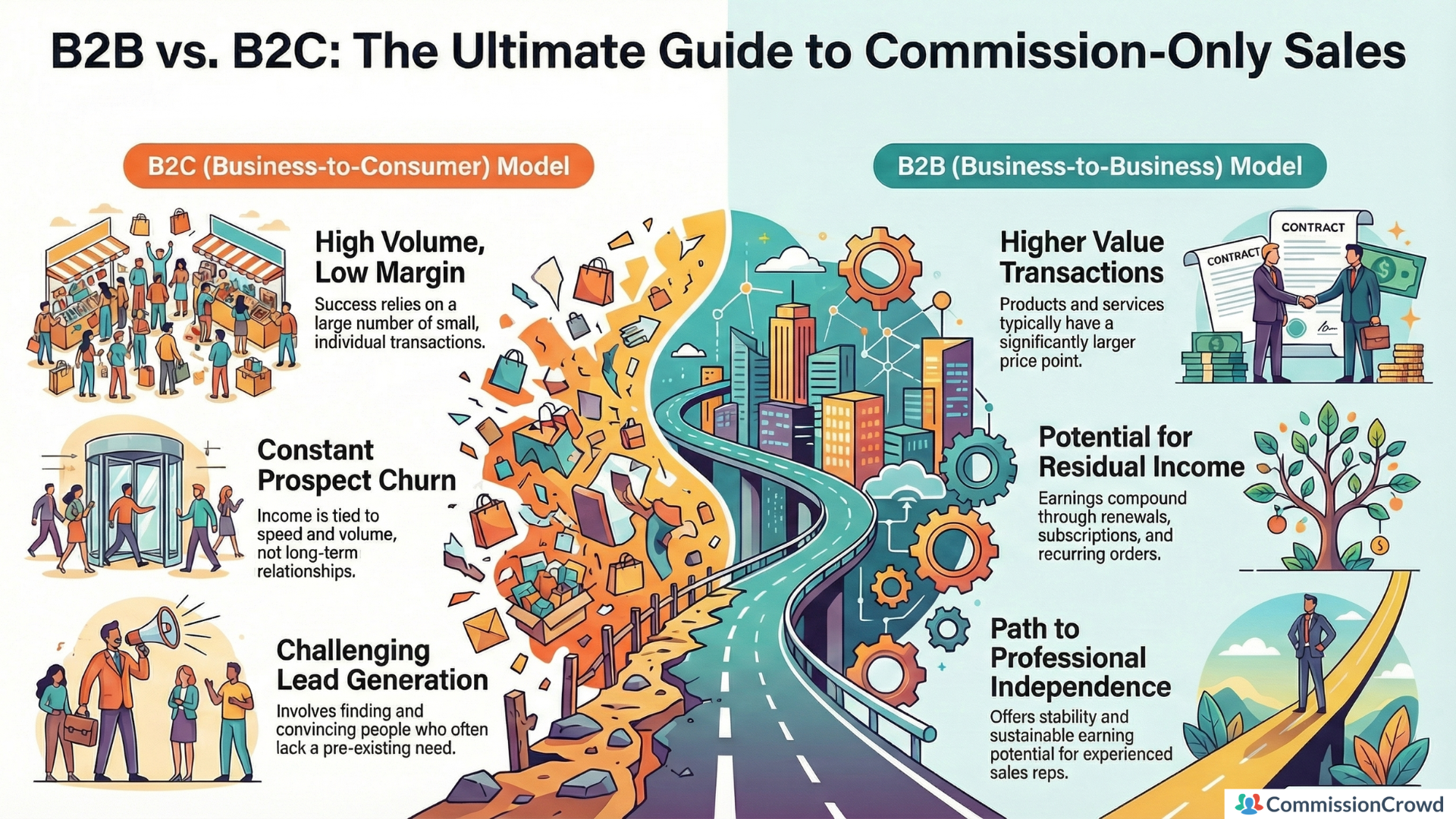
While commission-only sales exists in both B2B and B2C environments, the model is far more sustainable and lucrative when applied to B2B sales.
B2C commission-only roles often rely on high volume, low margin transactions, highly challenging lead generation (finding and convincing people typically without a need to purchase), and constant prospect churn.
Income is usually tied to speed and volume rather than relationships and long-term value. B2C commission-only sales rarely align with the goals of experienced sales reps looking to build a stable, professional independent sales business.
Because B2B products and services are typically higher value and repeat business is regular, either in renewals, subscriptions or recurring orders, they create an opportunity for residual (passive) income that compounds rather than resets after the sales has closed.
For sales agents transitioning from employment, B2B commission-only sales offers the clearest path to independence without sacrificing professionalism, stability, or long-term earning potential.
The Most Important Rule When Going Commission-Only: Don’t Chase 'High-Ticket' Deals First
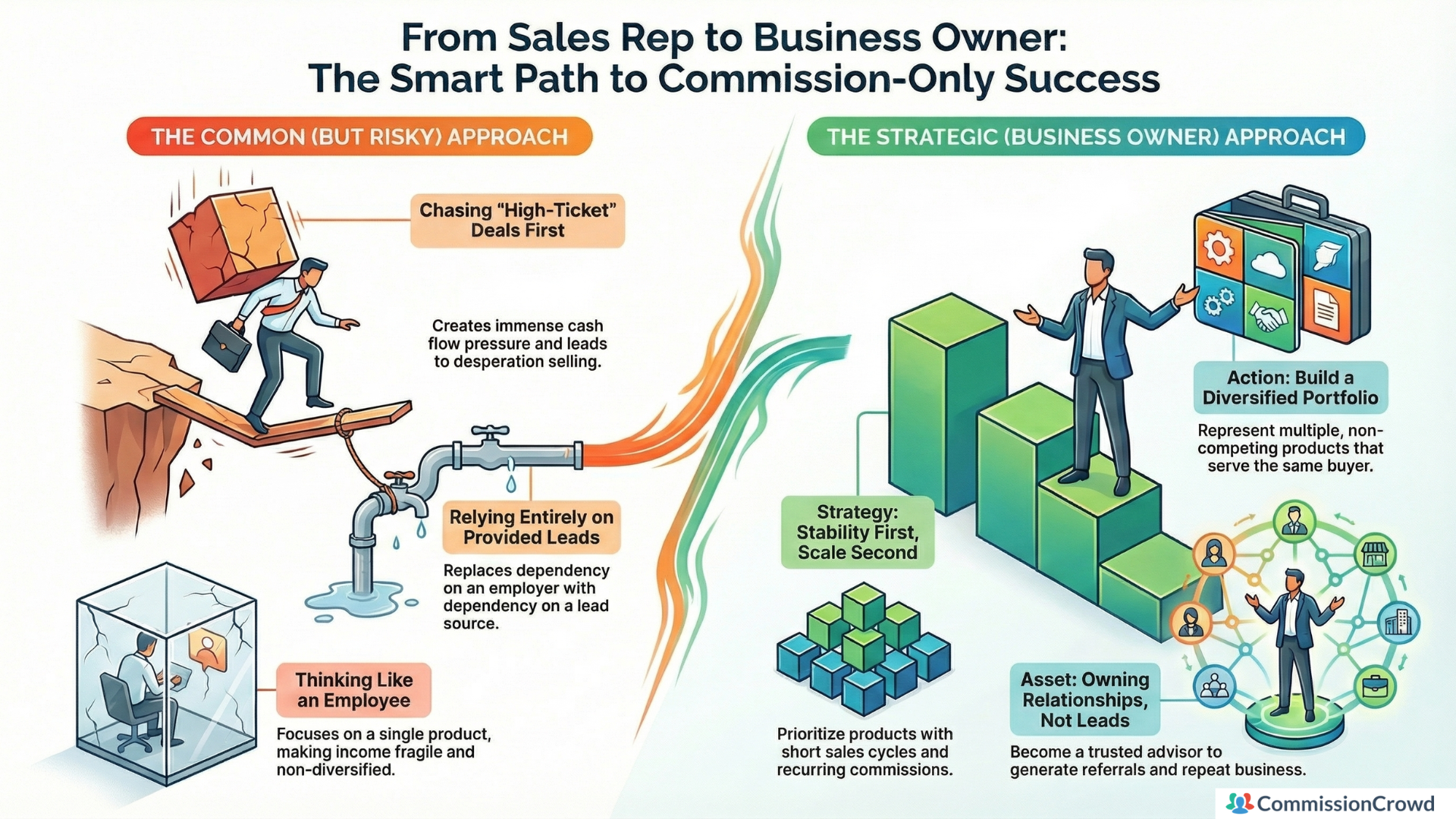
One of the biggest mistakes new commission-only sales reps make is chasing large, high-ticket deals from day one.
It’s an understandable temptation — big commissions promise a fast escape from employment but in practice, this approach creates unnecessary pressure and instability at the exact moment when stability matters most.
High income is not a starting strategy. It is a result of doing the fundamentals well over time.
When you transition from a salaried role into commission-only sales, your priority is not maximising upside on day one, it's survivability before scalability.
Without a salary, cashflow becomes the oxygen of your business. Long sales cycles and infrequent payouts may look attractive on paper, but they often leave new independent reps exposed, stressed, and forced into poor decisions just to close something.
This is why experienced sales agents who succeed independently focus first on:
- Shorter sales cycles that convert quickly
- Faster commission payouts that support monthly expenses
- Predictable, repeatable income (residual commissions) that compound over time
This type of income is often referred to as “bread and butter” income. It's what allows an independent sales business to function in the real world.
Early wins from shorter sales cycles do more than just pay the bills. They:
- Reduce financial stress and decision fatigue
- Build confidence during the transition period
- Provide proof that your independent sales model works
- Create time and space to think strategically rather than reactively
With steady recurring income coming in, you can afford to be patient with larger opportunities. You can nurture longer sales cycles properly, qualify harder, negotiate more confidently, and walk away from bad-fit deals without panic.
This is the opposite of desperation-driven selling and it consistently produces better outcomes.
It’s also important to reset expectations early. It is completely normal to earn less than your previous salary during the initial stages of commission-only sales.
This is not failure it's investment. The reps who succeed plan for this dip, structure around it, and build upward deliberately. The ones who struggle are usually those who ignore it and hope one big deal will solve everything.
Just like any entrepreneurial business, independent sales businesses grow in stages. Short-term stability enables long-term growth. Once your foundation is secure, adding larger deals with longer sales cycles becomes a strategic decision rather than a financial gamble.
In commission-only sales, the fastest way to sustainable success is rarely the biggest deal — it’s the most reliable ones.
High-Ticket Sales Explained: Why It’s Often Misunderstood (and How to Make It Sustainable)
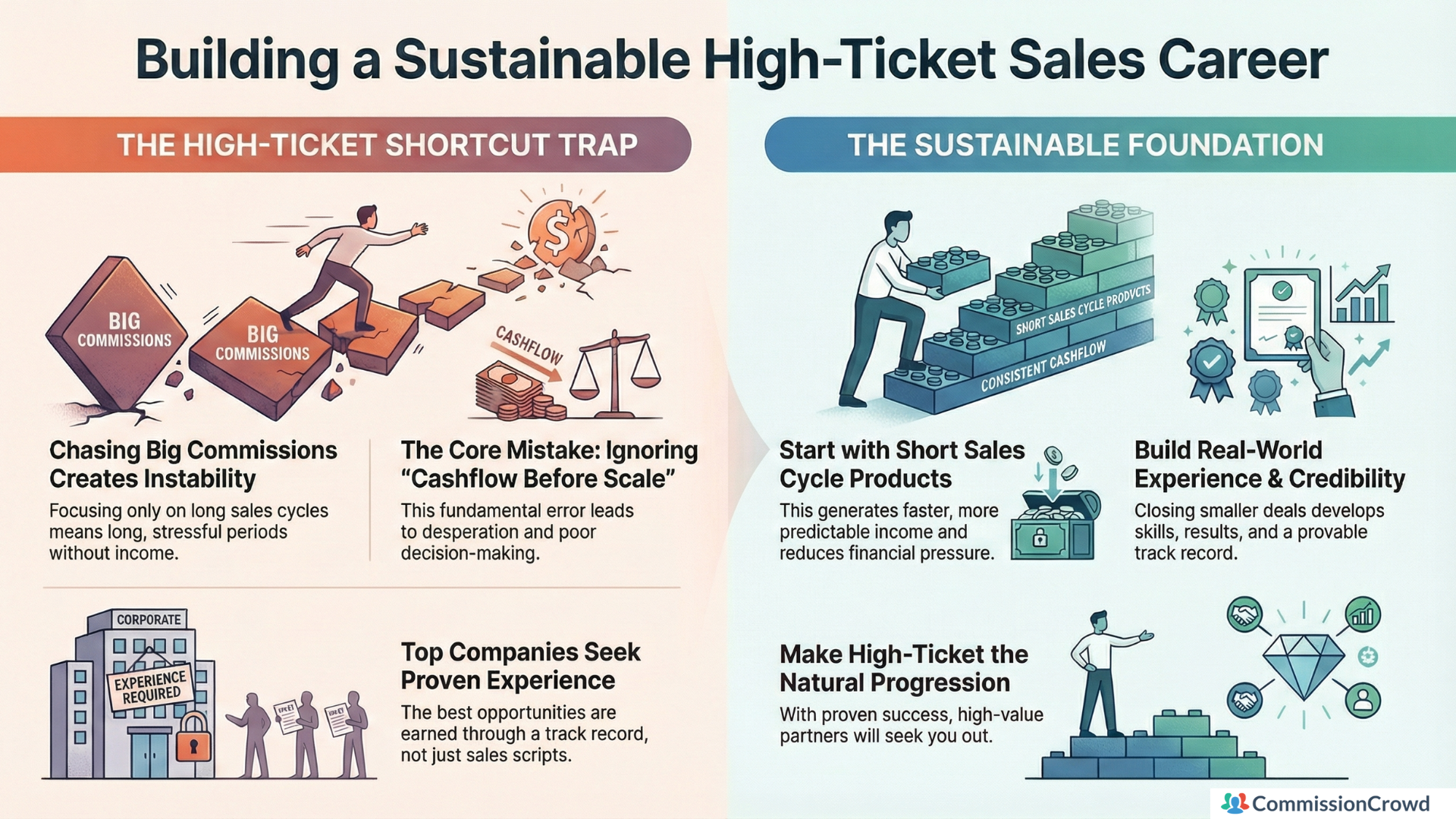
High-ticket sales has become heavily promoted online and is often positioned as the fastest route to freedom, wealth, and independence for a whole new generation of inexperienced sales people.
The narrative is simple and appealing: close fewer deals, earn larger commissions, and work less. For many people looking to escape employment quickly, this sounds like the ideal path.
In reality, high-ticket sales is frequently misunderstood. Not because it doesn’t work, but because of how and when it’s pursued.
Many high-ticket sales courses are aimed at people who:
- In many cases have a limited background in sales
- Do not yet have a professional sales network
- Lack long-term, demonstrable sales experience
- Rely entirely on leads being provided to them
These individuals are very different from experienced sales agents who have spent years building relationships, managing complex buying processes, and consistently generating revenue for their employer.
Treating high-ticket closing as a universal starting point creates unrealistic expectations and often sets people up for financial instability early on.
Where High-Ticket Closing Goes Wrong for Many People
High-ticket closing is often marketed as a shortcut into entrepreneurship, but it breaks one of the most time-tested principles of successful self-employment in sales:
Cashflow stability comes before scale.
Newer high-ticket closers are commonly encouraged to focus exclusively on high-value products or services with long and complex sales cycles. The problem is simple: long sales cycles mean long periods without income.
For anyone transitioning from employment, this can quickly create pressure, stress, and poor decision-making.
This is not a flaw in high-ticket sales itself. It is a flaw in the sequencing.
Companies selling genuinely high-value products or services also tend to be highly selective of who they entrust their valuable leads to.
They usually partner with sales reps who can demonstrate:
- An extensive and successful background in sales
- Consistent revenue generation
- Industry knowledge and credibility
- A track record of closing and retaining clients
These opportunities are typically earned over time, not accessed immediately through scripts or courses alone.
How High-Ticket Closers Can Build Sustainability (and Increase Their Long-Term Success)
For high-ticket closers who want to build a real, independent sales career, the most effective approach is not to abandon high-ticket opportunities, but to start with shorter sales cycle products and services that pay recurring residual commissions.
By working with short sales cycle offerings alongside high-ticket leads, closers can:
- Generate faster, more predictable income
- Reduce financial pressure while longer deals are in progress
- Stay patient and disciplined in complex negotiations
- Avoid chasing deals out of desperation
Shorter sales cycles provide immediate feedback, regular wins, and consistent cashflow. This stability allows high-ticket closers to treat large opportunities strategically rather than emotionally.
Why Starting With Short Sales Cycle Products and Services Lays The Foundation For Bigger Wins
Beginning with shorter sales cycle products and services does more than pay the bills — it builds the foundations that high-ticket success actually depends on.
Working with short and mid-cycle products helps high-ticket closers:
- Build real-world closing experience across multiple deals
- Develop deeper buyer understanding and negotiation skills
- Accumulate demonstrable results and case studies
- Establish credibility with future high-value partners
Over time, this creates something far more valuable than a script: a proven track record.
When high-ticket closers can show consistent results, retained clients, and repeatable success, they become far more attractive to companies selling high-value products and services. At that point, high-ticket opportunities are no longer a gamble, they are a natural progression.
What Successful Independent Sales Reps and Sales Agents Actually Do
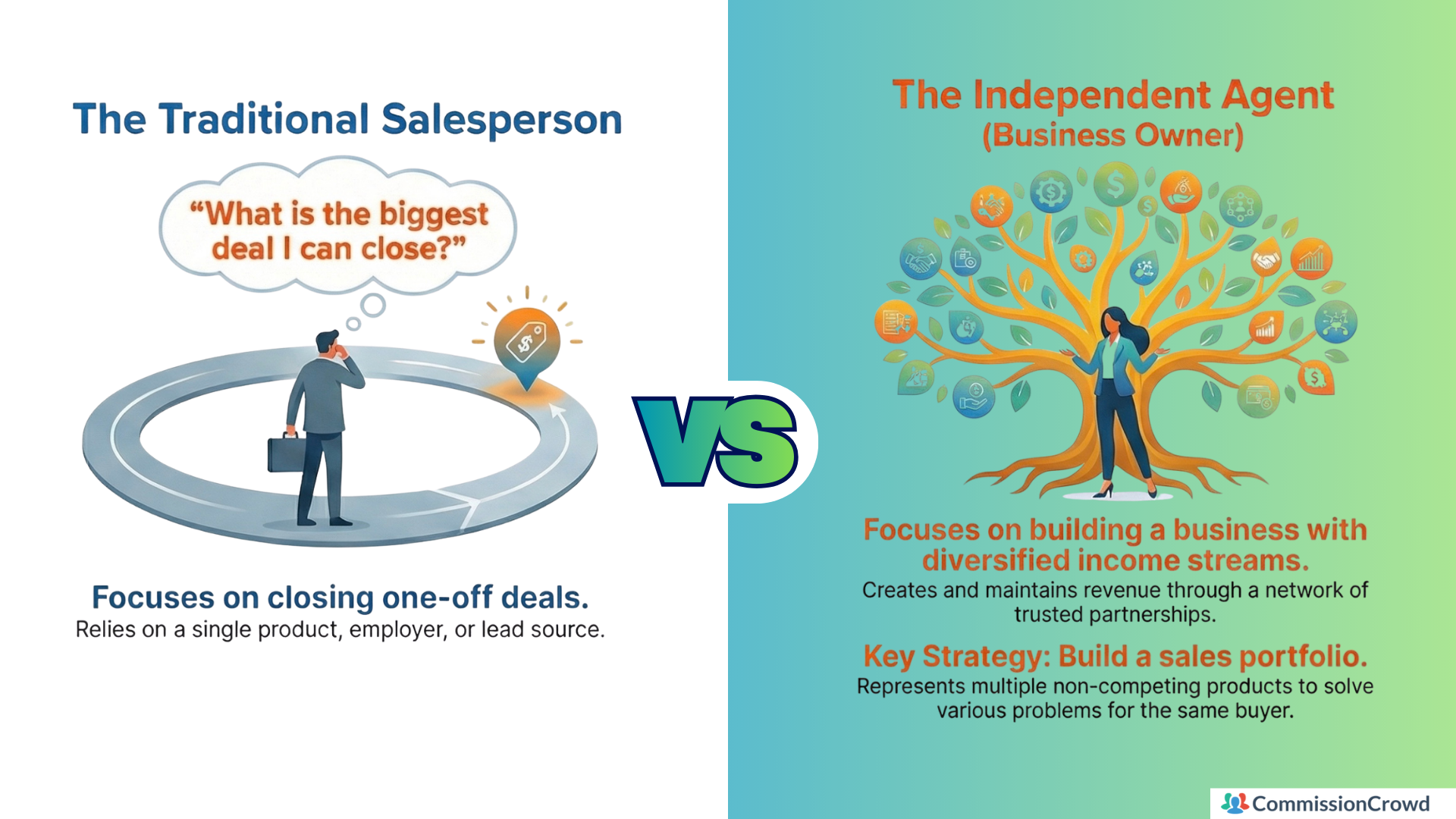
Successful independent sales agents operate very differently from traditional sales employees or high-ticket closers who are typically new to sales.
Instead of relying on a single product, employer, or lead source, they approach commission-only sales as a business built on relationships, partnerships, and diversified income streams.
The independent sales rep model doesn't focus on closing one-off deals, but on creating long-term value by serving the same buyer profile with multiple complementary solutions.
Understanding what independent sales reps actually do on a day-to-day basis is critical for anyone considering commission-only sales, because this mindset shift — from salesperson to business owner — is what separates sustainable success from short-lived results.
They think like business owners.
Instead of asking, “What is the biggest deal I can close?”, they ask:
- How do I build a diversified sales portfolio?
- How do I serve the same buyer with multiple solutions?
- How do I reduce reliance on any single partner?
Independent sales reps:
- Represent multiple non-competing products or services
- Sell into the same buyer profile
- Solve multiple problems for the same network
You do not manufacture products or deliver services. Your role is to create and maintain revenue through trusted partnerships.
How to Build Your First Commission-Only Sales Portfolio
Building your first commission-only sales portfolio is one of the most important steps when transitioning from employment into independent sales.
Unlike salaried roles, where income is tied to a single employer, commission-only sales requires a deliberate approach to choosing what you sell, who you sell to, and how your income is structured.
A well-designed sales rep portfolio reduces risk, stabilises cashflow, and creates long-term earning potential by spreading income across multiple non-competing products and services.
Before thinking about big deals or high commissions, it’s essential to understand how to build a commission-only sales rep portfolio that supports early income, recurring revenue, and sustainable growth.
Start With Your Existing Sales Experience and Network
Begin by assessing:
- Industries you already know and have experience selling in
- Companies you have sold to before
- Problems you understand deeply
Your network is your most valuable asset. Selling to familiar buyer profiles significantly shortens sales cycles.
Choose Products and Services With Short Sales Cycles
Early-stage portfolios should include offerings that:
- Close relatively quickly and pay residual commissions on recurring business
- Solve clear, urgent problems
- Are easy to explain and position
Why Recurring Commissions Matter Early On
Recurring commissions change the dynamics of commission-only sales. They allow income to compound rather than reset each month.
Common examples include:
- SaaS subscriptions
- Managed services
- Products with repeat purchasing behavior
When to Introduce High-Value, Long Sales Cycle Deals
Once your baseline residual income is stable, you can begin introducing:
- Higher-value deals
- Longer sales cycles
- Strategic, lower-frequency opportunities
Stability first. Scale second.
Why Relying on Provided Leads Is Not a Long-Term Sales Strategy
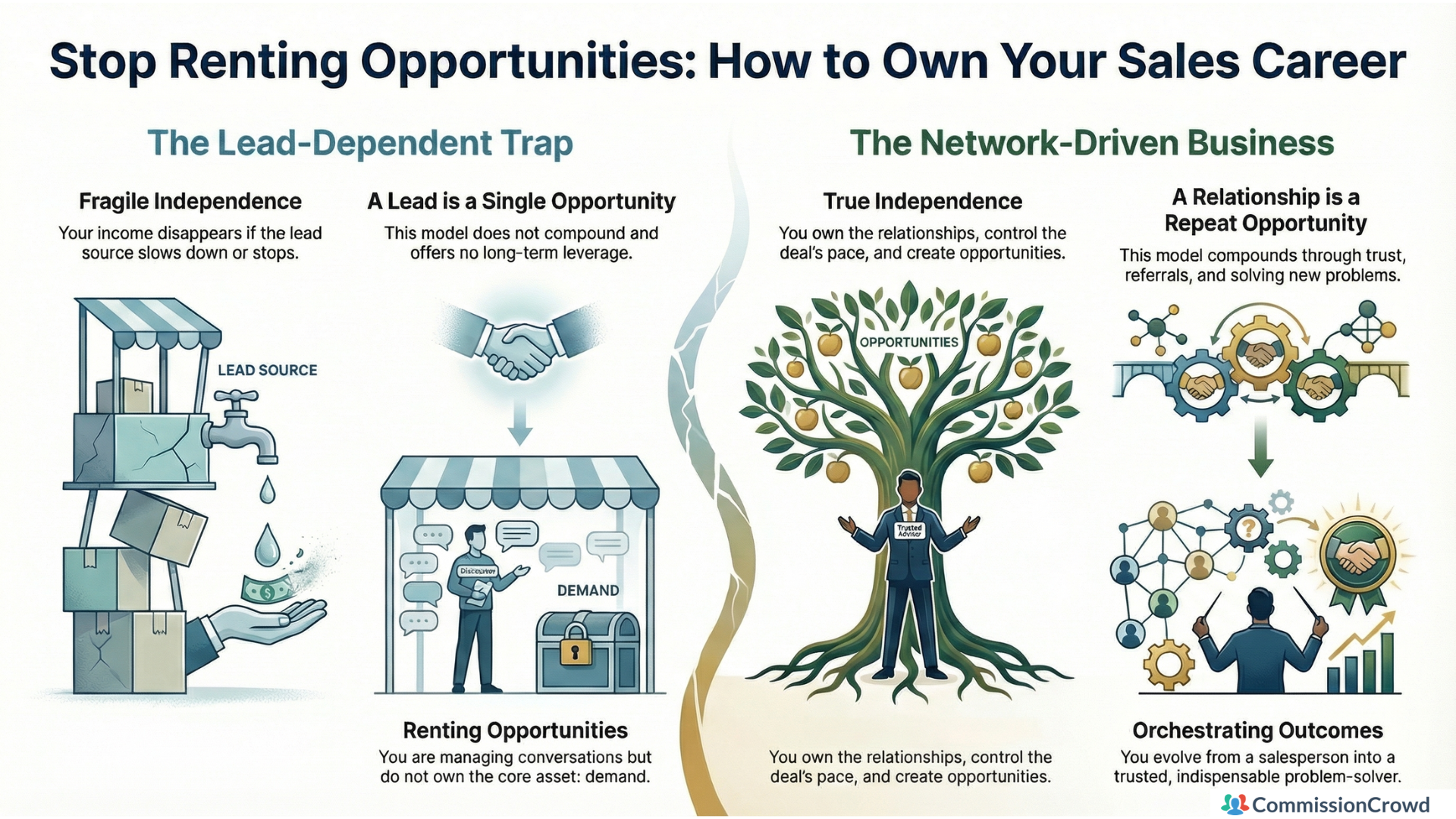
Leads can be useful, especially early on — but leads are not a business.
Relying solely on leads provided by a company, agency, or platform creates a fragile form of independence. You may be working on commission, but you do not control the most important asset in sales: demand. If the lead source slows down, changes strategy, or disappears altogether, your income disappears with it.
This is one of the most common traps people fall into when transitioning into commission-only sales. It feels safe to have leads handed to you, but in reality, it simply replaces one dependency (an employer) with another (a lead provider).
True independence in sales comes from:
- Owning relationships, not just managing conversations
- Generating referrals through trust and results
- Becoming a known problem-solver within a defined network
When you own the relationship, you control far more than just the sale. You control the pace of the deal, the positioning of the solution, and often the opportunity itself. This is where long-term leverage is created.
Experienced independent sales agents don’t think in terms of “leads” — they think in terms of networks. Networks compound. Leads do not.
A lead is a single opportunity.
A relationship is a repeat opportunity.
When clients trust you, they come to you with challenges before they’ve even defined the solution. Often, these problems sit outside the products or services you currently represent — and that’s where the real power lies.
When a client approaches you with a problem, you can:
- Identify the best solution on the market
- Source the right company or partner
- Negotiate commission terms based on the value of the introduction
- Create value for the client, the company, and yourself
At this point, you are no longer “closing leads.”
You are orchestrating outcomes.
This approach also dramatically reduces risk. Instead of being tied to one company’s marketing engine or one product’s demand, you build income from multiple directions. If one product slows down, your relationships don’t disappear. You simply help your network solve different problems.
Over time, this is how independent sales reps and Manufacturer's reps become indispensable. Clients don’t see them as salespeople — they see them as trusted advisors who save time, reduce risk, and bring solutions they wouldn’t have found on their own.
Leads can play a role in an independent sales business, but they should support your strategy, not define it. Long-term sustainability comes from being relationship-driven, referral-led, and trusted within a clearly defined market.
That is the difference between renting opportunities and owning a business.
How to Transition from Employment to Commission-Only Sales Safely
The most successful transitions from employment to commission-only sales are phased, deliberate, and planned. Very few independent sales agents succeed by quitting overnight or relying on a single opportunity to replace their income. The transition itself is part of the business you are building — and how you manage it has a direct impact on your long-term success.
You do not need to:
- Quit your job overnight
- Have a perfect or fully built-out sales agent portfolio
- Replace your entire salary immediately
Trying to do any of these things too quickly often increases pressure, shortens decision-making time, and leads to poor choices. Independence gained through urgency is rarely sustainable.
What you do need is a controlled ramp into commission-only work that prioritises learning, stability, and momentum.
Focus on Early Wins and Fast Feedback
Early wins matter — not because they are large, but because they provide feedback. Short sales cycles allow you to:
- Validate that your positioning works
- Test how buyers respond to your value proposition
- Learn where deals stall or accelerate
Fast feedback shortens the learning curve and helps you refine your approach before higher-stakes opportunities are on the line.
Understand Your Cashflow Before You Need It
Cashflow awareness is one of the most important skills new independent sales reps must develop. This means understanding:
- How long it takes to close a sale
- When commissions are actually paid
- Which expenses are fixed versus variable
Having clarity here allows you to plan realistically, reduce stress, and avoid being forced into reactive selling just to stay afloat.
Build Momentum Through Small, Repeatable Successes
Small, repeatable successes are the building blocks of confidence. Each closed deal — no matter the size — reinforces that your independent model works. Over time, these wins stack:
- Confidence increases
- Decision-making improves
- Risk tolerance becomes intentional rather than emotional
This momentum is what allows you to approach larger opportunities patiently and professionally, instead of chasing them out of necessity.
Treat the Transition Like the First Phase of Your Business
The transition period is not something to “get through” — it is the first stage of your independent sales business. Use it to:
- Identify which products and partnerships fit your network
- Eliminate what doesn’t work
- Build habits around pipeline management and follow-up
By the time commission-only sales becomes your primary focus, you’re no longer experimenting — you’re operating.
A phased transition doesn’t slow you down. It protects your confidence, preserves your optionality, and sets the foundation for sustainable growth. When done correctly, it turns uncertainty into clarity and replaces fear with informed momentum.
Common Mistakes New Commission-Only Sales Reps Make
The challenges faced by new commission-only sales reps are rarely unique. In fact, the same mistakes tend to appear again and again, regardless of industry or experience level. What separates those who succeed from those who struggle is not talent — it’s awareness and sequencing.
Understanding these patterns early can save months or even years of frustration.
Chasing One Deal Type
One of the most common mistakes is building an entire income plan around a single type of deal. This often shows up as an overreliance on either high-ticket opportunities or long sales cycles.
The problem with a single-deal strategy is fragility. If that deal type slows down, stalls, or disappears, so does your income. Sustainable independent sales businesses are built on variety, not concentration. Multiple deal sizes, multiple sales cycles, and multiple income streams provide resilience.
Saying Yes to Every Product
Early on, it’s tempting to represent every product or service offered. The thinking is simple: more products mean more opportunities.
In practice, the opposite is often true.
Saying yes too often leads to:
- Diluted focus
- Shallow product knowledge
- Confused positioning with buyers
Successful independent sales agents are selective. They choose non-competing products that solve different problems for the same buyer profile. Depth always beats breadth when credibility is on the line.
Ignoring Commission Payment Timing
Many new reps focus exclusively on commission percentage and deal size, while overlooking when they actually get paid.
Commission timing matters. A generous commission that pays six months after the sale may be far less useful than a smaller commission that pays quickly or recurs monthly. Cashflow keeps an independent sales business alive. Timing, not just total value, determines sustainability.
Overestimating Early Income
Another common mistake is assuming that income will quickly match or exceed a previous salary. This expectation often comes from comparing potential upside rather than early-stage reality.
The early phase of commission-only sales is an investment period. Earnings typically start lower and grow as momentum builds. Those who plan for this adjustment make better decisions and stay disciplined. Those who don’t often panic and chase poor-fit deals.
There are very real reasons why B2B commission-only sales reps earn more than salaried employees.
Underestimating the Value of Relationships
Finally, many new commission-only reps underestimate how valuable relationships truly are. They focus on closing transactions instead of building trust.
Relationships are not just a source of deals — they are a source of:
- Referrals
- Repeat business
- Early insight into future opportunities
Over time, relationships reduce the cost of selling, shorten sales cycles, and open doors that no lead list ever will.
The reality is that none of these mistakes are fatal on their own. They become dangerous only when they go unrecognised. Awareness allows you to correct course early, build with intention, and treat commission-only sales for what it truly is: a business that rewards patience, structure, and long-term thinking.
Simply understanding these patterns already puts you ahead of most new entrants — because most people only recognise them after it’s too late.
Your Next Step: Build Your Independent Sales Business on CommissionCrowd
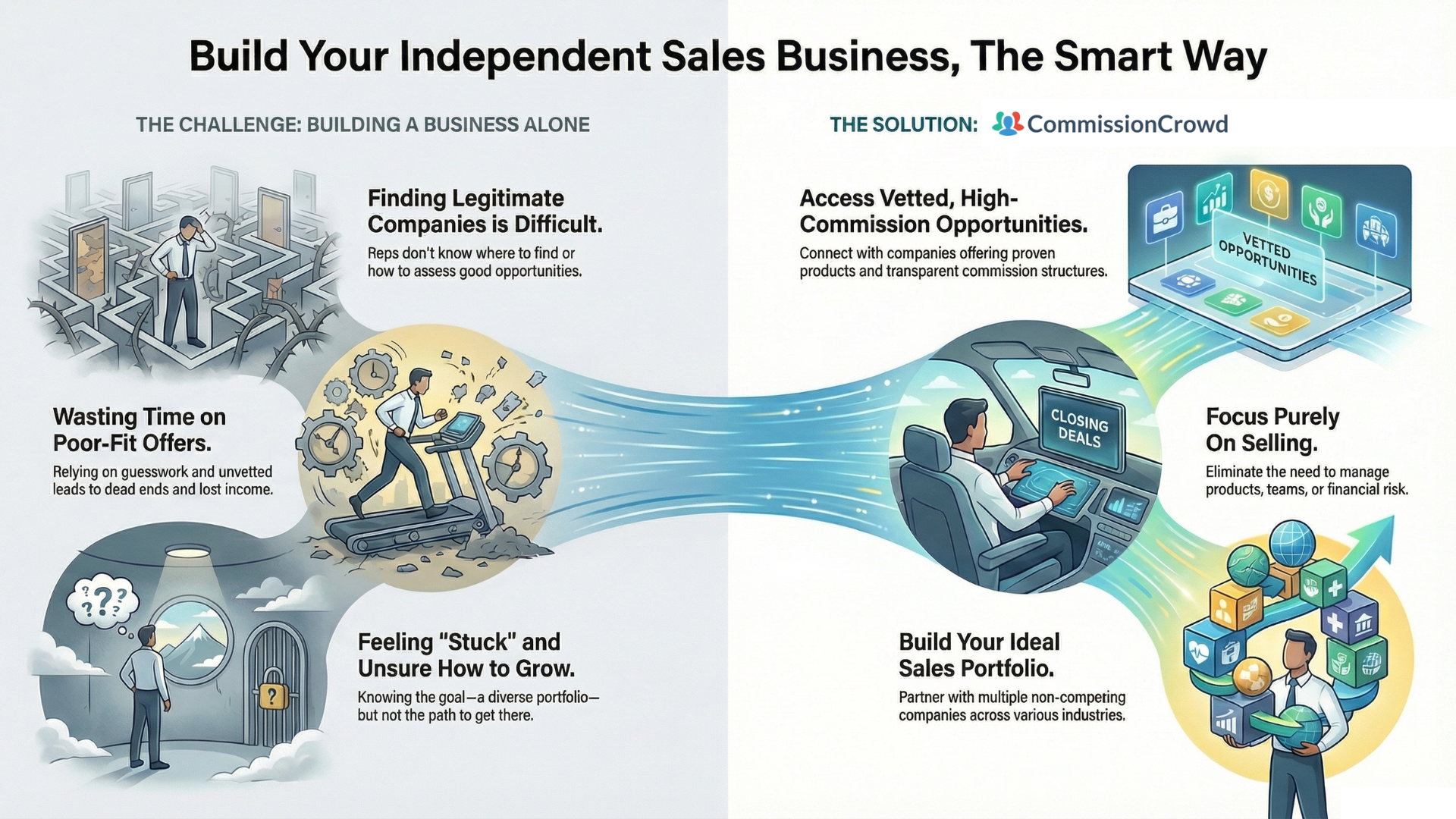
Understanding how commission-only sales works is one thing. Building a diversified, sustainable sales business in the real world is another.
This is where many aspiring commission-only sales reps get stuck. They know what they want to build — a sales portfolio of non-competing products, recurring income, and long-term partnerships — but they don’t know where to find legitimate companies, how to assess opportunities, or how to avoid wasting time on poor-fit offers.
This is exactly the problem CommissionCrowd was built to solve.
CommissionCrowd is a global commission-only sales network designed specifically for entrepreneurial sales reps who want to build a serious, long-term independent sales business. Instead of relying on cold outreach, guesswork, or unvetted opportunities, sales professionals can access companies that have already been assessed for product-market fit, commercial viability, and commission structure.
Companies on CommissionCrowd:
- Are actively looking for independent sales partners
- Offer some of the highest commission rates in their industries
- Provide clear, transparent commission structures
- Represent proven products and services with real demand
For independent sales agents, this creates a powerful advantage. You can build a diverse sales portfolio across multiple industries and solutions without having to:
- Manufacture products
- Deliver services
- Build internal teams
- Take on operational or financial risk
Instead, you focus on what you do best: generating revenue, building relationships, and creating value.
Whether you are just beginning your transition from employment or looking to expand an existing independent sales business, CommissionCrowd provides the infrastructure, opportunity flow, and global reach to support long-term growth. It allows you to design your “ideal company” — one partnership at a time — while sharing in the success of established businesses around the world.
Commission-only sales is not about finding a single role. It’s about building a business. CommissionCrowd exists to help you build it properly.
Final Thoughts: Commission-Only Sales Is a Business, Not a Shortcut
Commission-only sales is not a get-rich-quick scheme, and it is not a shortcut around the realities of building something meaningful. It is a business model — one that rewards experience, discipline, and long-term thinking far more than speed or bravado.
Like any real business, success in commission-only sales comes from structure, sequencing, and patience. Those who approach it with a clear strategy, realistic expectations, and a focus on sustainability give themselves a genuine advantage. Those who chase shortcuts or rely on a single deal, product, or lead source often discover that independence without structure is just another form of risk.
When built correctly, commission-only sales offers something few traditional roles can:
- Uncapped earning potential, driven by performance rather than salary bands
- Portfolio-driven stability, where income is spread across multiple products, services, and partnerships
- True professional independence, with control over who you work with, what you sell, and how you grow
Perhaps the most overlooked benefit is leverage. Independent sales reps can share in the success of established companies without taking on the operational burden of running one. They can align with proven products, growing markets, and real demand — while designing a business that fits their strengths, network, and lifestyle.
The transition from salaried employment to commission-only sales should never be rushed. Starting slowly allows you to learn, adjust, and build confidence. Building intelligently means choosing the right products, the right sales cycles, and the right partners. Thinking in portfolios — rather than pitches — ensures that your income compounds instead of resetting every month.
This is how real independent sales businesses are built: deliberately, sustainably, and with intention. For sales agents willing to treat commission-only sales as the business it truly is, the opportunity is not just financial — it is structural, scalable, and enduring.
Here's an article you will also find interesting: Debunking the Myths About Manufacturer’s Sales Reps: The Truth About Commission-Only Sales
Frequently Asked Questions About Commission-Only Sales & Self-Employment in Sales
Here are clear, practical answers to the most common questions sales professionals ask about commission-only sales, self-employment, and transitioning from employment to independence.
Becoming Self-Employed in Sales
How do I become self-employed in sales?
Becoming self-employed in sales means shifting from being paid a salary to being paid for the revenue you generate. Instead of working for one employer, you operate as an independent sales partner representing a diverse sales portfolio of companies for commission.
The most successful self-employed sales professionals treat this as a business by defining a buyer profile, choosing proven products or services, building a repeatable pipeline, and diversifying income across multiple non-competing partners.
How do I become a self-employed sales rep?
To become a self-employed sales rep, start by leveraging your existing sales experience and network. Choose one or two products or services with real demand and shorter, manageable sales cycles, ideally with recurring commissions.
Focus on building early cashflow first, then expand your sales portfolio over time. Independence comes from owning relationships and revenue streams, not relying on a single company or deal.
How do I start my own sales business?
Starting your own sales business does not require building a product or service offering. An independent sales business is built around revenue generation and partnerships. You sell for established companies that already have product-market fit, while you build your own income through commission agreements.
Treating sales as a business means tracking pipeline, managing cashflow, and structuring income for stability and growth.
The key takeaway is this: you are starting, building, and running your own business. Every entrepreneur operates on a commission-only basis — if their company doesn’t sell, they don’t get paid.
The unique advantage of commission-only sales is that you don’t need to create, manufacture, or deliver a product yourself. Instead, you can choose which proven products and services to sell on behalf of established companies. Your sole responsibility is revenue generation — and that focus dramatically reduces both complexity and risk.
What are the steps to start a sales business?
The core steps to start a sales business are:
- Choose a buyer profile you understand
- Select proven products or services with real demand
- Prioritise short sales cycles, recurring commissions and early cashflow
- Build a consistent pipeline and follow-up routine
- Track commission timing and expenses
- Expand your sales portfolio with additional non-competing products and services as income stabilises
This approach reduces risk and allows income to compound over time.
Commission-Only Sales Careers
Is commission-only sales worth it?
Commission-only sales can be highly rewarding for experienced sales professionals when approached as a business rather than an unpaid job role. When built around a diversified portfolio, recurring income, and long-term relationships, it offers uncapped earning potential, flexibility, and true professional independence.
Should I become a commission-only sales rep?
You should consider becoming a commission-only sales rep first and foremost if you are entrepreneurial and have a strong drive to start your own sales company. Solid sales experience is vital and you should have the ability to support yourself during a starting period with inconsistent income early on. Starting your own sales business is not ideal for those who lack sales experience or have no real desire to run a business.
Is commission-only sales risky?
Commission-only sales is risky only when approached without structure or planning. Risk is significantly reduced by focusing on short sales cycles first, understanding commission payment timing, building recurring income, and transitioning in phases rather than all at once.
Commission-only vs salary-based sales jobs: what’s the difference?
Salary-based sales roles offer predictable income, benefits, and lower short-term risk, but often come with capped earnings, limited autonomy, and dependency on a single employer or product. Commission-only sales offers uncapped earning potential, flexibility, and independence, but requires strong discipline, cashflow planning, and a business mindset, especially in the early stages.
Freelance & Independent Sales Roles
What skills do I need to be a freelance sales agent?
Key skills include prospecting discipline, qualification, pipeline management, negotiation, relationship-building, and commercial judgement. Successful freelance sales agents also think like business owners by managing cashflow, choosing partners carefully, and protecting their time and credibility.
Income & Earning Potential
How much can self-employed sales reps earn?
Earnings vary widely depending on industry, deal size, commission structure, and portfolio design. Income is influenced by sales cycle length, payment timing, recurring commissions, and diversification across multiple partners. Self-employed sales reps who build recurring income and multiple non-competing revenue streams often achieve far greater long-term stability and significantly higher earning potential than salaried sales job roles.
Finding Commission-Only Opportunities
How do I get a job as a commission-only sales rep?
Rather than looking for a traditional “job,” focus on finding commission-based partnerships with companies that already have proven products and demand. Look for clear commission structures, realistic expectations, and defined target markets. The goal is to build a portfolio of opportunities, not rely on a single role. CommissionCrowd is the network that most independent sales agents use to build their ideal sales portfolio.
Companies that commonly work with commission-only sales reps include B2B SaaS providers, managed service firms, manufacturers, logistics companies, and professional service businesses.
Opportunities are often found through industry networks, referrals, direct outreach, and platforms like CommissionCrowd that vet companies and commission structures before introducing them to independent sales professionals.
Common Misconceptions
Is commission-only sales a scam?
No. Commission-only sales is a legitimate and widely used business model across industries such as manufacturing, SaaS, and professional services. Problems arise when it is marketed as a shortcut or “get-rich-quick” solution rather than a long-term independent business.
Here’s an article you may find useful: Debunking the Myths About Manufacturer’s Sales Reps: The Truth About Commission-Only Sales
How do commission-only sales reps get paid?
Commission-only sales reps earn a percentage of the revenue generated from the deals they close. This may include one-time commissions on products that are sold once, recurring or residual commission income on repeat business, depending on the agreement and product or service sold.
How long does it take to make money in commission-only sales?
This depends on sales cycles and portfolio structure. Many independent sales professionals generate early income by prioritising short sales cycle products and services that pay frequent residuals first, while higher-value opportunities with much larger commission payouts typically take longer to close and are added to your sales portfolio later.
Is commission-only sales suitable for beginners?
Commission-only sales is generally best suited to professionals with prior sales experience and established networks. Most successful independent sales reps transition after several years in salaried sales roles, once they have developed strong selling skills and industry credibility.
Is commission-only sales really self-employment?
Yes. Commission-only sales professionals operate as independent or self-employed partners. They are not employees — they design their own business, choose their partners, and control how their income is generated and scaled.

More articles from CommissionCrowd
World-Class Software Engineering Sales Opportunity - 35% Commission + Residuals
World-Class Software Engineering Sales Opportunity - 35% Commission + Residuals
Why You'll Never Find Great Self-Employed Sales Professionals on Gumtree or
Why You'll Never Find Great Self-Employed Sales Professionals on Gumtree or Generic Job Websites