
Residual Commissions Explained: The Independent Sales Rep’s Secret Weapon for Passive Recurring Income

Why Residual Commissions Are the Real Game-Changer for independent sales reps and Manufacturer's reps:
If you’ve ever worked in an employed sales role, you’ll know the frustration: weeks of prospecting, pitching, and closing a deal… only to celebrate a one-time commission check.
After that, you’re back to square one, while your employer continues collecting revenue from the client you delivered.
Independent sales reps play a very different game.
Instead of working for capped or one-off payouts, they build diverse, complementary portfolios of companies they represent. These companies offer products and services that generate residual commissions — recurring income streams earned on repeat orders, renewals, and subscriptions.
By representing multiple companies and industries, reps transform short-term wins into long-term wealth.
And nowhere is this model more accessible than on CommissionCrowd — the world’s commission-only sales network where independent reps consistently earn the highest commissions and recurring residuals.
Residuals aren’t just another way to get paid. They’re the independent sales rep’s secret weapon: the foundation of passive recurring income, portfolio diversification, and the ability to monetise introductions without managing every sale yourself.
What Are Residual Commissions?
Residual commissions are ongoing payments you earn when a client you introduced keeps buying. Unlike one-off commissions, residuals continue month after month, or year after year, for as long as the client relationship lasts.
Examples include:
- SaaS subscriptions → Monthly residuals.
- Insurance & finance → Annual renewals.
- Telecoms, energy, utilities → Multi-year contracts with recurring payouts.
- Marketing or consulting retainers → Recurring monthly fees.
- Consumable products (e.g. packaging, beverages, medical supplies) → Repeat orders triggering residual commissions.
- Equipment leasing → Recurring payments on long-term agreements.
Not every company offers “lifetime” residuals, but many do. Others pay on fixed terms (12–24 months). Either way, residuals transform every deal into an income-producing asset.
On CommissionCrowd, we ensure that companies offer the strongest possible structures — high upfront commissions plus recurring payouts — and reps can negotiate terms before committing.
Why Residual Sales Commissions Are So Powerful
Residual commissions deliver advantages that no salary or capped sales role can match:
- Predictable Income Growth – Each deal adds to your base. You don’t reset to zero every month.
- Time Leverage – Work once, keep earning as long as the client stays.
- Portfolio Building – Each sale strengthens your long-term financial foundation.
- Career Security – Even if new sales slow, residuals provide a cushion of reliable income.
- Ownership – You keep the client relationships and the income.
Residuals are essentially like a sales pension: compounding income that rewards you for years, not just a one-off and back to the grind.
Why Employed Sales Reps Feel Trapped
Traditional employment keeps sales reps stuck:
- Capped sales commissions limit upside.
- One-off payouts give the company the lifetime value rather than you.
- No client ownership — your book of business stays behind if you leave.
- Constant resets create burnout.
This system is designed for employers, not sales reps. That’s why more professionals are moving into independence, where residuals and portfolio diversification create true upside.
The Multiplier: Building a Diversified Sales Portfolio
Residuals alone are powerful. But the greatest advantage comes when independent reps build diverse portfolios of complementary companies — spanning services and repeat-order physical products. This diversification multiplies the number of ways you can generate income from every client interaction.
Residual sales commissions becomes even more powerful when it forms part of a properly structured independent sales business. If you're looking at the bigger picture, our in-depth guide to building a successful independent sales business explains how to select complementary companies, build around an existing customer market and balance recurring income with shorter and longer sales-cycle opportunities.
Illustrative Examples: Residual Commissions in Action
Residual commissions are powerful on their own, but when independent sales reps build diverse portfolios of complementary companies — spanning services and repeat-order physical products — the results multiply. Here are some examples of how residuals work in practice:
1. The Healthcare Solutions Rep (Services + Products)
A rep decides to specialise in healthcare. Their portfolio combines medical equipment leasing (residuals on monthly payments), patient management software (SaaS subscriptions), and disposable medical supplies (repeat consumables). Each hospital or clinic becomes a multi-stream client, with recurring orders and subscriptions stacking into a steady six-figure annual income.
Hospitals and clinics spend heavily on leasing equipment, SaaS platforms, and consumables. Each account creates multiple streams of residuals.
Quick Math (per hospital):
- Equipment leasing: $25,000/month × 10% = $2,500
- SaaS platform: $8,000/month × 20% = $1,600
- Consumables: $30,000/month × 8% = $2,400
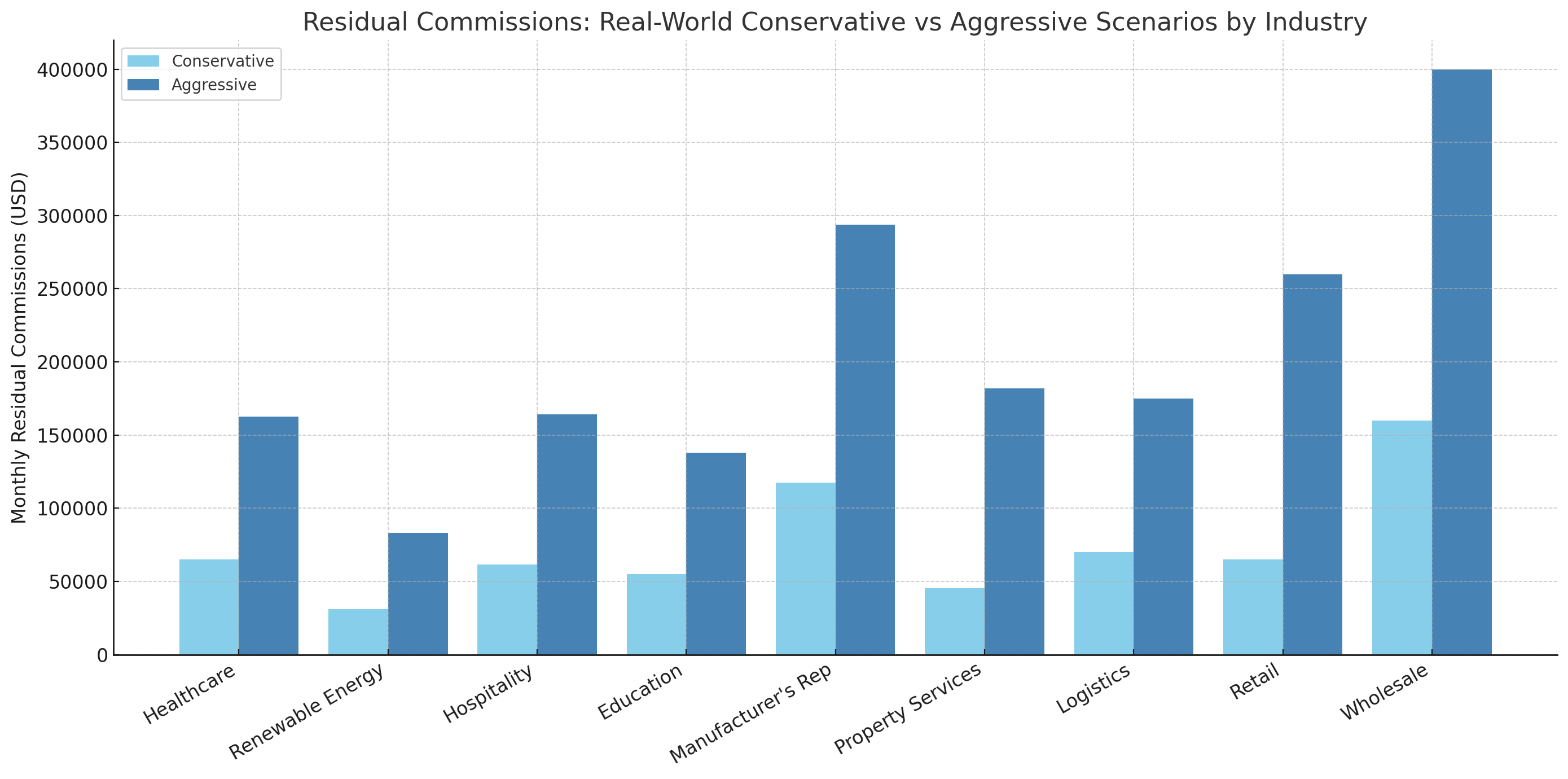
Total per hospital = $6,500/month - Conservative: 10 hospitals = $65,000/month (~$780k/year)
- Aggressive: 25 hospitals = $162,500/month (~$1.95m/year)
2. The Renewable Energy Partner (Physical Products + Services)
Another rep focuses on sustainability. They represent solar panel providers (residuals on financing or leasing contracts), energy-efficiency consulting (monthly retainer), and LED lighting solutions (repeat orders as businesses upgrade locations). Every introduction to a property manager or developer creates recurring commissions across several product lines.
Commercial solar projects, consulting retainers, and LED retrofits generate high-value, long-term residuals.
Quick Math (per building):
- Solar lease: $100,000/year × 8% = $8,000/year (~$667/month)
- Efficiency consulting: $5,000/month × 20% = $1,000
- LED retrofits: $50,000/year × 10% = $5,000/year (~$417/month)
Total per building ≈ $2,084/month - Conservative: 15 buildings = $31,000/month (~$372k/year)
- Aggressive: 40 buildings = $83,000/month (~$996k/year)
3. The Hospitality Growth Partner (Hybrid)
A rep builds a portfolio for restaurants and hotels. They represent a point-of-sale software company (monthly SaaS), a foodservice distributor (weekly recurring orders), and a laundry/linen rental provider (residuals on contracts). Each hospitality account becomes a bundle of ongoing commissions, turning a single introduction into multiple long-term revenue streams.
Hotels and restaurant groups generate ongoing orders for foodservice, software, and linens.
Quick Math (per account):
- POS SaaS: $3,000/month × 20% = $600
- Foodservice: $50,000/month × 5% = $2,500
- Linens: $10,000/month × 10% = $1,000
Total per account = $4,100/month - Conservative: 15 accounts = $61,500/month (~$738k/year)
- Aggressive: 40 accounts = $164,000/month (~$2m/year)
4. The Education Sector Specialist (Services)
Targeting schools and universities, a rep partners with e-learning platforms (monthly residuals), school supplies companies (repeat orders), and professional development training providers (annual contracts). Every new institution creates a recurring base that grows each academic year, compounding over time as their portfolio expands.
Universities and large schools spend on SaaS, supplies, and training contracts, creating compounding income streams.
Quick Math (per institution):
- E-learning SaaS: $20,000/month × 15% = $3,000
- Supplies: $30,000/month × 7% = $2,100
- Training: $50,000/year × 10% = $5,000/year (~$417/month)
Total per institution ≈ $5,517/month - Conservative: 10 institutions = $55,000/month (~$660k/year)
- Aggressive: 25 institutions = $138,000/month (~$1.65m/year)
5. The Manufacturer’s Rep (Physical Products)
A manufacturer’s rep builds a portfolio of complementary product lines in a single sector — for example, industrial tools, protective gear, and machine components. Their clients, typically distributors and wholesalers, place recurring orders every month or quarter to replenish stock. Each new account doesn’t just generate one commission — it creates a long-term revenue stream as those buyers reorder again and again. With the right territory, a single distributor account can generate tens of thousands annually in residuals across multiple product lines.
Distributors and wholesalers place huge repeat orders for tools, PPE, and components.
Quick Math (per distributor):
- Tools: $100,000/month × 5% = $5,000
- PPE: $50,000/month × 6% = $3,000
- Components: $75,000/month × 5% = $3,750
Total per distributor = $11,750/month - Conservative: 10 distributors = $117,500/month (~$1.41m/year)
- Aggressive: 25 distributors = $293,750/month (~$3.52m/year)
6. The Property Services Partner (Hybrid)
Specialising in property management companies, a rep builds a portfolio of security systems (residuals on monitoring contracts), cleaning and janitorial suppliers (monthly consumables), and landscaping services (retainer contracts). Each property manager controls dozens of buildings, multiplying the rep’s residuals across their portfolio.
Property managers oversee dozens or hundreds of buildings, each with recurring service contracts.
Quick Math (per building):
- Security monitoring: $1,000/month × 15% = $150
- Cleaning supplies: $5,000/month × 8% = $400
- Landscaping: $3,000/month × 12% = $360
Total per building = $910/month - Conservative: 50 buildings = $45,500/month (~$546k/year)
- Aggressive: 200 buildings = $182,000/month (~$2.18m/year)
7. The Logistics & Distribution Ally (Services + Products)
A rep works with logistics firms, offering warehouse management software (SaaS), pallet and packaging supplies (repeat orders), and equipment leasing (forklifts and vehicles with recurring payments). Just a few regional distribution hubs create a significant recurring base — and every introduction to a new operator compounds the income further.
Distribution hubs spend tens of thousands on SaaS, packaging, and leased equipment every month.
Quick Math (per hub):
- WMS SaaS: $20,000/month × 15% = $3,000
- Packaging: $50,000/month × 6% = $3,000
- Equipment leases: $10,000/month × 10% = $1,000
Total per hub = $7,000/month - Conservative: 10 hubs = $70,000/month (~$840k/year)
- Aggressive: 25 hubs = $175,000/month (~$2.1m/year)
8. The Retail Partner (Physical Products)
A rep builds a portfolio supplying retail chains with high-turnover products like snacks, beverages, or eco-packaging. Each store reorders weekly or monthly, creating highly predictable recurring income. With dozens or hundreds of outlets, even small-ticket items add up fast.
Retail chains reorder consumables and packaging constantly, creating highly predictable recurring commissions.
Quick Math (per store):
- Beverages/snacks: $15,000/month × 6% = $900
- Eco-packaging: $5,000/month × 8% = $400
Total per store = $1,300/month - Conservative: 50 stores = $65,000/month (~$780k/year)
- Aggressive: 200 stores = $260,000/month (~$3.1m/year)
9. The Wholesale Distributor Ally (Physical Products)
A rep partners with wholesalers and cash-and-carry distributors who supply SMEs. Their portfolio might include cleaning products, office supplies, and seasonal consumables. Because wholesalers sell in bulk and reorders are frequent, each account generates strong, ongoing commissions.
Wholesalers generate huge residuals through bulk reorders of multiple product categories.
Quick Math (per wholesaler):
- Cleaning products: $50,000/month × 5% = $2,500
- Office supplies: $100,000/month × 6% = $6,000
- Consumables: $150,000/month × 5% = $7,500
Total per wholesaler = $16,000/month - Conservative: 10 wholesalers = $160,000/month (~$1.9m/year)
- Aggressive: 25 wholesalers = $400,000/month (~$4.8m/year)
The Power of Introductions and Referrals
Independent reps don’t need to be experts in every product or close every deal themselves. One of the biggest advantages of independence is the ability to monetise your network by making introductions.
Here’s how it works:
- Spot a need (e.g. a logistics company needs vehicle leasing, or a restaurant chain needs new suppliers).
- Introduce your contact to the right provider in your portfolio.
- Step back — the provider’s sales team handles the close.
- Collect residual referral commissions on every repeat order or contract renewal.
This means every conversation and relationship becomes a revenue opportunity. Even if it’s not in your expertise, a simple introduction can generate years of recurring income.
Residuals + Diversification = Compounding Growth
Combine these three elements and the model becomes unbeatable:
- Residuals → Income that compounds month after month.
- Diversification → Multiple income streams from every client.
- Introductions → Revenue from industries you’ve never sold directly.
This is how independent reps transform sales from a paycheck hustle into a lucrative sales portfolio of multiple recurring revenue streams
How CommissionCrowd Maximises Your Success
CommissionCrowd isn’t a recruiter or a job board. We’re the global commission-only sales network and professional association for independent reps.
Here’s why agents worldwide trust CommissionCrowd:
- Vetted Companies – Every partner is screened for credibility and fairness.
- Highest Commissions + Residuals – We fight for the strongest terms.
- Negotiation Transparency – Reps see terms upfront and negotiate before committing.
- Guaranteed Opportunities – Memberships include guaranteed applications.
- Community + Tools – A global network of peers plus deal management tools.
With CommissionCrowd, independent reps turn their networks and skills into long-term assets — not just one-off paychecks.
How to Start Building Your Residual Portfolio
Here’s your roadmap:
- Shift your mindset – From employee to entrepreneur.
- Target recurring industries – SaaS, insurance, telecom, energy, FMCG, industrial supplies.
- Join CommissionCrowd – Access vetted companies offering high commissions + residuals.
- Negotiate upfront – Push for lifetime or multi-year recurring terms.
- Diversify your portfolio – Blend services with repeat-order products.
- Leverage introductions – Monetise your network, even outside your expertise.
- Protect your book – Treat every client as a long-term income asset.
Conclusion: Own Your Independent Future with Residual Sales Commissions
Residual commissions are not just a pay structure — they are the independent sales rep’s secret weapon. They turn one-off deals into passive recurring income, strengthen client portfolios, and create wealth that compounds year after year.
By combining services with physical products, diversifying portfolios, and monetising introductions, independent reps unlock opportunities that employed roles can’t match.
That’s why ambitious sales professionals are choosing independence — and why they’re choosing CommissionCrowd: the commission-only sales network where reps consistently earn the highest commissions and residuals worldwide.
Your network is an asset. Your skills are valuable. Don’t rent them out for capped paychecks.
Own them. Grow them. Profit from them.
Frequently Asked Questions About Residual Commissions
What are residual commissions in sales?
Residual commissions are ongoing payments sales reps earn when a client they introduced continues to buy, renew, or reorder. Instead of being paid once, reps keep earning for the duration of the client relationship — whether that’s monthly, annually, or for the life of the contract.
Which industries offer the best residual commissions?
Industries with recurring revenue models are best for residuals. Common examples include:
- SaaS software (monthly subscriptions)
- Insurance & finance (annual renewals)
- Telecoms & utilities (multi-year contracts)
- Marketing retainers (monthly services)
- FMCG, packaging, and consumables (repeat product orders)
- Equipment leasing (long-term agreements)
Do all companies offer lifetime residuals?
No. Some companies pay lifetime residuals as long as the client remains, while others limit payouts to 12–24 months. On CommissionCrowd, terms are clear upfront, and reps can negotiate for stronger commission and residual structures before starting their partnership with any company.
Why do independent sales reps earn more with residuals than employees?
Employed sales reps often face capped commissions and one-off payouts. Independent, self-employed sales reps on CommissionCrowd earn uncapped commissions and residuals, keeping ownership of client relationships.
This means income doesn’t reset each month - it compounds with every new deal.
Can I earn residual commissions from physical product sales as well as services?
Yes! Many independent sales reps and Manufacturers reps earn residuals on physical products like consumables, packaging, or building supplies through repeat orders. Others earn on services like SaaS, insurance, or telecom contracts. The most successful reps build diverse portfolios combining both product and services based sales opportunities.
Do I need to close every deal myself to earn residuals?
Not necessarily. Many reps on CommissionCrowd earn residuals simply by making introductions within their network. The company’s in-house sales team handles the close, while the rep earns residual referral commissions for as long as the client continues ordering.
It's important to note that a lower commission or shorter residual commission payout period may be offered by the company if the sales agent isn't handling the full sales cycle.
How do I start earning residual commissions with CommissionCrowd?
- Join CommissionCrowd to access vetted companies worldwide.
- Browse opportunities offering high commissions + residuals.
- Negotiate terms upfront — lifetime or multi-year payouts where possible.
- Build a diverse portfolio of companies you represent.
- Monetise your network through direct sales, referrals and introductions.
CommissionCrowd makes it simple to start building a residual income portfolio that compounds year after year.
Sales professionals will find this article from the CommissionCrowd blog interesting: 8 Real Reasons Why B2B Commission-Only Sales Reps Earn More Than Salaried Employees
Many sales professionals reach a point where the limits of salaried roles start to outweigh the security they provide.
If you’re exploring a move toward greater flexibility, uncapped earning potential, and true independence, this practical blueprint for moving into commission-only sales explains how experienced reps make the transition safely, avoid early pitfalls, and build long-term income through diversified sales portfolios.

More articles from CommissionCrowd
World-Class Software Engineering Sales Opportunity - 35% Commission + Residuals
World-Class Software Engineering Sales Opportunity - 35% Commission + Residuals
Why You'll Never Find Great Self-Employed Sales Professionals on Gumtree or
Why You'll Never Find Great Self-Employed Sales Professionals on Gumtree or Generic Job Websites