
Why Commission-Only Sales Is Not Unethical (And How Critics Get It Wrong)
Commission-only sales is one of the most criticised models in modern sales — and almost everyone seems to be arguing about the wrong thing.
Scroll through forums, comment threads, or “career advice” discussions and you’ll see the same assumption repeated again and again: if a company doesn’t pay a salary, it must be unethical. The blame is placed squarely on the business — accused of cutting corners, exploiting salespeople, or avoiding responsibility.
Commission-only sales professionals are often described using different industry terms, including freelance sales reps, freelance sales agents, 1099 sales reps, 1099 sales contractors, and manufacturer’s representatives.
But there’s a perspective that’s almost never discussed.
Commission-only sales isn’t just something companies offer. It’s something experienced sales professionals actively choose.
The most successful commission-only sales reps are not desperate, inexperienced, or unable to secure salaried roles. They are typically highly experienced sales professionals who have spent years selling, building networks, and generating revenue — and who have deliberately opted out of employment in favour of autonomy, ownership, and running their own business.
Once you recognise that commission-only sales is often a conscious entrepreneurial decision made by the salesperson, the standard criticism begins to unravel. Judging it by employment standards is fundamentally flawed.
The real mistake isn’t questioning whether commission-only sales is ethical. It’s evaluating it as if it were a job, rather than recognising it for what it actually is: a business model — one where sales professionals assume responsibility for revenue in exchange for independence, uncapped upside, and control over how their income is generated.
If you’ve ever dismissed commission-only sales as exploitative or “unpaid labour,” this article challenges the most common criticisms — not by defending bad companies or poor opportunities, but by exposing the deeper misunderstanding at the heart of the debate: confusing employment with entrepreneurship.
The Core Misunderstanding: Confusing Commission-Only Sales With Employment
Most criticism of commission-only sales comes from comparing it to salaried employment.
That comparison is fundamentally flawed.
Commission-only sales is not:
- A sales job missing employee benefits
- An unfair compensation structure
Commission-only sales is a form of business ownership.
When critics argue that commission-only sales is “unethical” because there is no guaranteed pay, what they are really expressing is an employment-based expectation — the belief that income should exist before revenue is created.
That expectation does not exist anywhere else in entrepreneurship.
Business owners are not paid first and expected to sell later. Revenue always comes before income. Commission-only sales follows the same principle, except the individual chooses to specialise in one function: generating sales.
This applies equally to commission-only sales reps, freelance sales reps, 1099 sales contractors, and manufacturer’s reps operating as independent businesses.
When someone says, “I would never work commission-only,” what they are often really saying is: “I would never choose self-employment.”
That is not a moral judgement.
It is a preference for employment over entrepreneurship.

The Reality: Every Business Owner Operates On A Commission-Only Basis
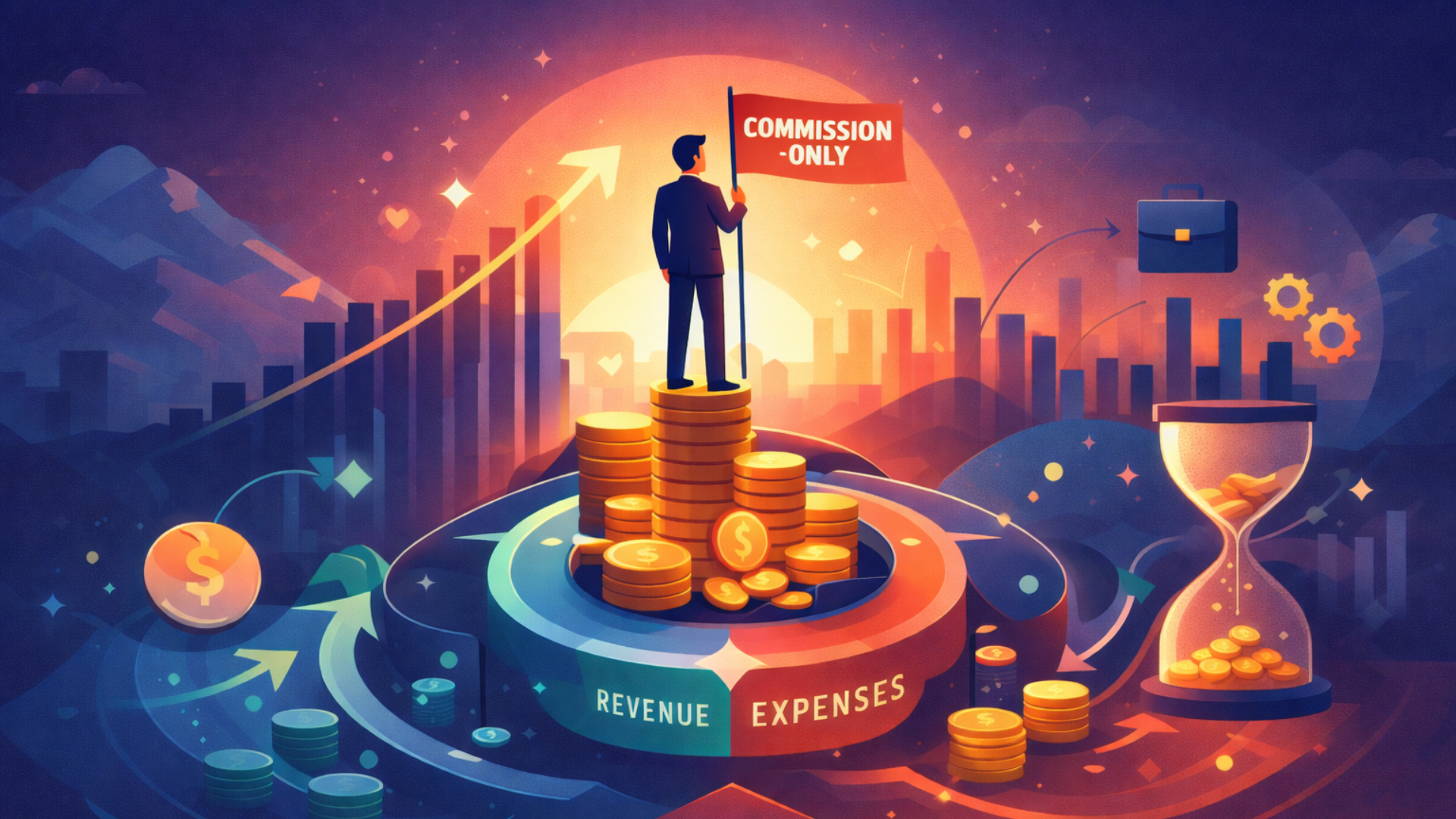
Entrepreneurs — regardless of the industry they operate in — are literally working on a commission-only basis. It's just that we associate the words ‘commission-only’ exclusively with the sales industry.
If a business doesn’t sell, there is no income. There is no salary waiting to be paid. No safety net. No one else footing the bill.
The size of the company or the industry it's operating within doesn’t change this reality. Whether it’s a solo founder or a global organisation, revenue is always generated from sales.
The real difference isn’t whether commission exists — it’s where the risk lives.
In a traditional business, the owner carries the full burden of that risk, including:
- Product creation
- Manufacturing or service delivery
- Staffing and payroll
- Operations and compliance
- Capital investment
Independent sales professionals and 1099 sales reps accept the same revenue responsibility while deliberately avoiding those additional layers.
- They don’t build products.
- They don’t manage operations.
- They don’t hire employees or fund infrastructure.
They focus on one function: building a diverse sales portfolio and generating sales.
That isn’t exploitation. It’s entrepreneurship, and there is no fundamental difference between a traditional business owner and a sales professional who chooses to build an independent business through commission-only sales.
Entrepreneurs are praised for taking the leap into business ownership — yet when sales professionals do the same, they’re often criticised for it. Why?
Here you'll find the Complete Guide to Leaving Employment and Starting an Independent Sales Rep Business
Why Commission-only Sales Is the Lowest-Risk Form of Entrepreneurship

Entrepreneurship is often associated with high risk and significant financial exposure. But not all forms of entrepreneurship carry the same burden.
Independent sales stands apart because it allows experienced sales professionals to participate in the creation of multiple revenue streams without absorbing the operational, financial, and execution risks that cause most businesses to fail.
Understanding why sales is the lowest-risk form of entrepreneurship is key to understanding why commission-only work, when chosen deliberately, is not reckless — it’s strategic.
Traditional entrepreneurs must:
- Build or manufacture products
- Deliver services
- Hire and manage staff
- Fund development and infrastructure
- Absorb operational and financial risk
Independent sales professionals do not.
Independent sales entrepreneurs:
- Partner with companies that already have product–market fit
- Build a diversified sales portfolio of proven products or services with real demand
- Earn commission for generating revenue while avoiding operational overheads
This is why sales is one of the lowest-risk forms of entrepreneurship available.
You participate in upside without carrying downside.
Commission-only sales is not unpaid labour.
It's revenue-sharing and partnership.
How Experienced Sales Professionals Evaluate Independent Sales Opportunities

Not all commission-only sales opportunities are equal, and this is where many critics miss the point.
When commission-only sales goes wrong, it’s not because the model itself is flawed. It’s generally down to poorly structured sales opportunities and misunderstanding of how independent 1099 sales reps and manufacturer’s reps operate.
Experienced commission-only sales professionals don’t “take a job.” They evaluate potential business partners.
Understanding the difference between a good and a bad commission-only opportunity is vital.
Myth: Commission-only is an easy way for companies to get cheap or free labour to sell your company's products or services.
Truth: Self-employed sales professionals have come from a long and successful background in sales prior to setting up their own business. Independent sales reps, and manufacturer’s reps are looking for mutually beneficial, win-win partnership opportunities with companies that have long-term vision and understand the value that this type of sales partner brings with them.
Partnership: This is the golden nugget. When you start looking for partners and treat your new reps as such, companies will enjoy a much higher rate of success attracting and retaining the very best independent sales talent to help scale their business.
What a Good B2B Commission-Only Sales Opportunity Looks Like

Not all commission-only sales opportunities are created equal, and experienced sales professionals and manufacturer’s reps — know exactly what to look for.
Established Companies With Proven Product–Market Fit
Attractive commission-only sales opportunities typically involve companies that already have:
- A proven product or service that has achieved product-market fit
- Paying customers
- Clear market demand
- A defined buyer profile
- Case studies and testimonials
Independent sales reps are not in the business of validating unproven ideas for free. They partner with companies that already have product–market fit and demonstrated demand.
They typically want to partner with companies where demand already exists and their role is to scale revenue.
There are exceptions, such as early-stage startups with genuinely innovative solutions that solve serious, well-defined problems within an underserved industry. In those cases, there should be a clear USP, early traction and strong evidence of customer demand.
The Importance Of Clear, Generous and Transparent Commission Structures

Even with the strongest commission-only sales models, everything ultimately hinges on a competitive commission structure.
Clear, generous, and transparent commission terms are what turn a sales partnership into a viable business.
Remember, the foundation of working with independent 1099 self-employed sales agents is partnership, not employment.
Gaining access to an agent's highly valuable network can open doors to new business extremely quickly.
Sales agents also incur their own costs while generating sales leads, qualifying prospects and nurturing deals all the way to close.
In many cases, these professional networks have taken years — or even decades — for the salesperson to build. Access to these hard-earned networks, market insight and experience is highly valuable. It comes at a premium, and commission structures must reflect that value.
Experienced independent sales reps and agents look for:
- Clearly defined and generous commission structures
- Transparent payment terms
- No vague promises or shifting goalposts
- Alignment between effort, deal size, and reward
Ambiguity around commission is a red flag. In a true partnership, compensation is treated as a strategic agreement — not an afterthought.
Residual or Recurring Commissions on Repeat Business

Residual (or recurring) commissions are earned when a client continues to generate revenue after the initial sale — whether through repeat orders, renewals, or subscription-based services.
One of the strongest indicators of a high-quality commission-only sales opportunity is income that compounds over time rather than simply resetting after each deal.
Experienced commissioned sales agents
- Generate ongoing revenue from the same client
- Pay residual commissions on renewals, subscriptions, or repeat purchases
- Reward long-term client value, not just one-off transactions
It’s also important to understand that commission rates and residual terms are not fixed by default. In legitimate commission-only partnerships, these terms are negotiated before any contractual agreement is put in place.
Agents with established networks, deep industry experience, and a proven ability to close deals will often negotiate:
- Higher commission percentages
- Longer residual or lifetime commission periods
- More favourable renewal or repeat-order terms
The scope of the agent’s involvement also matters. Sales professionals who take responsibility for the full sales process — from prospecting through to closing and ongoing account development — typically command different terms than those making a simple referral or warm introduction.
Agents who are primarily generating leads or passing opportunities to an internal sales team to close may accept:
- Lower commission rates
- Shorter residual periods
- One-time referral fees
This flexibility reflects the reality of partnership-based selling. Commission structures are designed to align compensation with the level of value, risk, and long-term commitment the sales agent brings to the relationship.
This is how commission-only sales becomes sustainable. Income is not dependent on constantly starting from scratch — it builds as relationships deepen, accounts grow, and partnerships mature.
Why Sales Cycle Transparency Matters in Commission-Only Sales
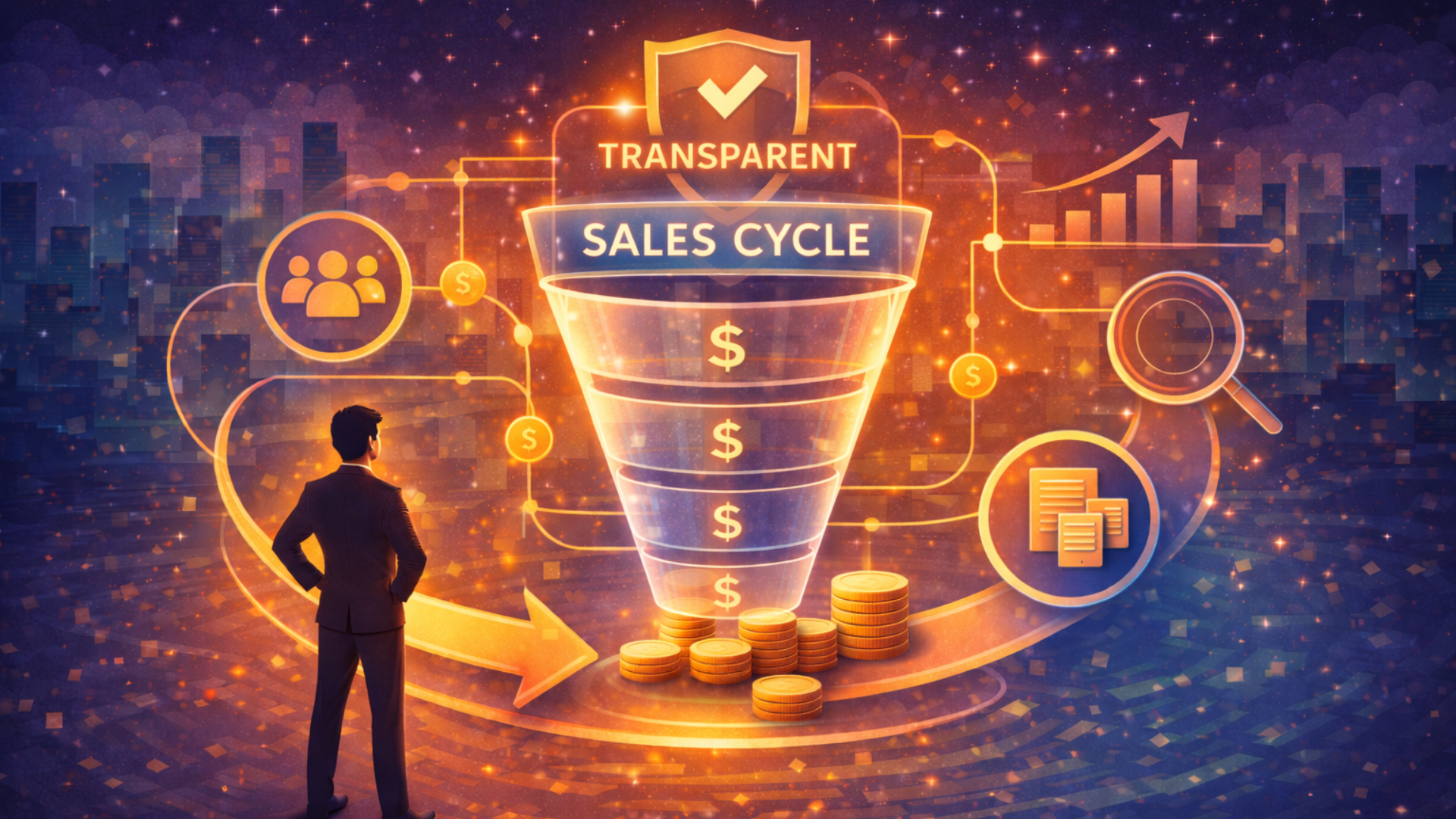
Honesty about sales cycle length is critical in commission-only partnerships.
Independent sales professionals — including freelance sales reps, 1099 sales contractors, and manufacturer’s reps — typically build portfolios that include a mix of short, medium, and long-cycle products and services.
Long sales cycles are not a problem in themselves — but misrepresenting them is.
Telling a sales agent that the average sales cycle is two weeks when it is realistically six months creates misaligned expectations and almost guarantees churn.
Transparency works in everyone’s favour. Being clear about how long it typically takes for a prospect to convert into a paying client attracts sales partners who are genuinely suited to nurturing those opportunities. It also saves time by filtering out agents whose experience, cashflow needs, or sales approach are not aligned with the role.
Honest sales cycle disclosure doesn’t reduce performance — it improves it by ensuring the right partners are engaged from the outset.
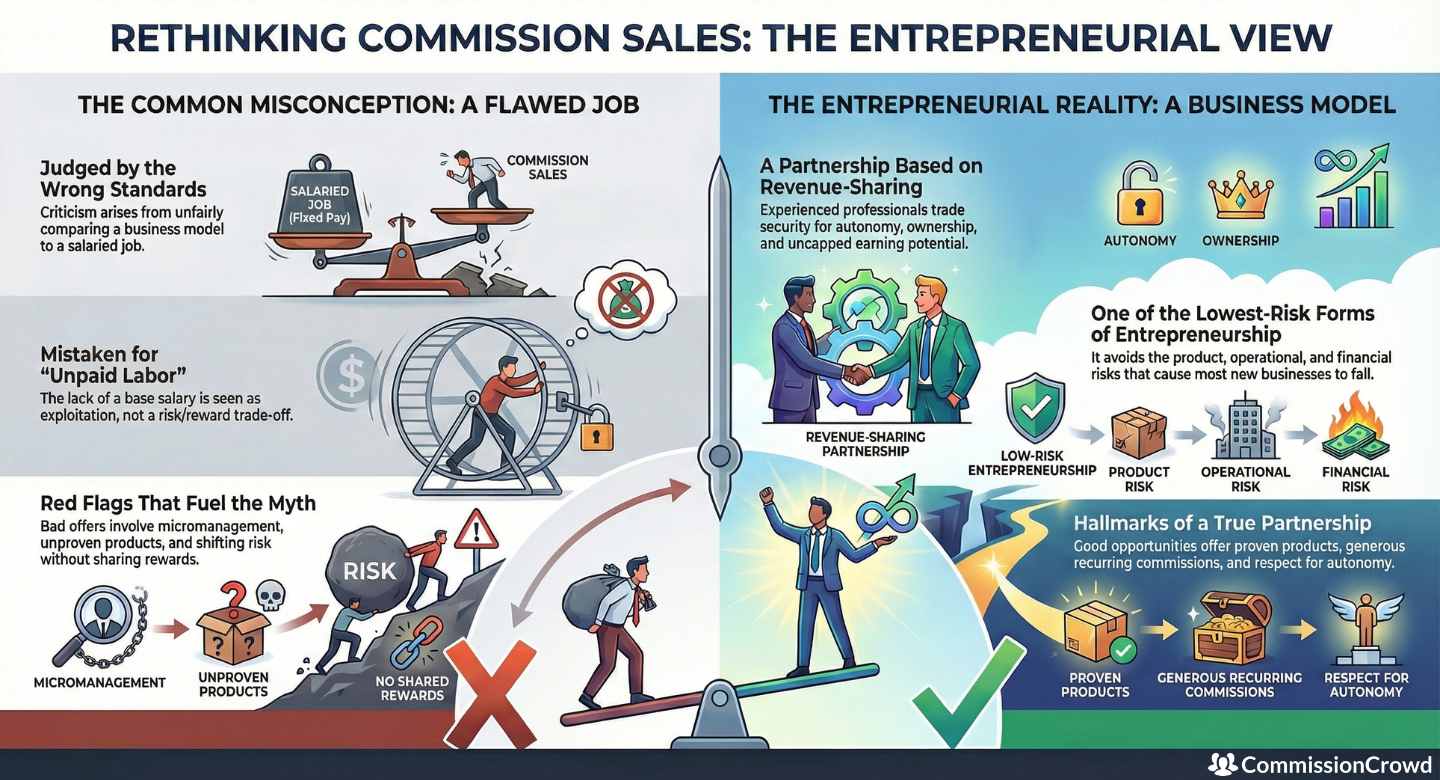
What an Unattractive Commission-Only Sales Opportunity Looks Like

The least attractive commission-only sales opportunities almost always come from companies that have never worked with independent sales agents before.
These companies often approach commission-only sales with the mistaken assumption that they can secure sales support at little or no real cost.
In most cases, this isn’t driven by bad intent — it’s driven by a lack of understanding.
When companies haven’t worked with commissioned sales professionals, freelance sales agents, 1099 sales contractors, or manufacturer’s reps before, they often underestimate what experienced sales agents bring to the table and what fair partnership actually looks like.
In our experience at CommissionCrowd, once these companies understand how independent sales reps operate, what they invest in prospecting and relationship-building, and what motivates long-term performance, they are typically very receptive to guidance. Many go on to restructure their offers and ultimately provide some of the most competitive commission rates in their industries.
Example of a Bad Sales Opportunity
Below is an example of a terrible commission-only sales opportunity.
Among other things, this company states that it is seeking full-time applicants, with expectations that the sales rep will work from the office and adhere to fixed working hours (8:30am–5pm, Monday to Friday).
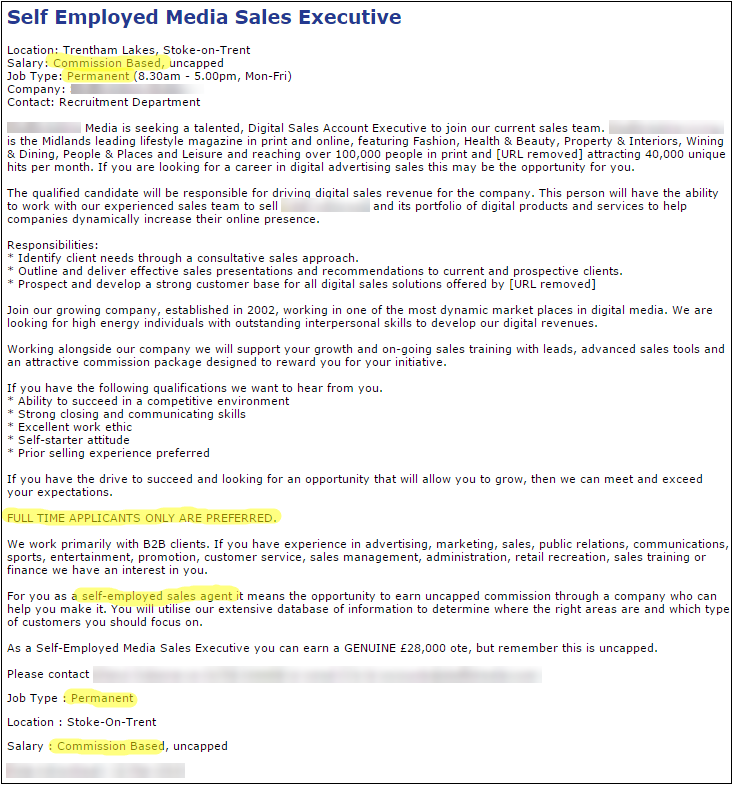
Whether intentional or not, this effectively positions the role as unpaid or heavily underpaid labour — while imposing the same constraints, controls, and obligations that typically apply to salaried employees.
In practice, this crosses a critical line: the company is treating a commission-only role as employment, without offering employment terms. In many jurisdictions, this type of arrangement also raises serious legal and compliance concerns.
Independent, self-employed sales professionals do not operate this way. They build and manage portfolios of multiple non-competing companies and are not looking for opportunities that resemble traditional employment — especially without a salary.
Opportunities structured like this are a major reason so many low-quality commission-only listings exist on generic job boards. They blur the line between partnership and employment, misunderstand how independent sales actually works, and ultimately repel the very sales professionals they hope to attract.
As a result, experienced sales agents tend to avoid broad job websites altogether, favouring platforms and networks like CommissionCrowd that vet and educate companies, prioritise properly structured, viable independent sales opportunities over generic listings from unsuitable companies.
Treating Self-Employed Sales Reps Like Employees

A major red flag is when companies expect commission-only reps to operate like employees while offering none of the protections or stability of employment.
This often includes:
- Expecting fixed working hours
- Mandatory meetings and reporting
- Micromanagement of sales activity
- Restricting the ability to represent other non-competing products in their sales portfolio
- Claiming ownership over relationships built by the sales rep
If a company wants this level of control, it is no longer a partnership — it is unpaid employment.
Not Respecting the Sales Rep’s Autonomy
Commission-only sales only works when genuine independence exists.
Independent sales agents, freelance sales agents, 1099 sales contractors, and manufacturer’s reps operate as business owners, not employees, and typically represent a diversified but complementary portfolio of products and services.
They will not — and should not — dedicate 100% of their time exclusively to a single opportunity.
Making up one part of a rep’s broader portfolio is often extremely beneficial to the company. Sales agents working across complementary solutions develop deeper insight into their clients’ needs, identify opportunities earlier, and create more value per relationship.
Shifting All Risk Without Sharing Upside
Another warning sign is when companies push excessive risk onto sales reps without offering meaningful upside.
Common issues include:
- Low commission rates for complex deals
- No residual income on repeat business
Lack of Product–Market Fit or Commercial Readiness
Commission-only sales fails fastest when companies expect sales agents to validate unproven ideas instead of scaling proven demand.
Common issues include:
- Expecting the rep to take a brand new product to market with no evidence of product–market fit
- No paying customers or poor retention
- An unclear value proposition
- Undefined buyer profile or pricing
Expecting sales professionals to discover product–market fit without equity, control, or fair compensation is not entrepreneurship — it’s risk dumping.
Where the Ethical Line Actually Is
The ethical question in commission-only sales is not whether a salary exists.
It’s whether:
- Autonomy is respected
- Risk and reward are aligned
- Expectations are transparent
- Sales professionals are treated as partners, not unpaid employees
When these conditions are met, commission-only sales is a legitimate entrepreneurial model.
When they are not, criticism is justified — but it should be directed at poor execution, not the model itself.
You'll also find this article incredibly useful when it comes time to onboard and train remote working Independent Sales Rep while respecting their autonomy.
Why Is Commission-Only Sales Criticised So Often?
Commission-only sales is frequently criticised because it is judged using the wrong framework.
Much of the negativity comes from outdated stereotypes rooted in low-quality B2C sales models — door-to-door selling, high-pressure tactics, and short-term transactional roles that bear little resemblance to modern, professional B2B commission-only sales.
Another source of criticism comes from viewing commission-only sales strictly through an employment lens. For individuals who have never considered entrepreneurship or self-employment, the absence of a salary feels unethical rather than optional.
In reality, commission-only sales — whether framed as freelance sales work, 1099 sales contracting, or manufacturer’s representation — is an opt-in, voluntary business model chosen by experienced professionals who value ownership, autonomy, and performance-based rewards.
Criticism is also reinforced by poorly structured commission-only offers — often from companies that have never worked with independent sales agents before and mistakenly treat commission-only sales as a way to secure free labour.
The Ethical Mistake Critics Are Actually Making
Many critics frame commission-only sales as unethical.
The real ethical mistake they make is this assumption:
risk must always be carried by the company and never by the individual.
That assumption does not exist in entrepreneurship.
Commission-only sales is:
- Voluntary
- Opt-in
- Chosen by experienced professionals
- One of many available career paths
Exploitation requires lack of choice.
Commission-only sales offers the opposite: agency.
A model that people freely choose — and actively prefer — cannot be exploitative by definition.
The Wrong Question People Keep Asking About Commission-Only Sales
The question is not:
“Is commission-only sales risky?”
The real question is:
“Compared to what?”
Compared to:
- Starting a traditional business
- Carrying payroll and operational risk
- Betting your income on a single employer
- Building a product from scratch
When framed correctly, the criticism collapses.
Final Thoughts: Commission-Only Sales Isn’t the Problem — Perspective Is
Commission-only sales is criticised because it is misunderstood.
Not because it is unethical.
Not because it is broken.
Not because it is reckless.
But because it is judged using the wrong framework.
Once you stop viewing commission-only sales as a job and start viewing it as a business, everything changes.
Sales, when approached entrepreneurially, becomes one of the most accessible, scalable, and low-risk paths to independence available.
It is not for everyone.
But for the right salespeople it is not a downgrade.
It is an upgrade.
How To Find The Best Commission-Only Sales Opportunities
Finding high-quality commission-only sales opportunities isn’t about scrolling generic job boards or responding to poorly defined listings. Experienced sales professionals know that the best opportunities are rarely advertised in traditional ways.
This is why specialist platforms like CommissionCrowd exist — not to defend commission-only sales, but to solve a discovery problem. As more experienced sales professionals choose independence, they need access to legitimate, well-structured, and commercially viable partnerships without relying on guesswork, cold outreach, or low-quality listings.
Commission-only sales didn’t emerge because platforms existed.
Platforms emerged because the model already worked — and needed better infrastructure.
CommissionCrowd provides that infrastructure by connecting independent sales professionals with vetted companies that understand partnership-based selling, offer transparent commission structures, and are genuinely prepared to work with self-employed sales reps.
For sales professionals who treat selling as a business, not a job, this dramatically reduces risk, saves time, and increases the likelihood of building a sustainable, long-term sales portfolio.
Frequently Asked Questions About Commission-Only Sales
Is commission-only sales unethical?
No. Commission-only sales is not unethical when it is entered into voluntarily and structured as a genuine partnership. It is a form of self-employment where sales professionals choose to take responsibility for revenue in exchange for independence, ownership, and uncapped earning potential. Ethical concerns arise only when companies misrepresent opportunities or attempt to control sales reps like employees without offering employment protections.
Why is commission-only sales criticised so often?
Commission-only sales (1099 sales in the US) is frequently criticised because it is looked upon through an employment lens rather than an entrepreneurial one. Many critics assume that good sales professionals should always expect a salary, and they fail to consider that experienced sales reps may deliberately choose self-employment. Outdated stereotypes from low-quality B2C sales roles also distort how modern B2B commission-only sales is perceived.
Is commission-only sales exploitative or unpaid labour?
No. Commission-only sales is revenue-sharing, not unpaid labour. Sales professionals are compensated directly for the revenue they generate, often with recurring or residual commissions. Exploitation requires a lack of choice — commission-only sales is an opt-in model chosen by experienced professionals who prefer autonomy over employment.
Who should not work in commission-only sales?
Commission-only sales is not suitable for individuals who require guaranteed income, lack sales experience, or are unwilling to take ownership of outcomes. It is also a poor fit for those who want employee-level structure, management, or security without being employed. Like any form of entrepreneurship, it rewards accountability and long-term thinking.
How are commission-only and 1099 sales different from salaried sales jobs?
Salaried sales roles prioritise income stability and predictability, while commission-only 1099 sales prioritises independence, ownership, and performance-based upside. Salaried employees trade autonomy for security; commission-only sales professionals trade guaranteed pay for control over their income, partnerships, and business structure. Neither is inherently better — they suit different personalities and career goals.
Can commission-only sales provide long-term stability?
Yes. Stability in commission-only sales comes from structure, not salary. Experienced independent sales professionals build diversified portfolios, focus on recurring or residual commissions, and develop long-term client relationships. Over time, this creates predictable, compounding income that is often more resilient than relying on a single employer.

More articles from CommissionCrowd
World-Class Software Engineering Sales Opportunity - 35% Commission + Residuals
World-Class Software Engineering Sales Opportunity - 35% Commission + Residuals
Why You'll Never Find Great Self-Employed Sales Professionals on Gumtree or
Why You'll Never Find Great Self-Employed Sales Professionals on Gumtree or Generic Job Websites