
How to Choose the Right Companies to Represent as an Independent Sales Rep
Finding companies willing to work with independent sales professionals isn't necessarily the difficult part. The much more important decision is determining which of those companies actually deserve your time, reputation and access to customer relationships that may have taken years to develop.
Whether you're an independent sales representative, self-employed sales agent, Manufacturer's Rep or another type of commission-based B2B sales professional, every company you agree to represent becomes part of the business you're building.
Their products and services become associated with you in the eyes of your customers, their commercial terms influence your earning potential and the time you invest in developing their opportunities is time you can't invest somewhere else.
This means the evaluation needs to work in both directions. A prospective principal may be deciding whether you're the right sales professional to represent them, but you should be making an equally important decision about whether they're the right company for you.
The strongest independent sales professionals therefore approach new commission-based opportunities less like job applicants and more like business owners allocating valuable commercial resources.
The question isn't simply "Can I sell this?" It's "Does representing this company make my own business stronger?"
Start With the Market You Already Know
One of the first things to consider is how closely the opportunity fits the market, customers and relationships you've already developed.
Imagine you're offered two opportunities.
The first pays 25% commission but targets an industry where you have limited experience, few relevant contacts and little understanding of the buying process.
The second pays 10% but sells into a market where you've spent fifteen years developing relationships, understand the competitive landscape and already know many of the people involved in purchasing decisions.
The higher percentage doesn't automatically make the first opportunity more attractive.
Your existing market knowledge can shorten the distance between taking on a new principal and creating meaningful sales opportunities. You may already understand which customers are likely to have a need, who needs to be involved in the conversation, what objections are likely to arise and how purchasing decisions are typically made.
This is commercial leverage that someone entering the market from scratch doesn't possess.
Before agreeing to represent a company, consider how naturally its proposition fits the commercial infrastructure you've already built.
Customer Overlap Creates Commercial Leverage
A strong opportunity doesn't necessarily need to sell to exactly the same people as every other company you represent, but customer overlap can make an enormous difference to the economics of your portfolio.
A manufacturers' rep selling industrial equipment into food production facilities, for example, might also be well positioned to represent monitoring technology, maintenance services, safety solutions or specialist software used by the same organisations.
The propositions are different, but much of the underlying market knowledge and customer access can be shared.
Contrast that with adding a company selling an unrelated service into an industry you've never worked in. You may need to learn a new market, identify completely different prospects and establish credibility with another group of decision-makers before you can create meaningful opportunities.
That doesn't automatically make it a bad company to represent, but it increases the commercial investment required from you and should form part of your decision.
Determine Whether Customers Actually Want the Product or Service
Commission only matters when business is generated.
Before becoming excited about the earning potential, understand whether the company has a proposition customers genuinely want to buy.
This requires more than deciding whether you personally like the product or service. Try to understand the commercial problem it solves, how important that problem is to the target customer and why someone would choose this particular company rather than an established competitor or alternative solution.
Ask about existing customers and sales performance where appropriate. Look at case studies, testimonials and evidence that the proposition is already creating value. Understand the pricing and how it compares with alternatives. Find out what objections the company commonly encounters and why previous customers ultimately decided to buy.
You should also consider what happens after the sale. A strong sales proposition can still become problematic if the principal regularly struggles with fulfilment, implementation, customer service or delivering what its salespeople have promised.
Independent sales professionals put their own credibility in front of customers. If you introduce a company into a relationship you've spent ten years developing and that company subsequently provides a poor experience, the damage isn't necessarily confined to the principal's reputation.
It can affect yours as well.
A high commission rate has little value if customers don't want the proposition or you wouldn't feel comfortable introducing the company to one of your best customers. In addition, you really shouldn't be testing the market for a new product or service that's largely unproven.
Calculate the Real Commission Earning Potential
Commission percentage is one of the most visible parts of an independent sales opportunity, which makes it easy to give it more importance than it deserves.
Consider two opportunities.
Opportunity A
- Average sale: £2,000
- Commission: 30%
- Commission per sale: £600
Opportunity B
- Average sale: £50,000
- Commission: 10%
- Commission per sale: £5,000
Looking only at commission percentage, Opportunity A appears substantially more generous. Looking at the actual commission generated from a successful transaction gives a very different picture.
But even that comparison is incomplete.
If Opportunity A can realistically close several times per month while Opportunity B has a twelve-month enterprise sales cycle, the economics change again.
An independent sales agent should therefore consider the relationship between average deal value, commission rate, realistic sales frequency and the amount of time required to generate the business.
You also need to consider how realistic the opportunity is within your particular market. A theoretical £20,000 commission means relatively little if the probability of closing the underlying transaction is extremely low.
The useful question isn't simply:
"What percentage commission do they pay?"
It's:
"What could this opportunity realistically generate relative to the time and commercial effort I need to invest?"
Look Beyond the First Transaction
The initial commission is only one part of the potential economics.
Some customers purchase once. Others reorder regularly, renew contracts, expand accounts or continue paying subscription and service fees for several years.
If your agreement provides commission entitlement on that ongoing revenue, the lifetime value of winning a customer can become considerably greater than the commission generated from the original sale.
A £2,000 initial commission that continues producing residual income for several years may ultimately be more valuable than a larger one-off payment. Equally, a substantial one-off commission on an excellent product may be considerably more attractive than a recurring opportunity with weak customer demand.
The point isn't that recurring commission is always better. It's that you need to understand the whole economic relationship rather than comparing opportunities on headline percentages.
CommissionCrowd has a separate guide explaining residual commissions for independent sales reps if you want to explore this part of the model in greater detail.
Understand the Complete Sales-to-Commission Timeline
The length of the sales cycle matters, but there is another consideration that is sometimes overlooked: closing the sale and receiving your commission are not necessarily the same event.
Suppose you're representing a complex B2B solution with a six-month sales cycle. You successfully close the customer, but the principal invoices on 60-day payment terms and your agreement states that commission becomes payable only after the company receives the customer's payment.
Your effective journey to commission could therefore look more like:
Start selling → develop opportunity → close business → customer is invoiced → customer pays principal → commission becomes payable → commission is paid
That timeline can be substantially longer than the advertised sales cycle.
Before committing significant time to a new opportunity, understand what event actually creates your commission entitlement.
- Is commission earned when the customer signs the contract, when the company raises an invoice or when the customer pays?
- How quickly do customers typically pay?
- What happens if payment is made in stages?
- When does the principal actually pay sales commissions after receiving customer funds?
- How are cancellations, refunds or non-payment handled?
For large or complex transactions, these details can have a significant effect on cash flow and should be understood before you begin developing business.
Evaluate the Company as Carefully as the Product
A strong product doesn't automatically mean you've found a strong principal.
When you represent another business independently, you're relying on that company to fulfil its side of the commercial relationship. That includes delivering what you've sold, supporting customers appropriately, communicating with you when opportunities develop and paying commissions according to the agreement.
Spend some time understanding the company behind the proposition.
Who runs it? How long has it been operating? Does it have credible customers? What does its reputation look like? How responsive has the team been during your conversations? Can it demonstrate that it is capable of delivering the product or service at the level you're being asked to sell it?
Pay attention to how the company treats you during the evaluation process as well.
If obtaining basic information is already difficult, important questions remain unanswered or communication repeatedly disappears for weeks at a time before you've even started working together, consider what that might look like when you have a significant customer opportunity requiring an urgent response.
A good product attached to a badly run principal can still become a poor sales opportunity.
Find Out What Sales Support You'll Actually Receive
Being independent doesn't mean being unsupported.
A professional independent sales representative is responsible for generating and developing business, but the principal still needs to provide the information, resources and expertise required to represent its proposition effectively.
What that looks like will depend on what you're selling.
A manufacturers' rep may need product training, technical specifications, samples and access to engineering expertise. A self-employed software sales professional might need demonstrations, implementation information, case studies and access to technical specialists. Someone representing professional services may need detailed information about delivery capabilities, previous client outcomes and proposal support.
Useful support can include:
- Product or service training
- Sales collateral
- Demonstrations
- Case studies
- Pricing information
- Proposal assistance
- Technical expertise
- Fast answers when customers raise questions
The important question is whether the company will enable you to represent it professionally.
An independent rep shouldn't expect the infrastructure of an employed sales team to be recreated around them, but neither should a principal expect an experienced sales professional to create results without providing the information and support required to sell effectively.
Examine the Commercial Terms Before Committing
Commercial enthusiasm at the beginning of a relationship shouldn't replace clarity about how the relationship actually works.
Before investing significant time or introducing customers, make sure the important terms are understood and documented.
This includes:
- Commission rate and how it is calculated
- What triggers commission entitlement
- When commissions are paid
- Repeat orders and renewals
- Residual or recurring commission
- Territory or account protection
- Existing house accounts
- Lead and opportunity ownership
- Exclusivity
- Competing products or services
- Responsibilities of both parties
- Termination
- Commission on business already generated if the relationship ends
The appropriate agreement will depend on the nature of the relationship and jurisdiction, but ambiguity tends to become considerably more expensive once meaningful business has been generated.
We've covered these considerations in greater depth in our guide to independent sales rep contracts.
Decide Whether the Company Strengthens Your Existing Portfolio
An opportunity can look attractive in isolation and still be a poor addition to your wider business.
Before adding another principal, look at how it interacts with the companies you already represent.
- Does it solve another problem for customers you already know?
- Does it give you another relevant reason to speak with those customers?
- Does it complement your existing products and services?
- Does it create an unnecessary conflict?
- Could two principals end up competing for the same customer requirement or budget?
- Does the new opportunity improve the balance of your income?
- Does it leave you with another lengthy sales cycle requiring substantial investment before any commission is likely to be generated?
This is why portfolio construction should be deliberate.
A self-employed sales agent representing three complementary companies within a market they understand can potentially have considerably more commercial leverage than someone representing ten unrelated companies across completely different industries.
The objective isn't to build the largest possible portfolio. It's to build one in which each carefully selected principal strengthens the commercial business around it.
Watch for Warning Signs Before You Say Yes
Not every concern means you should immediately reject an opportunity, but certain signals deserve further investigation before you commit your time or customer relationships.
Be cautious when nobody at the company can clearly explain who the target customer is or why customers buy the proposition. Likewise, extremely ambitious sales expectations combined with little evidence of existing customer demand should prompt further questions.
Commercial terms that remain vague after repeated discussions are another concern. You should be able to understand how commission is calculated, when it becomes payable and what happens to customers and opportunities you've introduced.
Be particularly careful where a company is reluctant to put important commercial terms in writing.
Communication can also tell you a great deal. A principal that is consistently difficult to reach before the relationship has begun may not become easier to work with once you're representing them.
Other areas worth examining include frequent changes to commission structures, unrealistic expectations about how quickly a new market can produce sales, poor support, inadequate fulfilment capability and arrangements where the company expects the control associated with an employee relationship while offering only the economics of independent representation.
None of these factors necessarily proves that a company is unsuitable. They are reasons to investigate further before making a commercial commitment.
Use a Principal Evaluation Scorecard
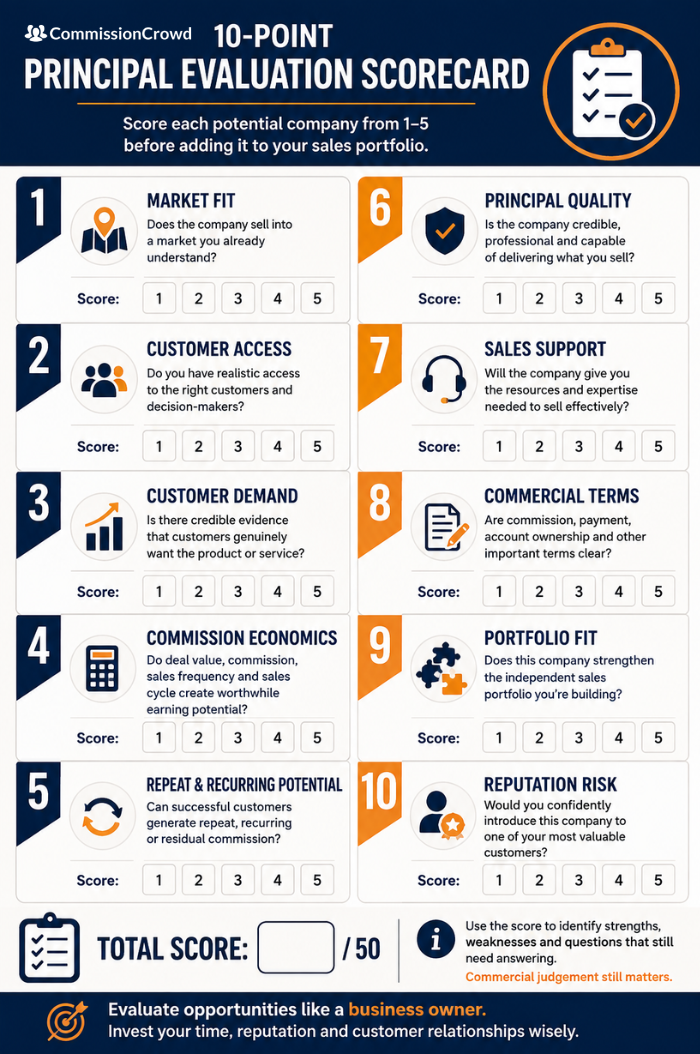
When you're comparing several companies to represent, use the following framework to score each opportunity from 1 to 5 across ten important commercial factors.
The purpose isn't to produce an automatic pass or fail result. It's to expose where an opportunity is particularly strong, where it is weak and which questions still need answering before you commit your time, reputation and customer relationships.
1. Market Fit
Score: 1–5
Consider:
- Do I already understand this industry or market?
- Do I understand how these customers buy?
- Do I know the competitive landscape?
- Can I identify realistic prospects without having to learn an entirely new market?
Higher score: The company sells into a market where you already have substantial knowledge, experience and credibility.
Lower score: You would need to develop significant new market knowledge before gaining meaningful commercial leverage.
2. Customer and Decision-Maker Access
Score: 1–5
Consider:
- Do I already have relationships with relevant customers?
- Do those relationships extend to the people involved in purchasing decisions?
- Can I realistically open conversations within my existing commercial network?
- Would I need to build an entirely new prospect base?
Higher score: You already have meaningful access to relevant customers and decision-makers.
Lower score: Most customer relationships would need to be developed from scratch.
3. Customer Demand
Score: 1–5
Consider:
- Does the product or service solve a genuine commercial problem?
- Is there evidence that customers are already buying it?
- Does the company have credible customers, case studies or repeat business?
- Is the proposition competitive against the alternatives available?
Higher score: There is strong evidence of genuine customer demand and a credible reason for customers to buy.
Lower score: Demand is largely theoretical or the company struggles to demonstrate why customers choose its proposition.
4. Commission and Earning Potential
Score: 1–5
Consider:
- What is the average deal value?
- What commission will I realistically earn from a successful sale?
- How frequently could deals reasonably close?
- How long is the typical sales cycle?
- Is the potential income proportionate to the time and effort required?
Higher score: Deal values, commission, realistic sales frequency and sales cycle combine to create commercially attractive earning potential.
Lower score: The headline commission may look attractive, but the realistic return relative to the work required is weak.
5. Repeat, Recurring or Residual Commission Potential
Score: 1–5
Consider:
- Do customers make repeat purchases?
- Are there renewals, subscriptions or ongoing contracts?
- Can accounts expand after the initial sale?
- Will I continue earning commission from future customer revenue?
- How long does any recurring or residual commission entitlement continue?
Higher score: Successful customer relationships have meaningful potential to generate additional commission over time.
Lower score: Each transaction produces a one-off commission with little opportunity for repeat or ongoing income.
A low score here doesn't automatically make an opportunity unattractive. A substantial one-off commission can still be extremely valuable if the wider economics are strong.
6. Principal Quality and Credibility
Score: 1–5
Consider:
- Is this a company I would feel confident representing?
- Does it have credible leadership and customers?
- Can it reliably deliver what I'm being asked to sell?
- Has communication been professional and responsive?
- Would I be comfortable associating my own reputation with the business?
Higher score: The principal appears credible, professional, responsive and capable of delivering a strong customer experience.
Lower score: There are unanswered questions around credibility, communication, fulfilment or the company's ability to support customers properly.
7. Sales Support
Score: 1–5
Consider:
- Will I receive appropriate product or service training?
- Are useful sales materials and case studies available?
- Can I access technical or specialist support when required?
- Will the company assist with demonstrations, proposals or complex customer questions?
- Can I get answers quickly when an opportunity is developing?
Higher score: The principal provides the resources and expertise required for you to represent the proposition professionally.
Lower score: You're largely expected to create everything yourself with limited access to information or support.
8. Commission and Commercial Terms
Score: 1–5
Consider:
- Is the commission calculation completely clear?
- Do I understand exactly when commission becomes payable?
- Are repeat orders and renewals addressed?
- Are territory, account and opportunity ownership clearly defined where relevant?
- Do I understand what happens to commission if the relationship ends?
- Are the important terms documented in writing?
Higher score: The commercial relationship is transparent, clearly documented and commercially reasonable.
Lower score: Important areas remain vague, undocumented or open to conflicting interpretations.
9. Independent Sales Portfolio Fit
Score: 1–5
Consider:
- Does this company complement the products and services I already represent?
- Can I introduce it naturally into existing customer relationships?
- Does it create another useful reason to engage my market?
- Does it conflict with another principal?
- Does it improve the overall income mix and commercial strength of my portfolio?
Higher score: The company strengthens the wider independent sales portfolio you're building.
Lower score: The opportunity operates largely in isolation and requires separate markets, customers or sales activity without creating much wider leverage.
10. Customer Relationship and Reputation Risk
Score: 1–5
Finally, ask yourself one particularly important question:
Would I confidently introduce this company to one of my most valuable customers?
Consider whether you trust the quality of the proposition, the people behind the company, its ability to deliver and the customer experience likely to follow your introduction.
Higher score: You would confidently put your reputation behind the company.
Lower score: You would hesitate to introduce the principal to a customer relationship you've spent years developing.
That hesitation deserves serious attention. Your customer relationships may ultimately be worth considerably more to your independent sales business than the commission available from one opportunity.
How to Interpret Your Principal Evaluation Score
Adding the ten scores gives you a maximum possible score of 50, but don't treat the final number as an automatic decision about whether you should represent a company.
Two opportunities receiving exactly the same overall score could have completely different strengths and weaknesses.
A complex enterprise technology opportunity might score lower for sales-cycle economics but exceptionally well for market fit, customer access and potential commission per deal. A frequently purchased product might offer smaller individual commissions but score extremely well for customer overlap, repeat business and speed to revenue.
Pay particular attention to where an opportunity scores poorly and why.
A low score may reveal a question that needs answering rather than a reason to reject the company. If everything looks strong except the commercial terms, for example, you know what needs to be resolved before you proceed.
The framework is there to make your commercial judgement more systematic, not replace it.
The Best Company Isn't Necessarily the One Paying the Highest Commission
The strongest company to represent is rarely determined by one number.
A worthwhile independent sales opportunity usually comes from the interaction between several factors: a market you can realistically access, customers with a genuine reason to buy, commercially worthwhile earning potential, a credible principal, appropriate sales support, clear terms and a proposition that strengthens the portfolio you're building.
Different opportunities can contribute in different ways. One company may provide frequent repeat business, another recurring commission and another occasional high-value transactions. What matters is whether the economics make sense for your business and whether you're comfortable investing your commercial assets behind the principal.
That is ultimately the mindset shift that separates simply accepting commission opportunities from deliberately building an independent sales business.
Choosing the right companies to represent is only one part of that process. Our complete guide to starting and building a successful independent sales rep business covers the wider model, including becoming independent, finding companies to represent, portfolio construction, recurring commission, customer relationships and developing the business over time.
If you're an experienced B2B sales professional looking for new products and services to represent, you can also join CommissionCrowd as an independent sales agent and connect with companies actively looking to develop partnerships with independent sales professionals.

More articles from CommissionCrowd
World-Class Software Engineering Sales Opportunity - 35% Commission + Residuals
World-Class Software Engineering Sales Opportunity - 35% Commission + Residuals
Why You'll Never Find Great Self-Employed Sales Professionals on Gumtree or
Why You'll Never Find Great Self-Employed Sales Professionals on Gumtree or Generic Job Websites