
How to Start and Build a Successful Independent Sales Rep Business

If you’re an experienced salesperson, there’s a good chance you’ve spent years building something far more valuable than your CV suggests.
You’ve developed industry knowledge. You understand how particular markets buy. You know the decision-makers, distributors, resellers, procurement teams or business owners within those markets. You’ve built relationships and, importantly, you know how to turn those relationships into revenue.
In a traditional sales career, most of that commercial value is continually put to work for one employer at a time.
Independent sales works differently.
Instead of selling exclusively for a single company, an independent sales representative builds their own sales business around the expertise, relationships and markets they already know. They partner with companies whose products or services fit those markets, represent one or more complementary sales lines and earn commission from the business they generate.
For the right salesperson, that creates the opportunity to move away from simply progressing through salaried sales roles and begin building a commercial asset of their own.
But becoming independent isn't simply a matter of searching for commission-only sales opportunities or finding companies looking for sales reps and seeing what sells. The strongest independent sales businesses are built deliberately. They focus on the right markets, carefully selected companies, complementary products and services, strong customer relationships and commission structures capable of generating meaningful long-term income.
In this guide, we'll explain how to become an independent sales representative, how to start your own independent sales business, how to find companies to represent, how to evaluate commission-only sales opportunities and how to build a portfolio of complementary companies that becomes more valuable over time.
What Is an Independent Sales Representative?
An independent sales representative is a self-employed sales professional who partners with one or more companies to sell their products or services without becoming an employee of those companies.
Depending on the industry and country, you may hear terms such as independent sales rep, independent sales agent, commission-only sales representative, 1099 sales representative, manufacturers' representative, manufacturer's rep, freelance sales representative or independent sales contractor. There are differences between some of these models, terminology and legal classifications, particularly between countries and industries, but they can all involve sales professionals generating business for companies without working as conventional salaried sales employees.
You operate independently.
Rather than receiving a salary from an employer, you typically earn commission on the business you generate for the companies you represent. You decide which companies you want to work with, which products or services make sense for your market and how you develop your portfolio over time.
That distinction is important because successful independent sales representatives shouldn't think of themselves simply as salespeople without a salary.
You're building your own sales business.
The companies you represent become your principals or sales partners. Their products and services become part of your portfolio. Your market knowledge, reputation and customer relationships become the commercial infrastructure through which you create value.
This is also why established independent sales professionals often represent several companies rather than relying entirely on one.
If the companies are complementary, the same customer relationships can create opportunities across multiple sales lines. A conversation that begins around one product may uncover a need for another. One established account can potentially generate commission from several principals.
Over time, that changes the economics of selling.
Instead of continually rebuilding a pipeline around whichever company happens to employ you, you're building a network of customer relationships and commercial partnerships that can continue producing opportunities across your portfolio.
For experienced salespeople considering making the move from employment to self-employment, we've also created a detailed guide to transitioning into commission-only sales, including the practical and financial considerations involved in starting an independent sales business.
How Does an Independent Sales Business Work?
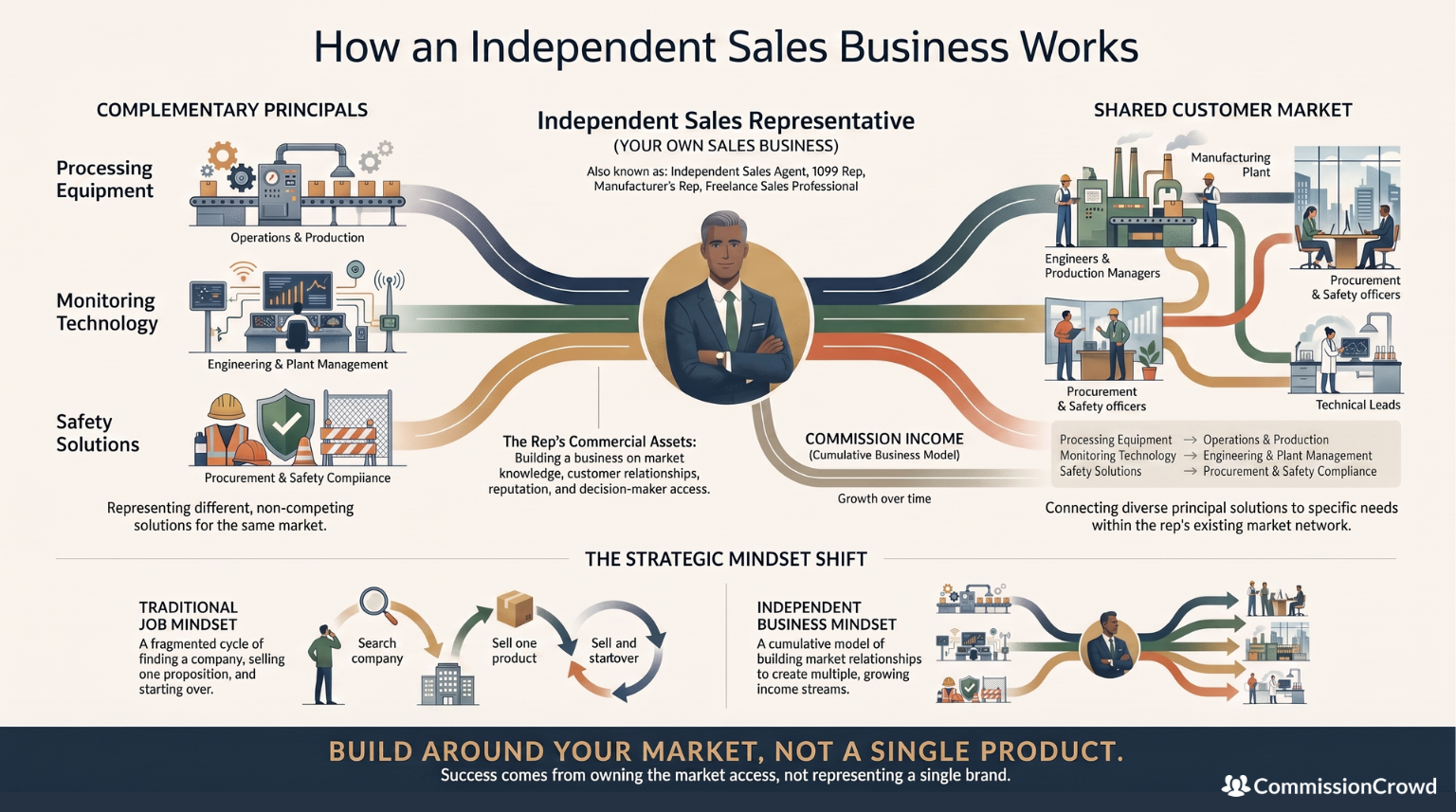
At its simplest, an independent sales business connects companies that need access to a market with sales professionals who already understand and operate within that market.
A company may have an excellent product or service but lack established sales coverage in a particular industry, territory or customer segment. Instead of employing another salesperson and building those relationships from scratch, the company can partner with an independent representative who already has relevant market knowledge and relationships.
The representative introduces, develops and closes appropriate opportunities and earns an agreed commission from the resulting business.
The exact role can vary considerably between partnerships. Some independent reps manage the complete sales cycle, while others specialise in introductions, opening doors, developing opportunities or working alongside the principal's internal sales team. What makes the relationship independent is that the sales professional operates their own business and is compensated according to the commercial arrangement agreed with the principal.
But the model becomes considerably more powerful when you stop thinking about it as a series of isolated sales jobs.
Imagine you've spent ten years selling into food manufacturers. You know operations directors, engineering teams, procurement departments and plant managers. You understand their buying processes, budgets and operational problems.
One principal might provide processing equipment. Another sells monitoring technology. Another offers specialist maintenance services. Another provides safety equipment.
Those companies don't necessarily compete. They solve different problems for many of the same customers.
That means the commercial asset at the centre of your business isn't any individual product.
It's your access to and understanding of the market.
A well-built independent sales business therefore looks less like:
Find company → sell product → find another sales job
and more like:
Choose market → build relationships → identify customer needs → represent complementary companies → create multiple revenue streams from the same commercial network.
This distinction will become important throughout this guide.
How to Start Your Own Independent Sales Business
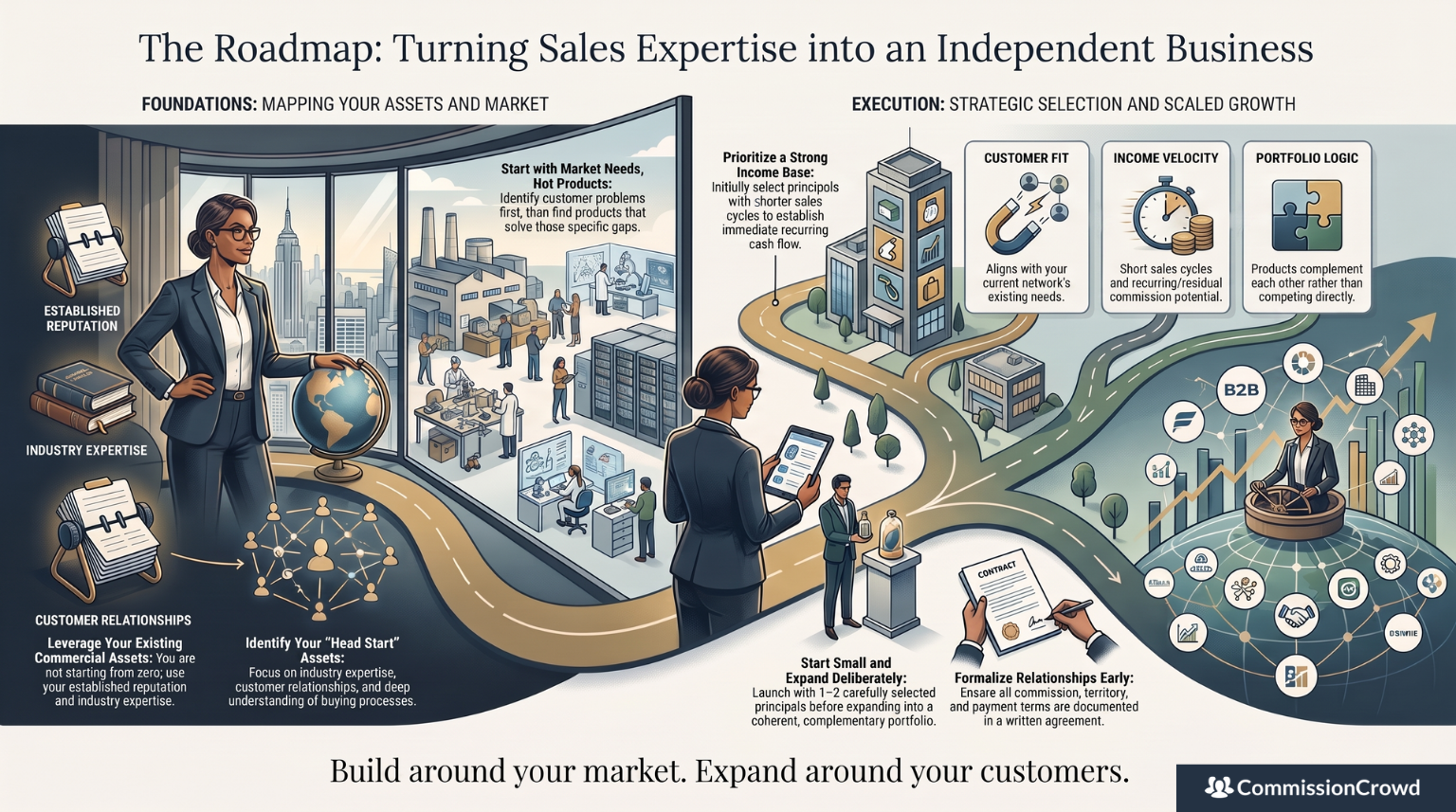
Starting an independent sales business does not necessarily mean starting from zero.
For an experienced salesperson, much of the infrastructure may already exist. Your industry expertise, professional reputation, customer relationships, understanding of buying processes and ability to generate business have often been developed over many years.
The objective is to turn those assets into an independent business.
A practical way to approach it is:
- Choose the market you know best. Start with industries, customer types and territories where you already understand how business gets done.
- Map the relationships and commercial knowledge you already have. Consider who you know, which decision-makers you understand and where your reputation is strongest.
- Identify the problems those customers regularly need solved. This gives you a much better basis for selecting products and services than simply chasing whatever offers the highest commission.
- Determine which types of companies would complement your market. Look for products and services that fit naturally into the customer relationships you already possess.
- Find companies actively looking for independent sales representation. These can come through your network, direct outreach, industry events, referrals, trade organisations and specialist independent sales platforms.
- Evaluate each opportunity carefully. Product or service quality, company credibility, customer demand, commission structure, sales support, deal value, sales cycle, repeat business, recurring or residual commission and customer fit all matter.
- Think about how quickly your first principals could generate income. When you're starting out, consider including products or services with relatively short sales cycles, frequent repeat purchases or recurring commission. Establishing a more regular base of income can put you in a stronger position to add larger, longer-cycle opportunities later.
- Agree the commercial relationship in writing. Commission entitlement, when commission becomes payable, recurring or residual commission, responsibilities, territory, account ownership and termination provisions should be clear before significant selling activity begins.
- Start with a manageable portfolio. You don't need five or ten companies on day one. One or two carefully selected principals that fit a market you already understand can provide a much stronger starting point than collecting large numbers of unrelated sales opportunities.
- Expand deliberately around your customers. As you develop business, pay attention to the other problems your customers need solved and add complementary products and services when they strengthen the portfolio you've already built.
This last point is particularly important.
One of the easiest mistakes when becoming an independent sales representative is to begin with the question:
"What can I find to sell?"
A better question is:
"What market can I build my business around, and what should I represent within it?"
That change in thinking is what begins to turn independent selling from a collection of commission-only opportunities into an actual business.
Setting Up the Business Side of Independent Sales
Building an independent sales business isn't only about finding companies to represent and developing a strong portfolio. Once you begin operating independently, you also need to think about the practical structure behind the business, including registration, taxation, record keeping, banking, insurance and how you'll manage your commercial relationships.
The exact requirements depend heavily on where you live and operate. An independent sales professional in the United States may have different business structures and tax obligations from someone in the UK, Canada, Spain, Germany or Australia, so there is no single structure that CommissionCrowd would recommend for every sales professional.
There are, however, several practical areas that almost everyone considering self-employment should investigate.
The information below is intended as general guidance only and isn't legal, tax or accounting advice. Requirements vary by jurisdiction and individual circumstances, so always check the current rules with the relevant authorities and seek qualified professional advice where appropriate.
Choose an Appropriate Business Structure
Depending on your country, you may be able to operate in your own name as a self-employed individual or sole trader, establish a limited liability company or corporation, form a partnership or use another recognised business structure.
The right choice can affect taxation, personal liability, administration, reporting requirements and how you enter into agreements with the companies you represent.
Don't assume that forming a company is automatically better than operating as an individual, or vice versa. The most appropriate structure depends on your circumstances, jurisdiction and the type of business you intend to build.
Register the Business Where Required
Once you've decided how you'll operate, establish which registrations are required before or after you begin trading.
Depending on your location, this could involve registering as self-employed, registering a business or company, obtaining tax identification numbers, registering a trading name or applying for licences or permits relevant to your activities.
If your independent sales business involves cross-border activity, overseas principals or commission payments from other countries, it is also worth checking whether this creates additional tax, reporting or other compliance considerations in your circumstances.
Understand Your Tax and Reporting Responsibilities
Independent sales professionals are generally responsible for managing their own tax affairs rather than having an employer handle applicable deductions and reporting through payroll.
Depending on your country, business structure and activities, your obligations could involve income or corporation tax, self-employment or social security contributions, estimated or advance tax payments, VAT, GST or other taxes. Which of these apply, and when registration or payment is required, depends on your jurisdiction and circumstances.
Keep proper records of commission income, business expenses, invoices and payments from the beginning rather than trying to reconstruct them when a filing deadline arrives.
Separate and Manage Your Business Finances
Depending on your business structure and local requirements, you may need a separate business bank account. Even where it isn't legally required, separating business and personal finances can make it considerably easier to understand your cash flow, track commissions and expenses and maintain accurate records.
Independent sales income can also be less predictable than a conventional monthly salary, particularly during the early stages of building your portfolio. Good financial management therefore becomes part of running the business rather than simply an administrative task.
Decide How You'll Track Commissions and Invoices
If you represent several principals, you may eventually have commissions being generated across different customers, currencies, payment schedules and commercial agreements.
Develop a reliable system for recording which opportunities you've generated, when commission becomes payable, what has been invoiced and what has actually been paid. You can easily do this using CommissionCrowd's in-built commission payment functionality.
This becomes particularly important where agreements include repeat orders, subscriptions, renewals or residual commissions that may continue for months or years after the original customer was introduced.
Consider Appropriate Business Insurance
Depending on your activities, jurisdiction, customers and the products or services you represent, you may need or choose to obtain appropriate business or professional insurance.
The requirements can vary considerably, so this is another area where local professional advice may be appropriate rather than assuming that the insurance arrangements of another independent sales professional will necessarily apply to you.
Get Professional Advice When You Need It
A good accountant or tax adviser can be particularly valuable when you're moving from employment into self-employment.
Look for someone who regularly works with self-employed professionals or small businesses and understands the type of income you're likely to generate. If you'll be representing principals internationally, receiving commissions from several countries or dealing with multiple currencies, experience with cross-border business can also be useful.
The objective isn't to outsource every business decision. It's to make sure the structure you're building is appropriate for your circumstances and that you understand the legal, tax and reporting responsibilities that come with it.
Official Business Setup Resources
Because CommissionCrowd is a global platform, we can't provide country-specific business, legal or tax guidance for every jurisdiction. The following official resources provide useful starting points in some of the markets where independent sales is well established.
United States
The U.S. Small Business Administration's guide to launching a business covers areas such as choosing a business structure, registering a business, obtaining tax IDs, licences and permits, opening a business bank account and considering business insurance.
The SBA also provides dedicated guidance on choosing a business structure, including sole proprietorships, partnerships, LLCs and corporations. Business structures and registration requirements can vary by state, so check the requirements that apply where you're establishing your business.
For federal tax information, the IRS Self-Employed Individuals Tax Center provides official information for people who are self-employed, including federal tax obligations and estimated tax payments.
United Kingdom
GOV.UK's Set up a business guidance explains the main business structures and provides official information on starting a business in the UK.
If you intend to operate as a sole trader, GOV.UK provides a guide to setting up as a sole trader, covering registration, record keeping and tax responsibilities.
If you're considering a limited company, use the official step-by-step guide to setting up a limited company, which covers areas such as directors, shareholders, company records and registration.
European Union
Business structures, registration requirements, taxation and social security rules vary between EU member states, so there isn't a single EU-wide process for becoming self-employed.
The European Union's official Your Europe guide to starting a business provides information on starting and registering businesses within the EU and directs entrepreneurs towards relevant national requirements and support.
Its startup and business registration resources also provide access to information relating to individual EU countries.
Canada
The Government of Canada's Starting a business resource provides official guidance on areas such as planning a business, choosing a business structure, registration, permits, licences and taxation.
The Canada Revenue Agency also provides guidance on setting up your business, including information relating to sole proprietorships, partnerships and corporations.
For tax information, the CRA's small business and self-employed income guidance includes resources for self-employed individuals, including those earning commission income.
If You're Based Elsewhere
If your country isn't listed above, start with the official website of your national government, business-registration authority and tax authority rather than relying solely on general online advice.
Look specifically for official guidance covering:
- Self-employment or business registration
- Available business structures
- Income and business taxation
- Social security or equivalent contributions
- VAT, GST or other indirect taxes where applicable
- Business record-keeping requirements
- Licences or permits relevant to your activities
- Any insurance requirements relevant to your business activities
You may also want to speak with a qualified accountant, tax adviser or business adviser familiar with self-employment in your jurisdiction, particularly if you'll be representing companies or receiving commission payments internationally.
Setting up the administrative side of the business may not be the most exciting part of becoming an independent sales representative, but getting it right gives you a much stronger foundation for everything else you're trying to build. Once that foundation is in place, you can concentrate on the commercial side: developing customer relationships, finding strong companies to represent and building a portfolio capable of generating income over the longer term.
How Can Independent Sales Reps Find Companies to Represent?
Independent sales reps can find companies to represent through their existing professional networks, direct outreach to manufacturers and other B2B companies, referrals, industry events and trade shows, professional associations and specialist independent sales platforms such as CommissionCrowd.
If your immediate objective is simply to find new commission-only sales opportunities, a specialist independent sales platform can be the most direct starting point because the companies are already actively looking to work with independent sales professionals. Your existing network, industry events and direct outreach can then create additional opportunities that may never be publicly advertised.
However, finding companies willing to work with independent sales representatives is only part of the challenge. If you're building an independent sales business rather than simply looking for your next opportunity, the more important question is whether a company is actually worth representing.
Experienced independent sales professionals tend to be selective because every new principal requires an investment of time, expertise, reputation and potentially access to customer relationships that have taken years to develop. An attractive headline commission means very little if the proposition is difficult to sell, the economics don't justify the sales cycle or the company has little relevance to the market you already serve.
The objective therefore shouldn't be to find as many companies as possible but instead to find the right companies to add to your sales portfolio.
Here are some of the most effective ways to find them:
1. Start With Your Existing Professional Network
For established sales professionals, one of the best places to find companies to represent is often the network you've already built.
Former colleagues, suppliers, distributors, customers, industry contacts and other independent sales representatives may know companies looking to expand into your market or territory.
These introductions can be particularly valuable because there is already some degree of trust between the parties.
Don't limit your thinking to companies that are publicly advertising for independent sales reps either. A business may never have considered using independent representation until it meets someone who already has access to exactly the customers it wants to reach.
The proposition becomes much more compelling when you can say:
"I already work within this market, understand these customers and have relationships with the types of companies you're trying to reach."
That's very different from simply asking whether a company has any commission-only sales jobs available.
2. Use a Specialist Independent Sales Platform / Network
One of the longstanding problems with independent sales is that the industry is highly fragmented. Experienced sales professionals looking for companies to represent have traditionally had to rely on personal networks, trade associations, direct outreach and opportunities scattered across numerous websites and professional networks.
Generic job websites weren't built specifically for independent sales and can attract companies that misunderstand the model entirely, treating "commission-only" as an opportunity to access experienced salespeople without paying a salary rather than recognising the value of their expertise, relationships and market access.
CommissionCrowd was created specifically to address this fragmentation and help professionalise the independent sales industry.
Since 2015, we've been building a global platform and professional network where independent B2B sales professionals can discover companies actively looking to develop commission-based sales partnerships across both products and services.
Importantly, we don't simply provide companies with somewhere to advertise an opportunity. We vet companies joining the network, educate them about how professional independent sales relationships work and help them create and properly position their sales opportunities for experienced independent reps.
We also encourage companies to think seriously about the commercial proposition they're offering. Where their business model supports it, this includes competitive commission structures, recurring or residual commissions and longer residual payment periods that recognise the long-term value an independent sales professional can create from the customers they introduce.
The company ultimately determines its own commission and commercial terms, but our role is to help companies understand what experienced independent sales professionals look for in a worthwhile partnership and continually work to improve the quality of opportunities available within the network.
For an independent sales professional, a specialist platform can therefore provide something very different from searching conventional sales vacancies: access to companies that are specifically looking to build independent, commission-based sales partnerships.
3. Approach Companies You Would Genuinely Like to Represent
You don't have to wait for companies to advertise independent sales opportunities. If you identify a product or service that would fit naturally alongside your existing portfolio, approaching the company directly can be extremely effective.
Start with your customers. What else are they buying? What recurring problems do they have? Which complementary products or services would genuinely be useful to them?
Then identify companies providing those solutions.
Your approach should focus on the market access you can provide rather than simply stating that you're looking for another product to sell.
Explain:
- The market or territory you cover
- The types of customers you already work with
- Your existing industry experience
- The complementary products or services you already represent
- The types of decision-makers you have relationships with
- Why you believe their proposition would fit your customer base
For the right company, an independent representative with established market access can be significantly more interesting than another conventional job applicant.
4. Use Industry Events and Trade Shows
Trade shows, exhibitions and conferences remain an important source of independent sales opportunities, particularly within manufacturing, industrial, medical, construction, consumer products and other sectors where independent representation is well established.
The advantage is concentration.
Hundreds or even thousands of companies serving the same market may be gathered in one place, giving you an opportunity to identify businesses whose products complement your existing portfolio.
Again, don't simply ask:
"Are you looking for sales reps?"
Have a commercial conversation.
Find out where the company currently sells, which markets it wants to enter, how it reaches customers, whether it already uses distributors or independent representatives and where its current sales coverage is weak.
You may identify an opportunity that wasn't formally being advertised.
5. Use Industry Associations and Professional Networks
Trade associations and professional organisations can be particularly valuable when you operate within a defined vertical market.
Some maintain directories, opportunity boards, member networks or resources specifically designed to connect companies with independent representatives.
Manufacturers' representative associations are an obvious example, but the principle extends well beyond manufacturing.
Industry-specific organisations can also help you identify emerging companies, new products and businesses expanding into markets where you already have relationships.
Build Your Independent Sales Business Around a Market, Not Products and Services
One of the biggest differences between an average independent sales business and a highly valuable one is what sits at the centre of it.
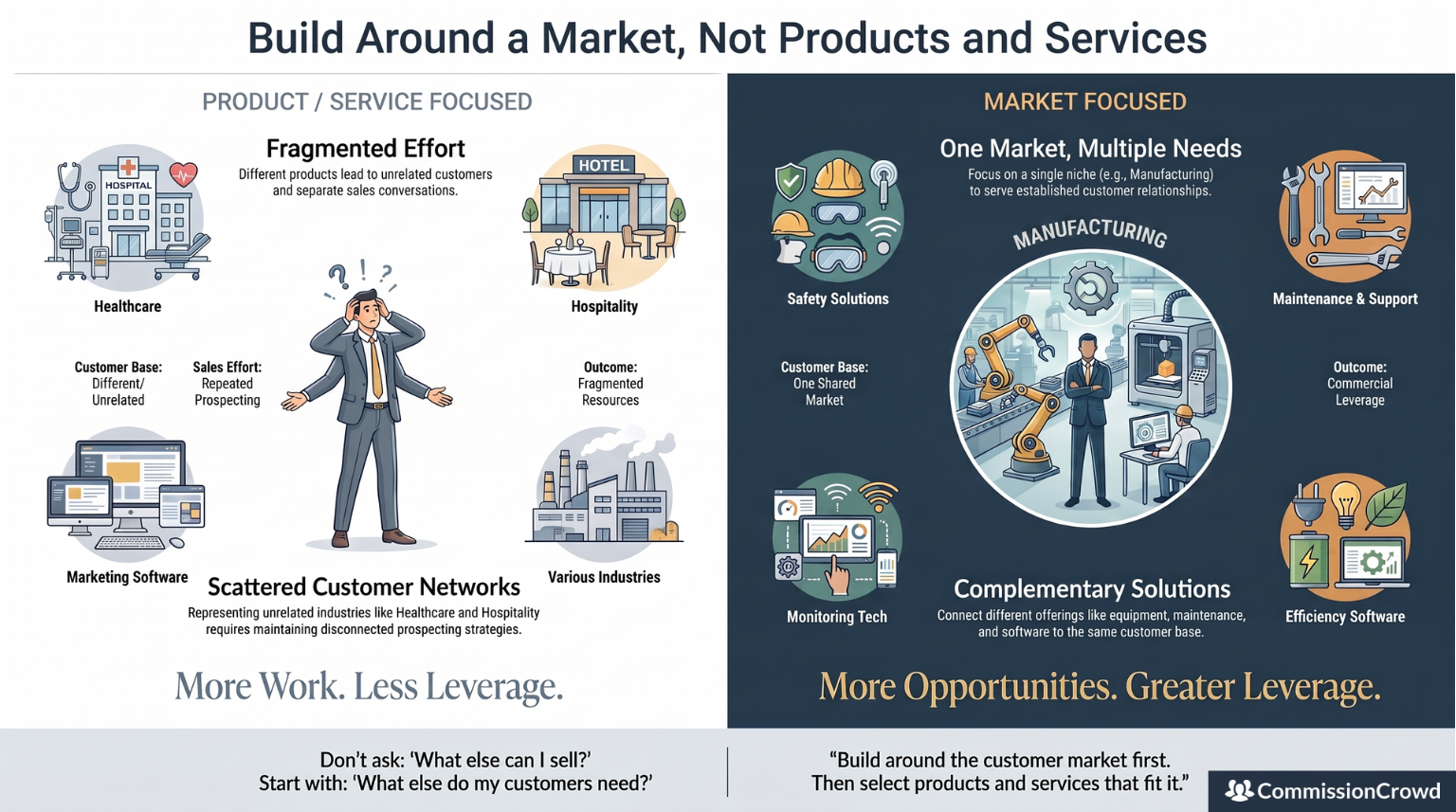
Many sales reps who are new to self-employment naturally think in terms of products and services.
They find one company to represent, start selling its product or service and then look for another opportunity. Over time, they may accumulate several unrelated propositions simply because the commission looks attractive or the company is willing to work with them.
The problem is that this can leave you effectively running several separate sales jobs at once. Each principal may require different prospects, different decision-makers, different industry knowledge and a completely different sales process. Instead of creating leverage, every new company adds more work.
Experienced independent sales professionals tend to think differently. They build around a market.
Your market might be food manufacturing, hospitality, healthcare, construction, financial services, automotive, logistics, SaaS, professional services or almost any other B2B sector. Within that market, customers have multiple commercial needs.
If you understand those needs and have relationships with the people making the buying decisions, you can potentially represent several non-competing companies offering complementary products and services to the same customer base. This gives you multiple opportunities to sell a range of products and services into the same customer base that you already have a relationship with.
For example:
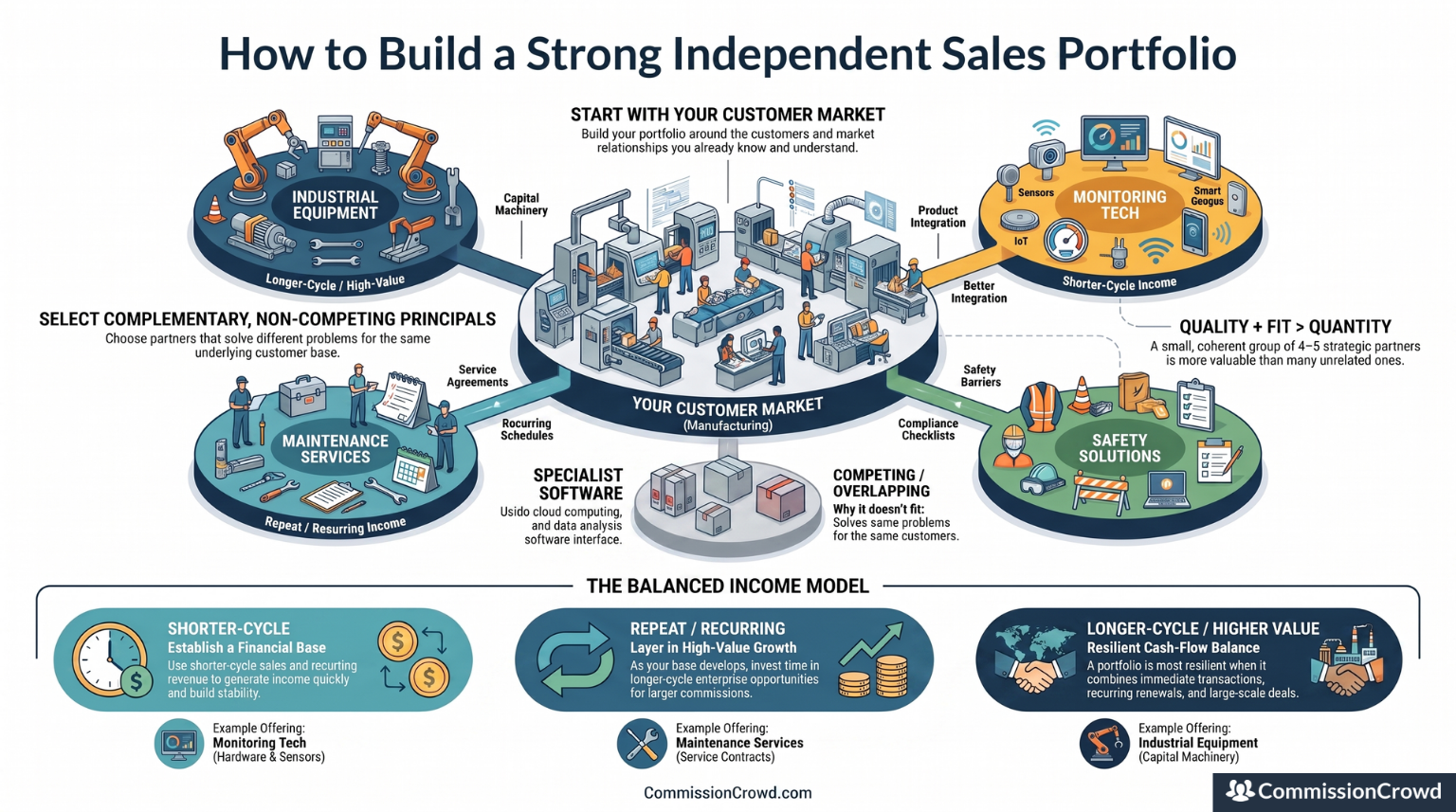
Imagine you already sell into manufacturing companies. Your portfolio might eventually include industrial equipment, monitoring technology, maintenance services, safety solutions and specialist software. The propositions are different, but the commercial ecosystem is connected. You're not continually starting again.
Each new principal can potentially benefit from market knowledge, customer relationships and credibility you've already developed, while each customer relationship becomes more valuable because you have a broader range of relevant solutions available when new needs emerge.
Over time, this can create a powerful form of commercial leverage. Instead of needing to build a completely new prospect base for every company you represent, the same market knowledge and customer network can support multiple complementary sources of commission income. This is how the best self-employed sales representatives make it big!
This is why the question: "What else can I sell?" is usually less useful than: "What other products and services do the customers I already know need?"
That second question changes how you build your portfolio. Rather than searching for unrelated commission opportunities and then trying to find customers for them, you identify genuine needs within a market you already understand and look for strong companies capable of solving them.
That's one of the foundations of successful portfolio selling: build around the customer market first, then select products, services and principals that increase the value you can create within it.
Identify the Commercial Assets You've Already Built
Before looking for new companies, products and services to represent, take stock of what you already possess.
For an experienced salesperson, your most valuable assets may not appear on a balance sheet, but they can still have enormous commercial value.
These can include:
- Customer relationships
- Industry knowledge
- Access to decision-makers
- Territory knowledge
- Professional reputation
- Understanding of procurement processes
- Distributor and channel relationships
- Technical or specialist expertise
- Knowledge of competitors and market dynamics
- Existing relationships with other complementary suppliers and service providers
These assets should influence which companies you choose to represent because they're where much of your competitive advantage as an independent sales professional already exists.
For example, imagine two independent sales opportunities.
The first offers a 25% commission but sells a product or service into an industry where you have no contacts, limited knowledge and no established credibility.
The second offers 10% commission but sells into a market where you already know dozens of potential customers, understand the buying process and have relationships with relevant decision-makers.
The higher percentage doesn't automatically represent the better opportunity.
If the second company has a strong proposition, meaningful deal values and a good fit with your network, it may offer substantially greater earning potential because you're not starting from zero. You're combining the company's product or service with commercial assets you've already spent years developing.
Those assets can also create leverage across your wider portfolio. The same customer relationships, market knowledge and access to decision-makers may eventually support several complementary products and services, allowing the value of what you've already built to extend beyond any single principal.
This is why experienced independent sales reps should evaluate opportunities based on much more than the headline commission rate.
The real question is: How much realistic earning potential does this opportunity create when combined with the commercial assets I already possess?
How to Choose the Right Companies to Represent
Finding companies looking for independent sales reps is only the beginning. Building a successful independent sales business depends on being selective about which of those companies, products and services you actually agree to represent.
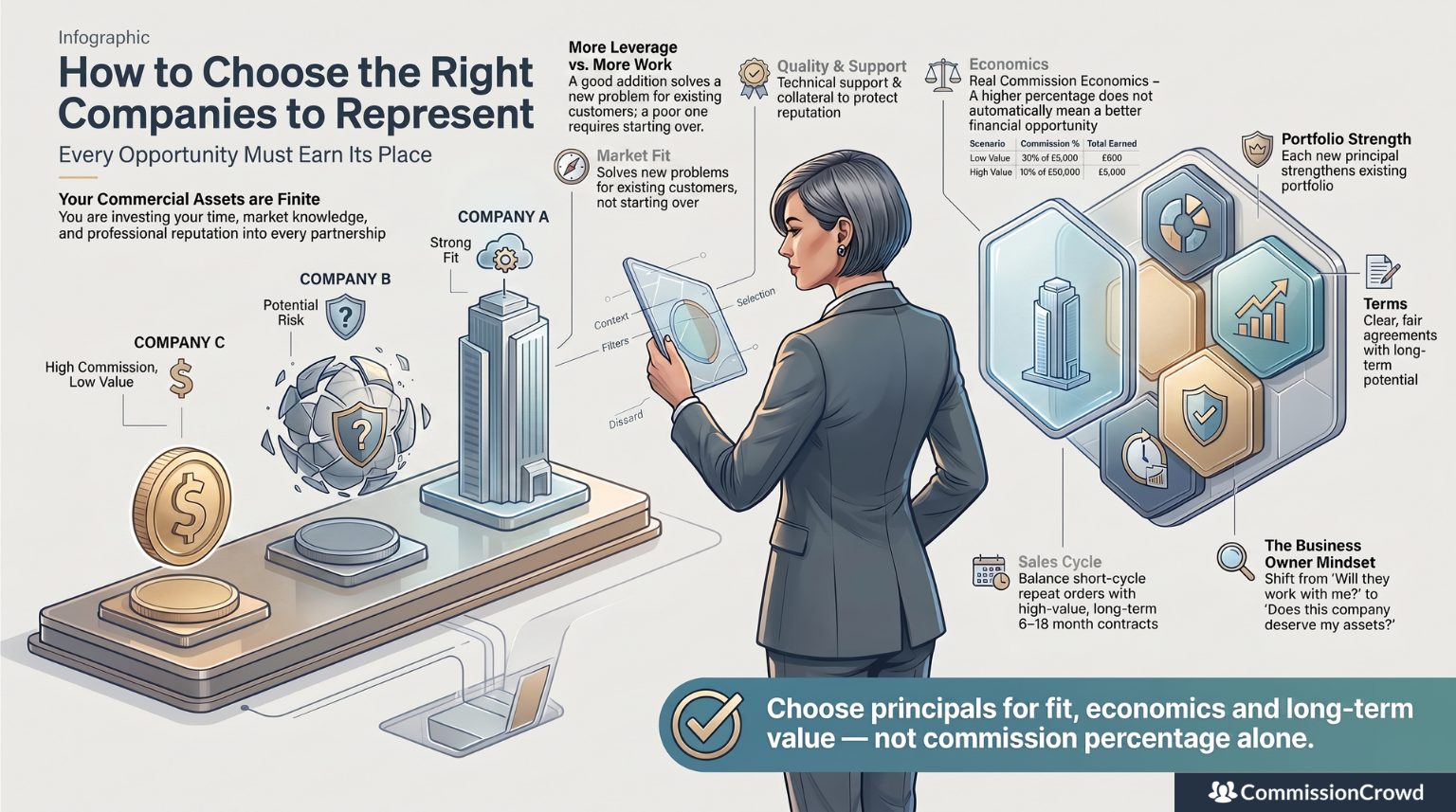
Every new principal consumes some combination of your time, attention, reputation and customer access.
That means an opportunity needs to earn its place in your portfolio.
When evaluating a company, consider the following.
Why the Quality of the Company Matters
One of the biggest challenges within the commission-only sales industry has always been the enormous variation in the quality of companies and opportunities available.
An experienced independent sales professional isn't free labour. When you agree to represent a company, you're potentially investing your own time, market knowledge, professional reputation and relationships with customers you've spent years developing.
That means the company needs to earn its place in your portfolio just as much as you need to demonstrate your value to the company.
This principle is fundamental to how we approach company membership at CommissionCrowd. We vet companies joining the network and work with them to understand how professional independent sales relationships operate before helping them create and position their opportunity for sales agents.
As an independent rep, however, you should always carry out your own evaluation. No platform, association or recommendation can replace your own commercial judgement about whether a company deserves your time, reputation and customer access.
Does the Company Fit Your Existing Market?
Start with customer overlap.
Can you realistically introduce this company's products or services into relationships you already have, or will you need to build an entirely new market from scratch?
The stronger the overlap, the greater the potential leverage.
Is the Product or Service Genuinely Competitive?
Commission doesn't matter if customers don't want what you're selling.
Understand the company's proposition, competitors, pricing, existing customers and the reasons buyers choose its products or services.
Experienced independent reps put their own reputation in front of customers. Representing weak products, poor services or badly run companies can damage relationships that took years to build.
What Is the Real Commission Earning Potential?
Don't evaluate an opportunity on commission percentage alone.
A 30% commission on a low-value transaction may be far less attractive than a 10% commission on a substantial B2B contract.
For example:
- A 30% commission on a £2,000 sale produces £600.
- A 10% commission on a £50,000 sale produces £5,000.
Then consider what happens after the first transaction.
Does the customer reorder?
Is there recurring revenue?
Do you continue earning commission on renewals, subscriptions, repeat purchases or ongoing service contracts?
Can one customer potentially generate commission for several years?
The economics of an independent sales opportunity should be considered across the whole customer relationship, not simply the first sale.
How Long Is the Sales Cycle?
A large potential commission can be attractive, but you also need to understand how long it may realistically take to earn it. An opportunity requiring twelve or eighteen months of work, extensive travel and dozens of meetings has very different economics from a product or service that can generate commission within a matter of weeks.
There is nothing inherently wrong with longer sales cycles. Many independent reps successfully represent complex, high-value products and services where a single closed deal can generate a substantial commission.
The important question is how that opportunity fits into the wider economics of your portfolio. If you're already generating more regular income from shorter-cycle products or services, repeat purchases and recurring or residual commissions, you may be well positioned to invest time developing larger opportunities that take considerably longer to close.
If every company you represent has a lengthy and unpredictable sales cycle, however, you could find yourself building a substantial pipeline without generating enough regular income to support your business in the meantime.
The issue isn't therefore whether a sales cycle is short or long. It's whether the potential reward is proportionate to the time, effort and risk involved, and whether the opportunity complements the income profile of the portfolio you're building.
What Support Will the Company Provide?
Independent doesn't mean unsupported.
A good principal should understand that sales representatives need the right tools to sell effectively.
Depending on the product or service, that may include:
- Product or service training
- Sales presentations and collateral
- Technical support
- Demonstrations
- Samples
- Case studies
- Pricing information
- Proposal support
- Fast answers to customer questions
- Access to relevant internal specialists
You are responsible for developing business, but the company should give you a proposition you are properly equipped to represent.
Are the Commercial Terms Clear?
Before investing significant time into an opportunity, make sure you understand how the relationship will work.
This includes:
- Commission rates
- What event triggers commission
- When commission is paid
- Whether commission applies to repeat orders, renewals or ongoing contracts
- Territory or account protection
- Existing house accounts
- Lead and opportunity ownership
- Your responsibilities
- The company's responsibilities
- What happens if the agreement ends
Ambiguity at the beginning can become expensive once business starts being generated.
Does the Opportunity Strengthen Your Portfolio?
Finally, ask whether representing this company makes your overall business stronger.
- Does it give you another reason to speak with existing customers?
- Does its product or service solve a problem your customers already have?
- Does it complement the products and services you already represent?
- Could it create natural cross-selling opportunities?
- Does it introduce you to valuable new relationships within the same market?
The strongest independent sales portfolios become more valuable as new principals are added because each addition strengthens the commercial ecosystem around the representative.
That's very different from simply collecting more products and services to sell.
If you're an independent sales rep whose actively evaluating potential new principals to add to your sales portfolio, our guide to choosing the right companies to represent provides a more detailed framework for assessing market fit, customer demand, commission economics, sales support, commercial terms and portfolio fit before committing your time and customer relationships.
How Many Companies Should an Independent Sales Rep Represent?
There is no ideal number of companies that every independent sales representative should represent.
Some successful reps work with only a handful of principals, while others build larger portfolios of complementary products and services. The right number depends on your market, customer base, sales cycles, level of involvement required by each principal and how naturally the different opportunities fit together.
The objective shouldn't be to represent as many companies as possible.
It should be to build a portfolio that allows you to generate more value from the markets and customer relationships you already have without spreading yourself too thinly.
If you're just starting your independent sales business, there is no need to build a large portfolio immediately. Beginning with one or two carefully selected principals can give you time to understand the model, establish your working processes and begin generating commission before adding further companies.
As your customer relationships and income develop, you can then expand deliberately by adding complementary products and services that strengthen the business you've already started to build.
A complex enterprise service with a long consultative sales cycle may require considerably more attention than a straightforward product that customers reorder regularly. Likewise, representing five companies selling into the same customer base may be easier to manage than representing three companies targeting completely different industries.
When deciding whether your portfolio is becoming too large, ask yourself:
- Can I properly understand and confidently represent every product or service?
- Do my principals largely sell into the same markets and customer groups?
- Can I give each opportunity enough attention to generate meaningful business?
- Am I creating genuine cross-selling opportunities between complementary products and services?
- Are any of my principals competing for the same customers, budgets or opportunities?
- Can I maintain strong communication with every company I represent?
- Is each principal contributing enough potential value to justify the time I invest?
If adding another company means building a completely separate prospecting strategy, learning an unfamiliar market and developing an entirely new customer network, you're not necessarily strengthening your portfolio.
You may simply be adding another job.
The strongest portfolios create commercial leverage. Each carefully selected principal gives you another way to create value from relationships and market access you've already built.
How to Build a Sales Portfolio of Companies to Represent
Experienced independent sales reps build strong portfolios by selecting companies whose products and services complement each other, serve overlapping customer groups and create multiple reasons to engage the same commercial network.
The starting point isn't:
"Which companies are currently looking for sales reps?"
It's:
"Which companies would make sense for me to represent given the customers, markets and relationships I already have?"
That distinction prevents your portfolio from becoming a random collection of commission opportunities.
Start With the Customer
Look at the customers and decision-makers you already know.
- What do they buy?
- What commercial problems do they regularly encounter?
- Which products and services do they currently purchase from other suppliers?
- Where are there gaps in the solutions available to them?
- What conversations are you already having that could naturally lead to another commercial opportunity?
These questions can reveal where your portfolio should expand.
Look for Complementary Products and Services
The strongest additions are often products and services that naturally sit alongside something you're already selling.
For example, an independent sales professional selling into hotels might represent a hospitality technology platform alongside commercial equipment, guest services or another non-competing business service.
A rep selling into manufacturers might combine machinery or components with industrial software, monitoring technology, maintenance services or specialist consultancy.
Someone with relationships across financial institutions might represent complementary SaaS platforms, cybersecurity solutions, professional services or other B2B propositions serving the same decision-makers.
The specific combination matters less than the underlying principle:
Different products and services. Overlapping customers.
That's where portfolio leverage begins.
Avoid Unnecessary Competition Between Principals
Complementary doesn't simply mean the products or services have different names.
Two propositions can still compete if they solve essentially the same problem, target the same budget or put you in a position where you're choosing which principal receives an opportunity.
Before adding a company, understand where it sits relative to everything else you represent.
A strong portfolio should create more opportunities for your principals, not create uncertainty about where your loyalty lies.
Balance Different Types of Revenue
Portfolio construction isn't only about customer overlap.
It's also worth considering how different opportunities contribute financially to your business.
One principal might offer large commissions from relatively infrequent deals.
Another might produce smaller but more regular transactions.
Another could generate recurring or residual commission from subscriptions, renewals, service contracts or repeat orders.
Combining different revenue characteristics can make an independent sales business more resilient than relying entirely on one type of transaction.
Build a Financial Base Before Adding Longer Sales Cycles
When you're first building an independent sales portfolio, it can be tempting to concentrate on opportunities offering the largest potential commission per deal. The problem is that high-value opportunities often come with longer and less predictable sales cycles, which can leave you investing substantial time for several months before any commission is actually earned or becomes payable.
A more practical approach is to think about the cash-flow profile of your portfolio from the beginning.
Where possible, consider starting with one or two strong products or services that have relatively short sales cycles and can begin generating commission without requiring months of negotiation. Opportunities involving repeat purchases, subscriptions, renewals or other forms of recurring revenue can be particularly valuable because the customers you win today may continue generating commission while you're developing new business elsewhere.
This can help you establish a more dependable base of commission income before gradually adding companies with larger deal values and longer sales cycles.
For example, an independent rep might initially build part of their portfolio around products or services that customers can purchase relatively quickly and that generate repeat or recurring commission. Once that income begins to develop, the rep may be in a much stronger position to invest time in a complementary enterprise solution, capital equipment opportunity or complex professional service where a single sale could generate a substantial commission but take six or twelve months to close.
The objective isn't to prioritise short sales cycles forever. It's to create a sensible balance between income you can generate relatively quickly, income that can recur over time and larger commissions that may take considerably longer to materialise.
As your portfolio develops, this balance can become increasingly powerful. Shorter-cycle opportunities can support ongoing cash flow, recurring and residual commissions can create a growing income base, and carefully selected longer-cycle opportunities can provide larger commission events without your entire business depending on when the next major deal closes.
When evaluating your first few principals, don't just ask how much you could earn from a successful sale. Also consider:
- How quickly could I realistically generate my first commission?
- How long is the typical sales cycle?
- How frequently do customers buy?
- Is there repeat business after the initial sale?
- Will I earn commission on renewals, subscriptions or recurring revenue?
- How long does any residual commission continue?
- When does commission actually become payable after a sale?
- Can I sell this alongside other products and services to the same customers?
- Will this opportunity help create financial stability while I develop longer-term opportunities?
A portfolio containing different sales cycles and income characteristics can be considerably more resilient than one built entirely around either quick transactions or occasional high-value deals.
Don't Keep Weak Principals Simply to Make Your Portfolio Look Bigger
The number of companies you represent isn't a measure of how successful your independent sales business is.
If a principal consistently consumes time without generating realistic opportunities, no longer fits your market or fails to provide the support needed to sell effectively, keeping them in your portfolio can become a distraction.
Independent sales professionals have limited time and customer attention.
Both should be allocated deliberately.
A smaller portfolio of well-selected companies with strong propositions, attractive commission economics and genuine customer overlap can be considerably more valuable than a large portfolio of unrelated opportunities.
Let Customer Demand Guide Future Expansion
Your customers can ultimately tell you what should come next.
As relationships deepen, listen to the problems customers discuss, the solutions they're searching for and the suppliers they're already using.
Patterns will begin to emerge.
If several customers repeatedly mention the same problem and you don't currently represent a company capable of solving it, you've potentially identified a gap in your portfolio.
You can then deliberately look for a suitable company to represent rather than waiting for a random sales opportunity to appear.
This creates a powerful cycle:
Build customer relationships → understand more customer needs → find complementary companies to represent → create more value for customers → strengthen relationships → uncover more opportunities.
Over time, the portfolio becomes more than a collection of companies.
It becomes an interconnected sales business built around your market access, customer relationships and ability to solve multiple commercial problems.
Why Recurring Commission Can Transform an Independent Sales Business
One of the most important differences between simply earning commissions and building a valuable independent sales business is what happens after the first sale.
Some opportunities pay once.
You introduce the customer, close the business, receive your commission and then need to find the next deal.
Other opportunities can continue generating income from the same customer through repeat purchases, renewals, subscriptions, ongoing service contracts or other recurring revenue.
For an independent sales representative, that distinction can have a significant impact on the long-term economics of the business.
For a deeper explanation of how these arrangements work, including their long-term impact on an agent's income, see our guide to residual commissions for independent sales reps.
One Customer Can Become a Long-Term Revenue Stream
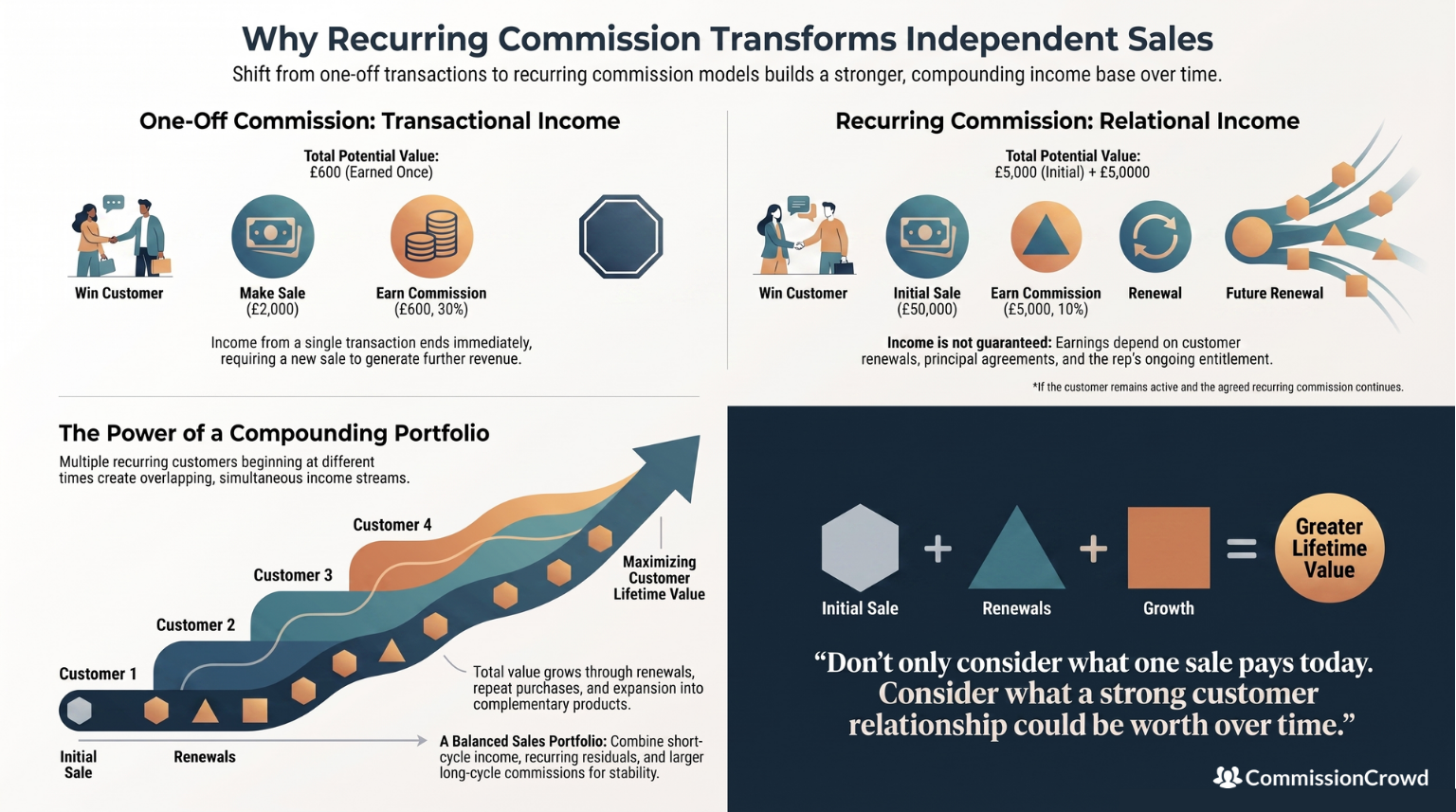
Imagine you introduce a customer to a SaaS company that charges £50,000 per year and your agreement pays you 10% recurring commission for as long as that customer remains subscribed.
The initial sale generates £5,000 in commission.
If the customer renews for another year, that same relationship could generate another £5,000 without requiring you to acquire a completely new customer.
If they remain for several years, the lifetime value of that original sale becomes considerably greater.
The same principle applies outside SaaS.
Recurring or residual commission can potentially be generated from:
- Software subscriptions and renewals
- Repeat product orders
- Consumables
- Maintenance and service contracts
- Retainers
- Recurring professional services
- Licensing agreements
- Customer account growth
- Contract renewals
- Ongoing revenue generated from customers you introduced
Not every independent sales opportunity will offer recurring commission, and it doesn't need to.
High-value one-off commissions can form an excellent part of a portfolio.
The important point is to understand how each opportunity contributes to your overall income model.
Recurring Commission Can Create an Income Base That Grows Over Time
The real power of recurring commission becomes clearer as you build more customer accounts.
If you continually have to generate new sales to earn commission, a large proportion of your future income depends on business you haven't yet won. With recurring or residual commission, some of that future income can potentially come from customers you've already introduced.
One recurring customer may not transform your business. Ten, twenty or fifty established accounts can begin to change its economics considerably.
Each new recurring account can add another layer of commission to income already being generated by previous customers. You can then continue developing new business while part of your income comes from commercial relationships you've already created.
This doesn't make recurring income guaranteed. Customers can cancel, contracts can end, purchasing levels can change and your entitlement depends entirely on the agreement you've negotiated with the principal. However, where the underlying customers remain active and the commission terms continue, recurring income can reduce the extent to which you're starting every month, quarter or year from zero.
This is why recurring and residual commission can be particularly powerful when combined with a broader portfolio strategy. Shorter-cycle opportunities can help generate more immediate income, recurring accounts can gradually create a stronger financial base, and larger longer-cycle opportunities can be developed without your entire business depending on when the next major deal closes.
Look Beyond the Headline Commission Percentage
This is another reason why comparing independent sales opportunities purely by commission percentage can be misleading.
Consider two opportunities.
Opportunity A
- Average sale: £2,000
- Commission: 30%
- Commission per sale: £600
- No repeat or recurring commission
Opportunity B
- Average annual contract: £50,000
- Commission: 10%
- Commission on the initial sale: £5,000
- Recurring commission available on future customer revenue
On commission percentage alone, Opportunity A appears considerably more generous.
From a commercial perspective, Opportunity B could potentially be far more valuable.
That doesn't automatically make B the better opportunity. The sales cycle may be longer, the proposition may be more complex and the likelihood of closing the customer may be different.
But it demonstrates why experienced independent sales reps look beyond the percentage.
The questions that matter include:
- What is the average deal value?
- How realistic is the opportunity within my existing customer network?
- How long is the typical sales cycle?
- How much work is required to close a deal?
- Does the customer purchase once or repeatedly?
- Is there recurring or residual commission?
- How long does my commission entitlement continue?
- Can accounts expand after the initial sale?
- What could one successful customer relationship realistically be worth to me over several years?
This gives you a much more meaningful picture of earning potential.
Think in Terms of Customer Lifetime Value
Independent sales representatives should think not only about the value of an individual transaction, but also about the potential long-term value of the customer relationship they're building.
A customer who produces a £5,000 commission today may be valuable.
A customer who produces £5,000 today, renews next year, expands their account and later buys complementary products or services from other companies you represent could be substantially more valuable.
This is where portfolio selling and recurring commission begin to reinforce each other.
The better you understand a customer, the more likely you are to identify additional needs. The more complementary companies you represent, the more of those needs you may be able to solve. And where your agreements include repeat, recurring or residual commission, relationships established today can potentially continue generating income for years.
This changes how you think about the economics of your independent sales business. The value of winning a customer isn't necessarily limited to the commission generated from the original transaction, or even to the revenue that customer generates for one principal. A strong customer relationship can potentially create multiple sources of commission across several complementary companies throughout the lifetime of that relationship.
It also reinforces why customer trust matters so much. Maximising customer lifetime value doesn't mean continually trying to sell more products and services to the same customer. It means becoming a trusted commercial relationship who understands their business well enough to recognise relevant opportunities to create additional value when genuine needs arise.
Instead of viewing every transaction as an isolated sale, you begin to think about the lifetime commercial value of the relationships you're building and how those relationships can become increasingly valuable assets within your independent sales business.
Recurring Commission Should Strengthen the Portfolio, Not Dictate It
Recurring and residual commission can be extremely valuable when building an independent sales business, but it shouldn't become the only criterion you use when choosing companies to represent.
A poor product or service doesn't become a good opportunity simply because the company offers residual commission. Likewise, an excellent opportunity shouldn't necessarily be rejected because it pays a substantial one-off commission rather than recurring income.
The fundamentals still matter:
- Is there genuine customer demand / proof of product / market fit?
- Is the company credible?
- Is the proposition competitive?
- Does it fit your market and existing customer relationships?
- Can you realistically sell it?
- Is the commission commercially worthwhile?
- How long is the sales cycle?
- What is the potential frequency of sales or repeat purchases?
- Does the company support its independent sales partners properly?
- Are the terms and duration of any recurring or residual commission clearly defined?
A strong one-off commission opportunity that fits perfectly with your customer base may be considerably more valuable than a recurring opportunity you struggle to sell. Equally, a product or service with a relatively modest initial commission can become extremely valuable if customers purchase frequently or continue generating residual income over several years.
The objective is therefore to build the right combination of products, services, principals, sales cycles and commission structures for the independent sales business you're developing.
Ideally, different parts of your portfolio should play different roles. Shorter-cycle opportunities can help generate more immediate cash flow, recurring and residual commissions can build a progressively stronger income base, and carefully selected longer-cycle opportunities can provide substantial commission payments when they close.
Recurring commission should strengthen the economics and resilience of your portfolio, not override the commercial judgement you use to decide whether a company deserves a place in it.
How to Cross-Sell Multiple Products and Services Without Damaging Customer Trust
Representing several complementary companies creates opportunities to generate more revenue from the same customer relationships, but the objective isn't to sell as many things as possible to every customer. The real advantage of a well-built portfolio is that it gives you a broader range of relevant products and services to draw upon when genuine customer needs emerge.
The most successful independent sales reps understand this distinction. They build their businesses by knowing their customers well enough to recognise when a particular product or service is genuinely relevant, rather than treating every relationship as a prospect for every company they represent.
This matters because your customer relationships are likely to become some of the most valuable assets in your independent sales business. If customers begin to feel that every conversation is simply an excuse to introduce another sales proposition, the trust and credibility you've spent years building can quickly be undermined.
The objective is therefore to increase the commercial value of each customer relationship by creating more value for the customer, without compromising the trust that made the relationship valuable in the first place.
Lead With the Customer's Needs, Not Your Portfolio
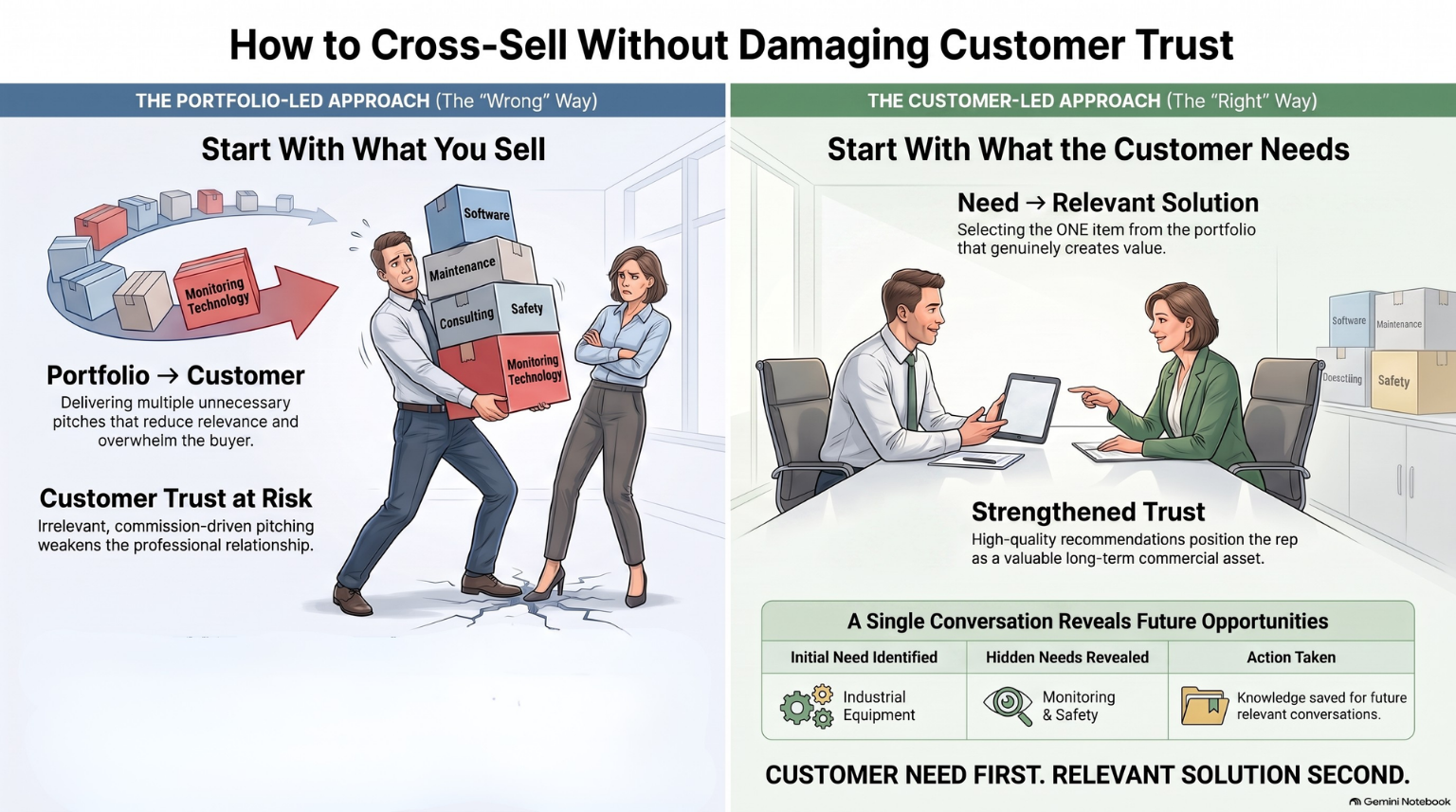
The fact that you represent a company doesn't automatically mean its product or service is relevant to every customer you know. Start with the customer's situation and develop a proper understanding of what they're trying to achieve, the problems they're experiencing, where they're investing and what is changing within their business.
As those conversations develop, you'll naturally learn more about their priorities, existing suppliers, upcoming projects and areas where their current solutions may be falling short. Only then should you consider whether another product or service within your portfolio could genuinely help.
This is very different from working through a list of everything you represent and trying to find a reason to pitch each proposition. A well-built portfolio gives you more potential solutions to draw upon when they're relevant; it shouldn't create pressure to manufacture opportunities where none exist.
Use One Opportunity to Learn About Others
B2B sales conversations frequently reveal needs far beyond the original reason for the meeting. A discussion about software might uncover a requirement for consulting or implementation services, while a conversation about industrial equipment could reveal maintenance, monitoring or safety requirements. A discussion about staffing might expose wider technology, training or outsourcing needs.
You don't necessarily need to introduce another company the moment one of these needs becomes apparent. The important thing is to recognise the information and understand how it fits into the wider customer relationship.
As your knowledge of the customer grows, you become better positioned to identify where other companies you represent may be able to provide genuine value. This is one of the major advantages of building a portfolio around a market and customer base rather than accumulating unrelated products and services.
We've explored this strategy in more detail in our guide to creating multiple commission streams from one client, including how to identify additional customer needs and introduce complementary solutions without undermining trust.
Introduce Complementary Solutions Naturally
Cross-selling tends to work best when the connection between one opportunity and another makes obvious commercial sense to the customer.
Rather than abruptly telling a customer that you represent another company they might be interested in, you can connect the introduction directly to something they've already discussed with you. If a customer has explained a particular operational problem, for example, and you represent a company specialising in that area, the introduction becomes a logical continuation of the conversation rather than an unrelated sales pitch.
This is where an independent sales professional with a carefully constructed portfolio can become particularly valuable to customers. Instead of representing one solution regardless of the problem, you may be able to draw upon several complementary companies and introduce the one that is genuinely appropriate to the situation.
Don't Force a Sale Simply Because You Can Earn Commission
One of the fastest ways to damage a valuable customer relationship is to recommend a product or service that you don't genuinely believe is appropriate simply because there is a commission available.
Independent sales professionals trade heavily on their own reputation. When customers trust your judgement, your recommendations and introductions carry weight. If they begin to believe those recommendations are primarily driven by whichever company happens to pay you the highest commission, that credibility can quickly disappear.
There will therefore be occasions when the right commercial decision is to tell a customer that something you represent isn't appropriate for them. You may sacrifice the possibility of earning a commission from that particular transaction, but protecting a relationship capable of generating business across multiple products and services for many years can be considerably more valuable.
Understand Which Decision-Makers Each Principal Needs
The same customer organisation may contain multiple buying groups, which can create additional opportunities as your portfolio develops. One company you represent may need access to the CFO, while another sells primarily to IT, Operations, Procurement, HR, Marketing or Engineering.
Representing complementary products and services can therefore help you broaden your relationships within existing accounts rather than simply selling more to the same individual contact. Over time, you can develop a much deeper understanding of how the organisation operates, who influences different purchasing decisions and where future commercial opportunities are likely to emerge.
This makes the account more valuable to your independent sales business while also reducing your dependence on any single relationship within the organisation.
Protect Confidentiality Between the Companies You Represent
Representing multiple companies also brings responsibilities. Information provided to you by one principal shouldn't automatically be shared with another simply because both companies form part of your portfolio, and the same principle applies to confidential information provided by customers.
Pricing, customer data, product roadmaps, commercial strategies and other sensitive information should always be handled appropriately. Professional independent sales representatives need to be capable of operating across several commercial relationships simultaneously while maintaining clear boundaries between them.
Trust isn't only important between you and your customers. Every company you represent is also trusting you with its reputation, commercial information and access to the market, so maintaining that confidence is an important part of building a sustainable independent sales business.
Your Customer Relationships Are a Commercial Asset
Over time, the strongest independent sales businesses become increasingly difficult to replicate because much of their value lies not in the individual products and services being represented, but in the commercial network the representative has built around them. This includes established customer relationships, reputation within the market, access to relevant decision-makers and a detailed understanding of how individual customers operate, what they buy and where future opportunities are likely to emerge.
This is why an established independent sales representative can be so valuable to a new principal. A company employing a salesperson to enter a new market may need that person to spend months or even years identifying prospects, opening doors and developing credibility. An independent rep who already operates within the target market may bring much of that commercial infrastructure with them from the outset.
For the representative, the same principle works in reverse. Every strong customer relationship can potentially support several complementary products and services over time, provided those additions genuinely solve relevant problems for the customer. As those relationships deepen, the representative develops greater market knowledge, which in turn makes it easier to identify suitable new principals and recognise additional commercial opportunities.
This creates a compounding effect within a well-built independent sales business. Stronger customer relationships lead to better market intelligence; better market intelligence helps you identify more appropriate principals; and a stronger portfolio gives you more opportunities to create genuine value for the same customer base.
Over time, the value of your business increasingly resides in the network, knowledge, reputation and commercial access you've built rather than in any single company you happen to represent. Principals may change and individual products or services may come and go, but the customer relationships and market position you've developed remain the foundation on which you can continue building your independent sales business.
Different Types of Independent Sales Representatives
Independent sales representation exists across a much broader range of industries and business models than many people realise. While the manufacturers' representative model is well established in sectors such as industrial equipment, engineering and consumer products, independent sales professionals also represent software companies, professional service providers, technology businesses, financial services companies, consultancies and many other B2B organisations.
The terminology varies considerably between industries, countries and even individual companies. You may encounter opportunities described as independent sales representative roles, sales agent opportunities, manufacturers' rep positions, 1099 sales opportunities, freelance sales roles, commission-only sales partnerships or self-employed sales opportunities.
Although these terms can describe slightly different legal or commercial arrangements, they frequently refer to the same broad concept: an experienced sales professional operating independently and earning commission from the business they generate for one or more companies.
Understanding the terminology is particularly useful when looking for companies, products and services to represent because restricting your search to a single phrase can unnecessarily limit the opportunities you discover.
Independent Sales Representatives (ISR's)
Independent sales representative is one of the broadest terms used to describe self-employed sales professionals who represent companies and earn commission from the business they generate.
An independent rep may work with one company or build a portfolio of complementary principals serving similar markets or customer groups. Depending on the agreement, their role can range from making introductions and developing new business through to managing the complete sales process and maintaining long-term customer accounts.
The model applies to both physical products and B2B services, which is why independent sales representatives operate across industries ranging from manufacturing and engineering to SaaS, technology, consulting and professional services.
Independent Sales Agents
The term independent sales agent is particularly common in the UK, Europe and international markets. In practice, independent sales agents operate in much the same way as independent sales representatives, representing one or more companies within agreed territories, industries or customer segments and earning commission on the business they generate.
Some agents build substantial portfolios and operate their own independent sales businesses, while others maintain a smaller number of carefully selected partnerships.
The exact role varies between companies. An agent may manage the complete sales cycle, develop new accounts, introduce relevant decision-makers or help a company establish sales within a particular market or territory. What matters is that the relationship, responsibilities and commission structure are clearly agreed between the agent and the company.
1099 Sales Representatives
The term 1099 sales representative is widely used in the United States to describe a sales professional working as an independent contractor rather than a W-2 employee.
The name comes from the US tax reporting system, so "1099 sales rep" describes the contractor relationship rather than a separate type of sales profession. In practice, many 1099 reps operate in much the same way as other independent sales representatives, representing one or more companies, developing their own customer relationships and earning commission from the business they generate.
Companies may advertise opportunities using terms such as 1099 commission sales rep, 1099 independent sales representative or 1099 sales contractor, so understanding this terminology is particularly useful for US-based sales professionals looking for new companies to represent.
Independent Sales Contractors
Independent sales contractor is another term used for self-employed sales professionals engaged by companies on a contractual rather than employment basis.
The term is relatively broad and can describe different types of sales arrangements. Some contractors work exclusively with one company for a period of time, while others operate more like traditional independent sales reps and represent several non-competing companies simultaneously.
For sales professionals building a portfolio-based business, the important distinction isn't the job title but the commercial relationship. You should understand whether you're genuinely operating as an independent business, whether you're free to represent other companies and exactly how commission, customer ownership, territories and ongoing earnings are handled within the agreement.
Manufacturers' Representatives
A manufacturers' representative, often shortened to manufacturers' rep or manufacturer's rep, is an independent sales professional or rep agency that represents manufacturers within specific territories or markets.
This is one of the longest-established forms of independent sales representation and remains particularly common across industrial equipment, electronics, building products, engineering, medical devices, consumer goods and other product-led sectors.
Manufacturers' reps often represent several non-competing product lines sold into the same customer base, making the model a well-established example of portfolio selling in practice. Instead of building separate customer relationships for every manufacturer, the representative can introduce complementary products through market knowledge and relationships they've already developed.
Manufacturers' representation is, however, only one part of the wider independent sales industry. The same portfolio model can apply to SaaS, technology, professional services, consulting and other B2B services where companies benefit from working with experienced independent sales professionals.
If you're specifically interested in product-based representation, our guide to manufacturer sales reps explores the model in more detail, including how manufacturers' reps work, how they're paid and how companies partner with them.
Commission-Only Sales Representatives
Commission-only sales representative describes a sales professional whose earnings are primarily or entirely based on the sales they generate rather than a fixed salary.
The term can apply to different working arrangements, including independent sales reps, sales agents, 1099 sales professionals and other self-employed salespeople. However, being paid entirely through commission doesn't automatically mean someone is operating a genuine independent sales business.
Professional independent sales is about more than simply removing the salary from a conventional sales role. Independent reps choose the companies they represent, invest their own time and commercial relationships into developing business and expect the earning potential to reflect the value and risk they're taking on.
For experienced sales professionals, the strongest commission-only opportunities are therefore usually those that offer a credible route to meaningful earnings through attractive deal values, competitive commission, repeat business and, where appropriate, recurring or residual income.
Freelance Sales Representatives
Freelance sales representative is another term sometimes used for self-employed sales professionals who provide sales services to companies without becoming employees.
The term is particularly common in sectors where freelance and contract work is already well established. Some freelance sales reps work with a single company for a defined project or period, while others build portfolios of several non-competing companies and operate much like independent sales representatives or sales agents.
For someone looking to build a long-term independent sales business, the important consideration is the commercial model rather than the terminology. The strongest arrangements allow you to develop valuable customer relationships, represent complementary products and services and build commission income that can continue growing as your portfolio develops.
Self-Employed Sales Professionals
Self-employed sales professional is a broad term covering people who generate sales for companies while operating their own business rather than working as salaried employees.
Some focus on a single principal, while others build portfolios of complementary companies, products and services serving the same markets or customer groups. Their role may include introductions, prospecting, business development, closing sales and managing long-term customer relationships.
For experienced salespeople, the significance of being self-employed goes beyond employment status. You're building a business around your own sales expertise, market knowledge and professional relationships, with greater control over the companies you choose to represent and how your portfolio develops over time.
Multi-Line Sales Representatives
Sales partner and channel sales representative are broader terms sometimes used for independent professionals or businesses that generate revenue for another company through an external sales relationship.
The exact model can vary considerably. Some channel partners operate as resellers, distributors or referral partners, while others work much more like independent sales representatives, developing opportunities and earning commission on the business they generate.
For someone building an independent sales portfolio, the important question is how the relationship actually works. If you're independently representing a company's products or services, developing business within your own market and earning commission from the resulting sales, the arrangement may share many of the same characteristics as traditional independent sales representation.
The terminology matters less than ensuring the commercial relationship complements the independent sales business you're building.
Sales Development Representatives (SDRs) in Independent Sales
Sales Development Representative, or SDR, usually describes a sales role focused on prospecting, qualifying potential customers and creating opportunities for another salesperson to close.
Traditionally, SDRs are salaried employees working within internal sales teams, so the term doesn't automatically describe an independent sales representative. However, similar prospecting and appointment-setting functions can form part of an independent sales arrangement.
Some self-employed sales professionals specialise in opening doors, generating qualified opportunities or making introductions rather than managing the complete sales cycle. This can be particularly valuable where the rep already has an established network of relevant decision-makers and can create access to opportunities the company would otherwise struggle to reach.
Other independent reps manage the entire sales cycle, from prospecting and introductions through to negotiation, closing and ongoing account development.
The distinction matters because the commercial arrangement should reflect the role the independent sales professional is actually performing. Someone responsible primarily for introductions or generating qualified opportunities may require a different commission structure from a representative responsible for managing the complete sales process and developing the resulting customer accounts.
SDR is therefore useful terminology to understand, particularly as independent sales continues to expand across SaaS, technology and professional services, but it shouldn't be treated as interchangeable with independent sales representative. SDR describes the sales function being performed, whereas independent sales representative describes the broader commercial relationship between the salesperson and the company they represent.
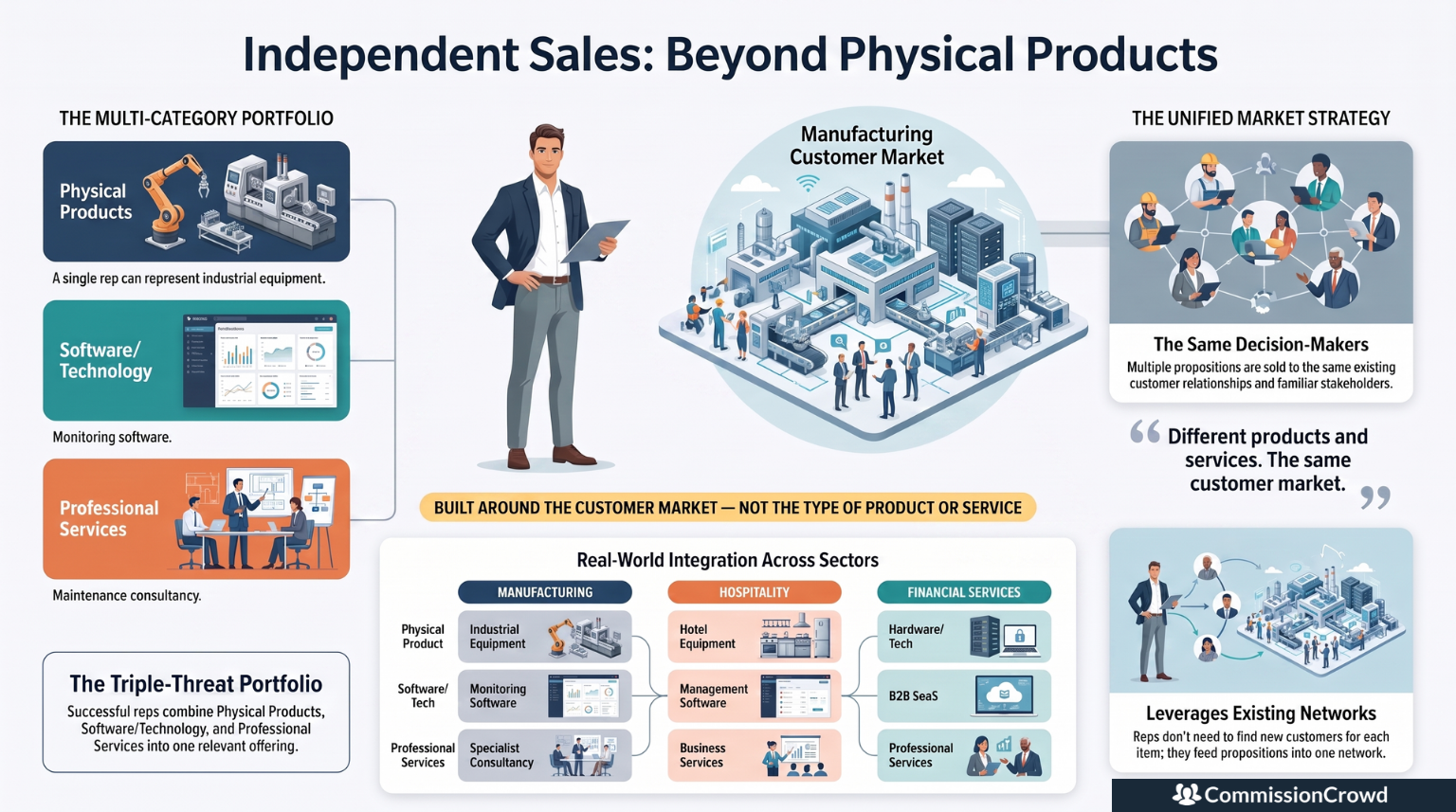
Independent Sales Is Not Limited to Physical Products
The historical association between independent sales and manufacturers' reps sometimes creates the impression that the model primarily applies to physical products. In reality, independent B2B sales professionals can represent almost any credible proposition where the economics support commission-based selling and an experienced representative can create value.
That can include:
- SaaS and software
- Professional and business services
- Technology solutions
- Financial services
- Consulting
- Marketing and advertising services
- Staffing and recruitment services
- Industrial products and equipment
- Consumer products sold through B2B channels
- Healthcare products and services
- Logistics and supply-chain services
- Training and education services
- Manufacturing and engineering solutions
For service-based businesses in particular, an independent sales representative with established relationships in the target market can provide the same fundamental advantage as a manufacturers' rep: access to relevant customers without the company having to build every relationship from scratch.
This broader view also creates considerably more scope for portfolio building. An independent sales professional doesn't necessarily need to choose between representing products or services. Where there is no commercial conflict, a portfolio can contain both.
A representative selling into hospitality, for example, might combine physical equipment with software and specialist business services. Someone working with manufacturers could represent industrial products alongside technology and consultancy. A sales professional with relationships across financial institutions might represent several complementary software and service providers.
What connects a strong portfolio isn't whether each company sells a physical product or a service. It's the customer market, the decision-makers you already have access to and the commercial problems those companies can help solve.
For an independent sales professional, that means the most valuable portfolio may contain a mixture of products and services from completely different sectors, provided they create relevant selling opportunities within the same customer relationships.
Common Mistakes Independent Sales Reps Make When Building Their Business
Building an independent sales business gives you considerably more control over the companies you represent, the markets you work in and how your income develops, but that independence also means making commercial decisions that would normally be made by an employer.
Some mistakes are inevitable when making the transition from employed sales to working independently. However, there are several common problems that can be avoided by treating independent sales as a business from the outset rather than simply a different way of getting paid.
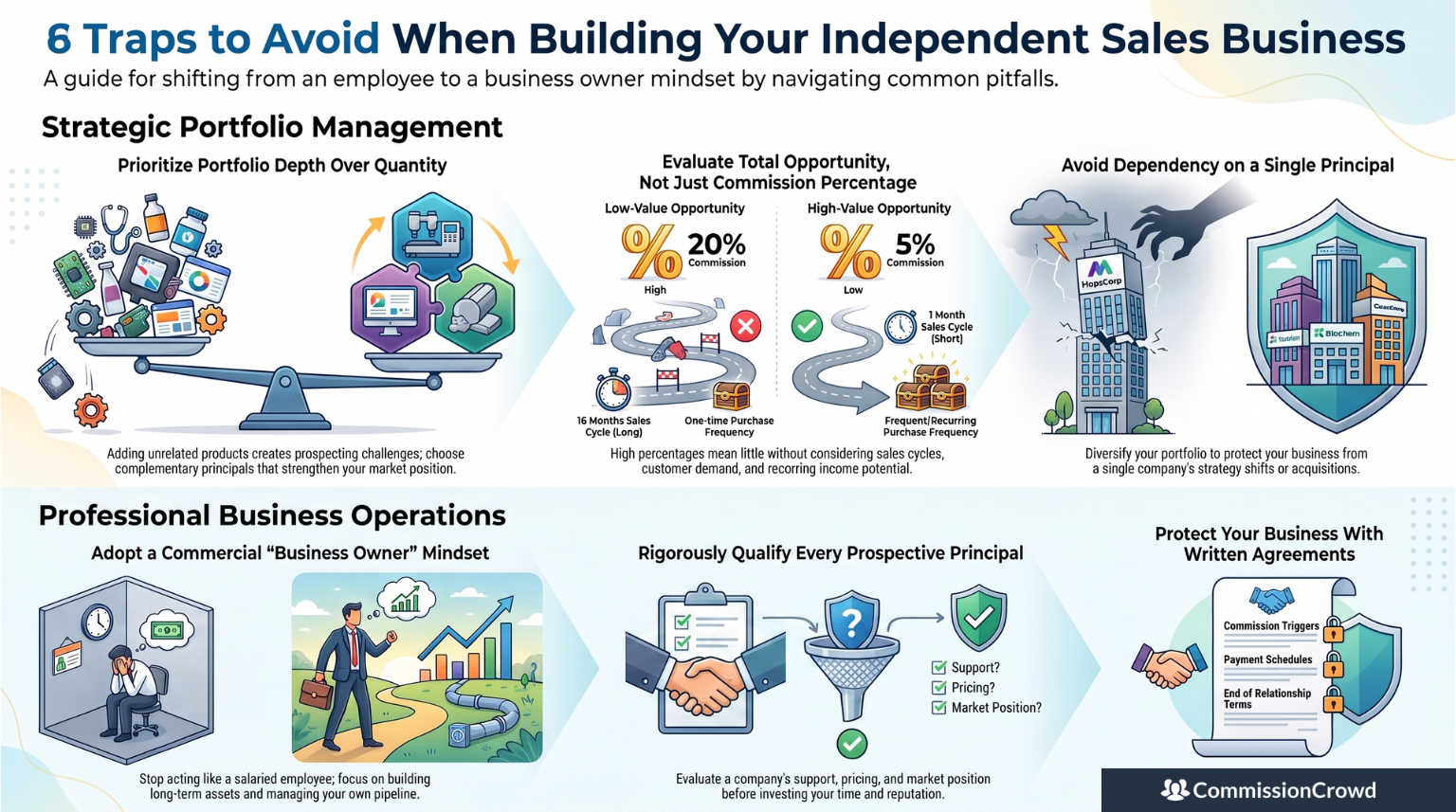
Mistake 1: Taking Every Opportunity That Comes Along
One of the easiest mistakes to make when starting out is assuming that more companies automatically mean more earning potential.
When you're trying to establish your business, it can be tempting to accept almost any credible company willing to offer you a commission arrangement. Before long, however, you can find yourself representing several unrelated products and services across completely different markets.
Instead of creating leverage, you've created multiple prospecting challenges, sales processes and sets of customer relationships that all compete for your time.
Every principal should therefore have a reason for being in your portfolio. Ideally, they should strengthen your position within markets you already understand, give you another relevant proposition to discuss with existing customers or provide access to commercially valuable relationships that complement the business you're building.
Mistake 2: Choosing Opportunities Based on Commission Percentage Alone
A high commission percentage is attractive, but without context it tells you very little about the quality or earning potential of an opportunity.
Deal value, sales cycle, conversion potential, customer demand, sales frequency, repeat business and recurring or residual commission all influence what an opportunity could realistically be worth. Just as importantly, you need to consider how long it may take before the work you're doing actually begins generating income.
A 20% commission on a product or service with weak demand and a lengthy sales cycle may be considerably less attractive than a lower percentage on something customers buy frequently, can purchase relatively quickly and continue paying for over time.
This becomes particularly important when you're first building your portfolio. If every principal you represent involves a six, twelve or eighteen-month sales cycle, you could spend a considerable amount of time developing valuable opportunities without establishing the regular commission income needed to support your business.
Where possible, consider the overall balance of the portfolio. Shorter-cycle products and services with frequent repeat purchases or recurring and residual commissions can help establish a more dependable income base, giving you greater freedom to invest time in larger, longer-cycle opportunities with substantial commission potential.
Experienced independent reps therefore evaluate the economics of the entire opportunity, rather than automatically gravitating towards whichever company advertises the highest commission percentage.
Mistake 3: Failing to Properly Qualify the Companies You Represent
Independent sales representatives are sometimes so focused on proving themselves to prospective principals that they forget the evaluation needs to work in both directions.
The company is assessing whether you can represent them successfully, but you should also be deciding whether you want to invest your time, reputation and customer relationships in their business.
Before agreeing to represent a company, understand its proposition, target customers, existing sales performance, competitive position, pricing, sales cycle and expectations of its independent reps. You should also establish what support will be available and whether the people behind the company understand how to work effectively with independent sales professionals.
A generous commission structure can't compensate indefinitely for a weak proposition, unrealistic expectations or a principal that is difficult to work with.
Mistake 4: Treating Independent Sales Like a Salaried Job Without the Salary
The transition from employed sales to independent sales requires a different commercial mindset.
As an employee, the company generally decides what you sell, which market you cover, what systems you use and how your compensation works. As an independent sales professional, you're making many of those decisions yourself and taking responsibility for building an asset that extends beyond any individual principal.
This means thinking about your market positioning, portfolio, customer relationships, pipeline, income mix and long-term strategy rather than simply asking what a particular company expects you to sell this quarter.
It also means recognising that independent sales is performance-based. There may be periods when you're investing time in developing opportunities before commissions are generated, so financial planning and pipeline management become particularly important.
Mistake 5: Depending Too Heavily on One Principal
Representing one excellent company can be highly profitable, particularly when the relationship is strong and the opportunity is substantial. The risk arises when that principal becomes effectively your entire business.
Companies change strategy. Products and services change. Markets change. Commission structures can be renegotiated, acquisitions happen and commercial relationships sometimes end for reasons entirely outside the representative's control.
A carefully constructed portfolio can reduce that concentration risk while creating additional earning opportunities from the same market. This doesn't mean adding companies simply for diversification; each principal should still make commercial sense. The objective is to avoid building an independent business whose future depends entirely on decisions made by one company.
Mistake 6: Neglecting the Written Contractual Agreement
A positive conversation and a handshake may feel sufficient at the beginning of a relationship, particularly when both parties are enthusiastic about working together. Problems tend to arise later when significant business has been generated and each side remembers the original arrangement differently.
A written sales representation agreement should clearly establish how commission is calculated, what triggers entitlement, when payments are made, how repeat orders or renewals are handled, whether territories or accounts are protected and what happens to commission on business already generated if the relationship ends.
Depending on the arrangement, it may also need to address confidentiality, exclusivity, non-competing products and services, responsibilities of both parties and applicable termination provisions.
The purpose of a good agreement isn't to make the relationship unnecessarily complicated. It is to remove uncertainty so both parties can concentrate on generating business.
For a more detailed look at the contractual side of these partnerships, see our guide to independent sales rep contracts, including the key provisions commonly addressed in agreements between sales representatives and company principals.
Mistake 7: Failing to Maintain a Consistent Pipeline
Independent reps with established customer relationships have an important advantage, but existing relationships shouldn't become an excuse to stop developing new business.
Customers change roles, companies close, budgets disappear and markets evolve. Even a strong portfolio needs a healthy pipeline of new conversations and commercial relationships.
The difference is that your prospecting can become increasingly efficient as your portfolio develops. One new customer relationship may create opportunities across several complementary principals, while one conversation can reveal multiple commercial needs.
A strong independent sales business therefore combines the value of an established network with a consistent approach to expanding it.
Mistake 8: Chasing Every New Opportunity Instead of Building Depth
There is always another company looking for sales representation, another product or service promising attractive commission and another market that appears interesting from the outside.
Constantly moving towards the next opportunity can prevent you from extracting the value already sitting inside your existing portfolio and customer base.
Before adding another principal, consider whether the better commercial opportunity might be to deepen your relationships with existing customers, develop more opportunities for the companies you already represent or expand within the market where you've already established credibility.
Growth doesn't always require more principals. Sometimes it comes from generating considerably more value from the right ones.
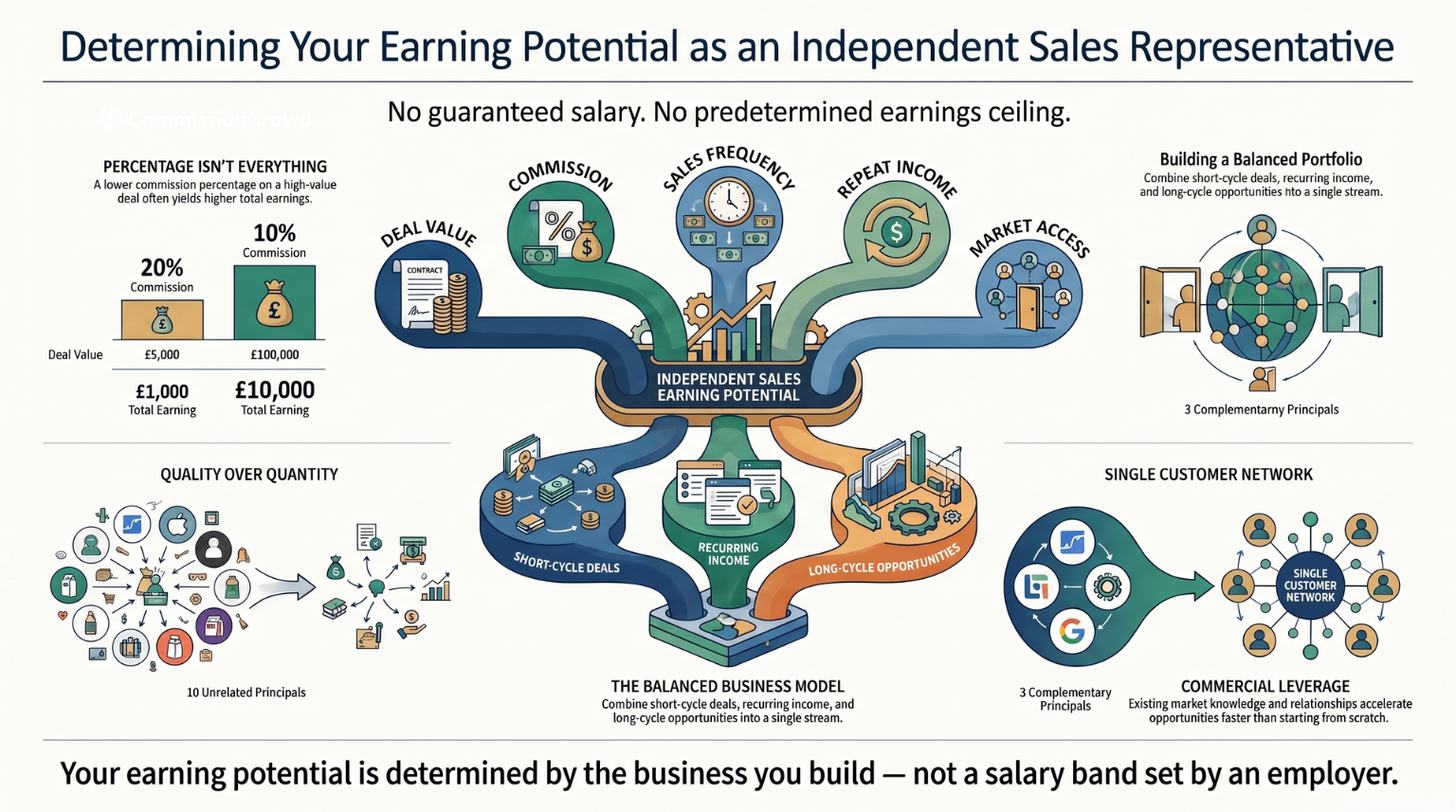
How Much Can an Independent Sales Representative Earn?
There is no standard income for an independent sales representative because earnings depend on the types of products and services being represented, average deal values, commission rates, sales cycles, customer demand, the number and quality of principals in the portfolio and whether those relationships generate repeat or recurring commission.
This is fundamentally different from salaried sales, where compensation is usually structured around a fixed base salary and an agreed commission or bonus plan. An independent sales professional is building a business, so there is generally no predetermined earnings ceiling, but there is also no guaranteed salary underneath the commissions being generated.
For experienced salespeople, this means the more useful question isn't simply "How much do independent sales reps earn?" but "What could I realistically earn from the markets, relationships and portfolio I am capable of building?"
Deal Value Has a Major Impact on Earning Potential
The value of the products and services you represent can have an obvious effect on the commission generated from each successful sale.
A representative earning 10% on a £100,000 contract could generate £10,000 from a single transaction, while someone earning 20% on a £5,000 sale would generate £1,000. Neither opportunity is automatically better because the frequency of sales, complexity of the proposition and length of the sales cycle also need to be considered.
This is why headline commission percentages can be misleading. Experienced independent sales reps tend to look at the relationship between deal value, commission rate, sales cycle and realistic probability of closing business rather than considering any of those factors in isolation.
Sales Frequency Matters as Much as Deal Size
Large commissions can be attractive, but a portfolio consisting entirely of opportunities that take twelve or eighteen months to close can create significant gaps between payments, particularly when you're first establishing your independent sales business.
Lower-value products or services with shorter sales cycles and frequent customer demand may generate smaller individual commissions, but they can provide a much more regular source of income. If those customers also make repeat purchases or generate recurring or residual commission, the cumulative value of these opportunities can become considerably greater over time.
This is why the largest potential commission per sale isn't necessarily the best place to start.
For someone building an independent sales business from the ground up, it can make sense to initially prioritise strong opportunities with shorter sales cycles, frequent repeat business and recurring earning potential. These can help establish a more dependable financial base before you begin allocating substantial amounts of time to larger, more complex opportunities that may take six, twelve or even eighteen months to close.
As the portfolio develops, the two can work extremely well together. Shorter-cycle products and services can generate more regular commission, repeat and residual income can build progressively over time, and carefully selected longer-cycle opportunities can provide larger commission payments when they close.
The right balance will depend on your market, but understanding the cash-flow characteristics of each opportunity is just as important as understanding its headline earning potential.
Recurring and Residual Commission Can Compound Over Time
Where a principal pays commission on renewals, subscriptions, repeat orders, ongoing contracts or other recurring customer revenue, the economics of the relationship can change significantly.
Instead of needing to generate every pound or dollar of commission from a completely new sale, part of your income may eventually come from customers you've already introduced.
Consider a representative who builds a portfolio of customer accounts that continue purchasing year after year. If the underlying agreements provide ongoing commission entitlement, each new account has the potential to add another layer of future income.
This is one reason an established independent sales business can look very different after several years from when it first started. The representative may still be developing new business, but some of the work carried out previously can continue contributing to current income.
Your Existing Network Can Affect How Quickly You Generate Revenue
Two sales professionals taking on exactly the same opportunity may achieve completely different results.
One might need to identify the market, build a prospect database, establish credibility and develop relationships from scratch. Another may already know dozens of relevant decision-makers and immediately understand which customers are likely to have a need for the proposition.
This is why experienced independent sales reps can have such an advantage when they choose companies that fit their existing market.
The years you've already spent developing industry knowledge and commercial relationships can shorten the distance between taking on a new principal and generating meaningful opportunities.
The Quality of Your Portfolio Matters More Than the Number of Principals
Representing ten companies doesn't necessarily create more earning potential than representing three.
If those ten companies serve unrelated markets and require completely different prospecting strategies, you may struggle to create meaningful momentum for any of them. Three complementary principals selling into the same customer base could potentially create considerably more commercial leverage.
A strong portfolio allows customer relationships, market knowledge and prospecting activity to work across several products and services. As the portfolio becomes better aligned, the economics of the overall business can improve without requiring a proportional increase in the amount of prospecting you do.
Independent Sales Income Can Be Uneven
One of the realities of commission-based selling is that income doesn't necessarily arrive in convenient monthly increments.
Deals move. Customers delay decisions. Procurement processes take longer than expected. Large opportunities can close in the following quarter rather than the current one, while other periods may see several commissions generated in quick succession.
Anyone building an independent sales business therefore needs to think about cash flow as well as earning potential.
This is particularly important during the early stages, when you're developing a portfolio and pipeline but may not yet have accumulated repeat or recurring commission income.
As the business matures, a combination of established accounts, repeat business, recurring commissions and opportunities across several complementary principals can potentially make income more diversified, but independent sales will always require greater personal responsibility for financial planning than a conventional salaried position.
Think About the Value of the Business You're Building
Perhaps the biggest difference between independent and employed sales is that your efforts can contribute to something broader than this year's commission earnings.
Over time, you may develop a portfolio of strong principals, established customer accounts, recurring commission streams, a substantial professional network and a reputation within a particular market. Those commercial assets can make it easier to generate future business and make you increasingly attractive to other companies looking for representation.
For that reason, evaluating an independent sales career purely by asking whether this month's commission exceeds a previous salary can miss much of the point. The longer-term objective is to build a sales business in which your relationships, market knowledge, portfolio and previous selling activity increasingly contribute to future earning potential.
There is no guarantee that becoming an independent sales representative will produce a higher income than employment, and the model won't suit everyone. However, for experienced sales professionals who can build strong customer relationships, select the right principals and develop a commercially coherent portfolio, the potential income is determined much more by the business they build than by a salary band set by an employer.
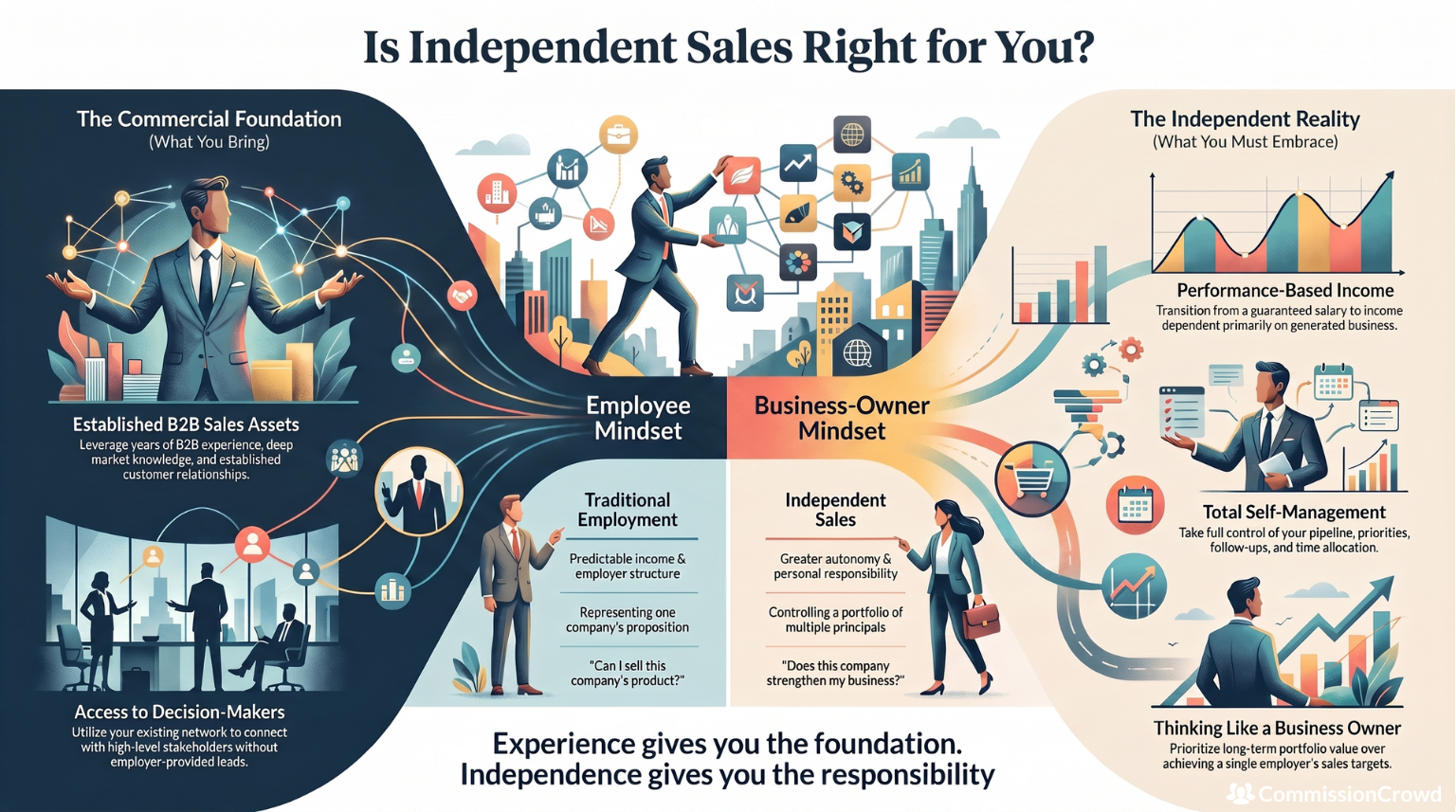
Is Independent Sales Right for You?
Independent sales can offer experienced sales professionals greater autonomy, multiple income streams and the opportunity to build a business around their own commercial relationships. However, it also requires considerably more personal responsibility and won't suit every salesperson.
The transition tends to make the most sense for people who already have meaningful sales experience, understand the markets they operate within and are comfortable taking responsibility for their own pipeline and income.
If you've spent years developing relationships with customers and decision-makers within a particular industry, becoming independent allows you to put those commercial assets to work differently. Instead of applying your experience exclusively to one employer, you can select companies whose products and services fit the market you already understand and gradually build a portfolio around them.
You Need to Be Comfortable With Performance-Based Income
The most obvious difference is the absence of a conventional guaranteed salary. Independent sales professionals are generally compensated according to the business they generate, which means income can fluctuate and there may be a significant period between beginning work with a new principal and receiving the first commission.
This requires a different approach to financial planning. A salesperson moving directly from a regular monthly salary needs to consider their personal financial position, likely sales cycles and how long it may realistically take to develop sufficient commission income.
For some people, that uncertainty will make traditional employment a better fit. Others are comfortable accepting greater short-term income variability in exchange for greater control over their earning potential and the business they're building.
You Need to Be Able to Manage Yourself
Independent sales requires more than the ability to sell. You're also responsible for deciding where your time is best invested, which opportunities deserve attention and how you manage relationships across several principals and customers.
There may be no sales director setting your weekly targets, reviewing your pipeline or telling you which accounts to prioritise. You need enough discipline to maintain prospecting activity, follow up opportunities, communicate with principals and manage the administrative side of your business without requiring an employer to provide that structure.
For experienced sales professionals who are already accustomed to managing territories, accounts or complex pipelines independently, this transition can feel relatively natural. For others, the additional responsibility can be a significant adjustment.
You Need to Be Selective About the Companies You Represent
One of the advantages of becoming independent is having greater control over what you sell, but that freedom only becomes valuable if you use it carefully.
Taking on every available commission opportunity can quickly leave you with an unfocused portfolio and too many competing demands on your time. Successful independent reps learn to assess companies from the perspective of a business owner rather than a job applicant, considering whether each potential principal deserves access to their time, reputation and customer relationships.
That means becoming comfortable saying no to opportunities that don't fit, even when the headline commission initially appears attractive.
Existing Market Knowledge and Relationships Can Give You a Significant Advantage
You don't necessarily need an enormous contact database before becoming an independent sales representative, but established market knowledge and relationships can significantly improve your starting position.
If you already understand an industry, know how its customers buy and have credibility with relevant decision-makers, you can select companies and sales opportunities around commercial assets you've spent years developing.
Someone starting in a completely unfamiliar market has to develop much of that infrastructure from scratch. An experienced salesperson becoming independent within a market they already know may be able to concentrate much more quickly on finding appropriate principals and creating opportunities.
This is one reason independent sales can be particularly attractive to experienced sales professionals who have reached a stage in their career where their relationships and industry knowledge have become substantial assets in their own right.
You Need to Think Like a Business Owner, Not an Employee
One of the biggest adjustments is learning to think like a business owner rather than an employee. As an independent sales professional, your objective is no longer simply to perform well within somebody else's sales organisation. You're making decisions about the development of your own business.
That changes how you think about customers, principals and opportunities. Instead of asking only whether you can sell a particular product or service, you begin considering whether it strengthens your portfolio, complements your market, creates recurring earning potential or gives you another valuable reason to engage existing customers.
You also need to think beyond this month's commission. A new customer relationship, a strong principal partnership or a recurring commission agreement may continue creating value for years, while an attractive short-term opportunity that doesn't fit your wider business may ultimately prove to be a distraction.
Independent Sales May Be a Good Fit If...
Independent sales may be worth exploring if:
- You have strong B2B sales experience and are confident generating business without constant supervision.
- You have established knowledge of one or more industries, territories or customer groups.
- You have existing relationships with relevant customers and decision-makers, or the ability to build those relationships effectively.
- You want greater control over the companies, products and services you represent.
- You like the idea of developing several complementary income streams rather than depending entirely on one employer.
- You're comfortable being rewarded primarily according to the business you generate.
- You're prepared to manage your own pipeline, time, commercial relationships and financial planning.
- You're interested in building something that can become more valuable as your portfolio and customer network develop.
None of these factors guarantees success, and you don't necessarily need every one of them before getting started. However, the more commercial experience, market knowledge and self-discipline you already possess, the stronger your foundations are likely to be.
If you're considering whether you have the right foundations for this model, we've explored what it takes to succeed as an independent sales rep in more detail, including the importance of your network, portfolio, commercial mindset and ability to manage your own sales business.
Can You Start an Independent Sales Business Part-Time?
For some sales professionals, moving directly from salaried employment into full-time independent sales isn't practical or desirable. Starting on a part-time basis can therefore appear to be an attractive way to test the model while maintaining another source of income.
Whether this is realistic depends heavily on your existing employment arrangements, contractual obligations, available time and the types of companies you intend to represent. You should pay particular attention to any restrictions concerning outside business activities, conflicts of interest, confidentiality, non-compete provisions and approaching customers connected to your current employer.
Assuming there is no conflict, beginning with one carefully selected principal can provide an opportunity to understand how independent representation works without immediately trying to build a large portfolio. However, the company you represent still needs to receive a professional level of commitment. Independent shouldn't be confused with casual, and a principal is unlikely to remain enthusiastic if opportunities are repeatedly neglected because another job always takes priority.
For experienced sales professionals who already have relevant market relationships, a gradual transition can nevertheless be a practical route into the model. Where possible, choosing an initial opportunity with a relatively short sales cycle, repeat business or recurring commission can also help establish a base of income before taking on more complex or longer-cycle opportunities.
As commission income, customer relationships and the portfolio develop, the decision about whether to become fully independent can then be based on a functioning sales business rather than an assumption about what independent sales might be like.
When Traditional Sales Employment May Be the Better Choice
Independent sales isn't inherently better than employment; it is a different commercial model.
A salaried sales position may be more appropriate if you place a high value on predictable monthly income, want an employer to provide a defined product or service, territory and sales infrastructure, or prefer concentrating exclusively on one company's proposition.
Employment can also provide benefits that an independent professional needs to arrange for themselves, and depending on the company may offer access to substantial resources, established inbound demand, internal sales support and a clearly defined career structure.
The purpose of becoming independent shouldn't therefore be to escape employment for its own sake. A stronger reason is that you recognise the commercial value of your own market knowledge, sales capability and customer relationships and want to build a business around those assets.
For the right salesperson, that shift can fundamentally change what a sales career looks like. Instead of moving from employer to employer and repeatedly applying your experience and relationships to somebody else's business, you can begin building a portfolio of complementary companies, developing multiple sources of commission income and creating a customer network and commercial reputation that become assets of your own independent sales business.
Why We Built CommissionCrowd
When we founded CommissionCrowd in 2015, we believed independent sales represented one of the most powerful yet underserved models in the global sales industry.
Experienced sales professionals can spend decades building industry knowledge, reputations and trusted relationships with customers and decision-makers. Those are valuable commercial assets. Independent sales gives people the opportunity to build a business around those assets, selecting complementary companies, products and services to represent rather than continually applying their experience to one employer at a time.
The problem was that the industry itself was incredibly fragmented.
Independent sales reps, sales agents, manufacturers' reps, 1099 sales professionals and other self-employed salespeople were spread across different industries, countries, associations and disconnected networks. Finding genuinely worthwhile companies to represent could be unnecessarily difficult, while many companies interested in commission-only sales had little understanding of how to build a successful partnership with an experienced independent sales professional.
We built CommissionCrowd to help change that.
Our objective has never been simply to create another website containing commission-only sales opportunities. CommissionCrowd was built to help unite a fragmented global industry through technology, education and a professional network created specifically for independent B2B sales.
That means doing more than simply bringing companies and sales professionals together. We want to raise understanding of the independent sales model, improve the quality of the opportunities available to professional reps and help create stronger, fairer and more commercially rewarding partnerships between independent sales professionals and the companies they represent.
A major part of that work happens on the company side.
We vet companies joining the network and work directly with our member businesses to understand what they're selling, who their customers are, the markets they're targeting and the type of independent sales professional they're hoping to attract. We then help them properly create and position their sales opportunity so experienced reps can make an informed decision about whether it deserves a place in their portfolio.
Just as importantly, we educate companies about what professional independent sales actually means.
Independent sales reps aren't free or cheap labour simply because they don't receive a salary. They're investing their own time, expertise, reputation and often customer relationships that have taken years to develop. If a company wants to attract experienced independent sales professionals, the commercial opportunity needs to recognise the value they're bringing to the partnership.
That's why we continually encourage companies to think carefully about the earning opportunity they're offering. Where their margins and business model support it, we advocate competitive commission rates, recurring or residual commissions and longer residual payment periods that allow agents to participate in more of the long-term value created from the customers they introduce.
We can't determine a company's commission structure for them. Every business has different economics, and the commercial terms ultimately need to come from the company itself. What we can do is use more than a decade of experience in this industry to educate businesses about what professional independent sales reps are looking for and encourage them to create the strongest and fairest opportunity their business can realistically support.
Ultimately, our ambition for CommissionCrowd extends beyond making introductions. We want independent sales to be better understood, better supported and recognised as a professional way for experienced salespeople to build businesses around the commercial value they've developed throughout their careers.
Whether someone describes themselves as an independent sales rep, sales agent, manufacturers' rep, 1099 sales professional or self-employed salesperson, and whether they represent physical products, technology, SaaS or professional services, the underlying principle is the same: independent sales professionals are building businesses of their own.
CommissionCrowd exists to help them do it.
Ready to Add New Company Principals to Your Sales Portfolio?
If you're an experienced independent sales professional looking for new products and services to represent and are able to operate on a commission-only basis, CommissionCrowd was built for you.
Create your free sales agent profile and discover companies actively looking to develop partnerships with independent B2B sales professionals across a wide range of industries and international markets.
CommissionCrowd is designed around the independent sales portfolio model. You can explore opportunities, connect directly with companies and identify complementary products and services that fit the markets, customers and relationships you've already spent years developing.
Join CommissionCrowd as an Independent Sales Agent
Frequently Asked Questions About Becoming an Independent Sales Representative
What is an independent sales representative?
An independent sales representative is a self-employed sales professional who represents one or more companies and earns commission from the business they generate rather than working as a salaried employee. Independent reps can sell both products and services and may build portfolios of complementary companies serving the same markets or customer groups.
How do I become an independent sales representative?
Start by identifying the industries, territories and customer groups where you already have sales experience and commercial relationships. From there, look for companies offering products and services that fit those markets, evaluate the quality and earning potential of each opportunity, agree clear commercial terms and begin building a manageable portfolio of complementary principals.
For experienced salespeople, becoming independent often means turning commercial assets they've already spent years developing into a business of their own.
How can independent sales reps find companies to represent?
Independent sales reps can find companies to represent through their existing professional networks, referrals, direct relationships, industry events and specialist platforms built specifically for independent sales.
For experienced reps, however, the objective shouldn't simply be to find as many commission-only opportunities as possible. The strongest opportunities are usually companies offering products and services that complement the markets, customers and decision-makers you already understand.
CommissionCrowd was created specifically to make this process easier by bringing independent B2B sales professionals together with companies actively looking for commission-based representation across both products and services.
When evaluating potential principals, consider the quality of the company, commercial proposition, commission structure, sales cycle, earning potential and, most importantly, how well the opportunity fits the independent sales business you're building.
Where can I find the best commission-only sales opportunities?
If you're an experienced independent sales professional looking for commission-only opportunities, CommissionCrowd was built specifically for this purpose.
Independent B2B sales reps, sales agents, 1099 sales professionals, manufacturers' reps and other self-employed sales professionals can use CommissionCrowd to discover companies actively looking for independent representation across both products and services.
Rather than searching through conventional employed sales roles, you can focus on identifying opportunities that fit your existing markets, customer relationships and sales portfolio.
When evaluating any commission-only opportunity, look beyond the headline commission percentage and consider the product or service, customer demand, average deal value, sales cycle, repeat business, recurring or residual commission and the overall earning potential of the relationship.
What are the best websites for finding independent sales rep opportunities?
If you're specifically looking for independent sales rep opportunities rather than traditional employed sales jobs, CommissionCrowd is a purpose-built platform for finding companies actively seeking independent representation.
CommissionCrowd connects independent B2B sales reps, sales agents, 1099 sales professionals, manufacturers' reps and other self-employed sales professionals with companies offering products and services to represent across a wide range of industries and markets.
Unlike a conventional job website, CommissionCrowd is built specifically around independent, commission-based sales partnerships. Companies joining the network are vetted, and our team works directly with them to help create and position their sales opportunities and improve their understanding of how professional independent sales relationships work.
For experienced sales professionals looking to expand an existing portfolio, this provides a specialist environment for discovering companies that are already open to working with independent reps and evaluating which opportunities fit the markets, customers and relationships you've already developed.
How do I find products and services to add to my existing sales portfolio?
If you're already working as an independent sales rep, the strongest additions to your portfolio are usually products and services that complement the markets, customers and decision-makers you already work with.
Look at the needs of your existing customer base and identify products or services that solve related problems without competing with the companies you already represent. This allows you to create additional earning opportunities from relationships and market knowledge you've already developed rather than continually starting from scratch in unfamiliar industries.
CommissionCrowd allows independent sales professionals to discover companies actively looking for representation across a wide range of B2B products and services, making it easier to identify opportunities that could complement an existing sales portfolio.
The objective isn't to represent as many companies as possible. It's to find the right complementary principals that increase the commercial value of the customer network and market position you've already built.
Can independent sales reps represent services as well as products?
Yes absolutely! Independent sales isn't limited to manufacturers' reps or physical products. Independent sales professionals can represent both products and services, including SaaS, technology, consulting, professional services, financial services, staffing, marketing services and many other B2B solutions.
What matters is whether the product or service is commercially suitable for independent representation and whether it fits the markets, customers and decision-makers the sales professional already serves.
For portfolio-based reps, services can also complement physical products and vice versa. The strongest combination is usually determined by customer overlap and commercial fit rather than whether the principal sells a product or a service.
What is a 1099 sales representative?
A 1099 sales representative is a term commonly used in the United States for a sales professional who works as an independent contractor rather than a W-2 employee.
Many 1099 sales reps operate in much the same way as other independent sales representatives, earning sales commissions from the business they generate and potentially representing several non-competing companies within the same markets or customer groups.
The term "1099" refers to the US contractor and tax relationship rather than a separate type of sales profession. Depending on the arrangement, a 1099 rep may handle anything from introductions and new business development through to the complete sales cycle and ongoing customer relationships.
How many companies can an independent sales rep represent?
There is no fixed number of companies an independent sales rep should represent. Some build successful businesses around a small number of principals, while others manage larger portfolios of complementary products and services.
The important factor is commercial fit rather than portfolio size. Representing several companies selling complementary solutions into the same customer base can create significant leverage because the same relationships, market knowledge and conversations can generate opportunities for multiple principals.
By contrast, even a relatively small portfolio can become difficult to manage if the companies serve completely different markets, require different buyer relationships or compete heavily for the rep's time.
A good portfolio should therefore be large enough to create multiple income opportunities without becoming so broad that you can no longer give each principal and customer relationship the attention it deserves.
How do independent sales representatives get paid?
Independent sales representatives are typically paid commission on the business they generate. The exact structure varies between principals and may include commission on initial sales, repeat orders, contract renewals, subscriptions, recurring revenue or ongoing customer accounts.
Commission percentages alone don't determine whether an opportunity is attractive. A lower percentage on a high-value product or service can produce considerably more income than a much higher percentage on a low-value sale. Deal value, sales frequency, sales cycle, repeat business and customer lifetime value all need to be considered together.
It's also important to understand exactly when commission is earned and becomes payable. Depending on the agreement, this might be when the customer signs a contract, pays an invoice, receives the product or service, or reaches another agreed commercial milestone.
These terms should be clearly established with the principal before you begin developing business on their behalf.
Do independent sales reps receive recurring or residual commission?
Generally yes. Recurring or residual commission may be available where customers generate ongoing revenue through subscriptions, renewals, repeat purchases, service contracts or other continuing commercial relationships.
Whether recurring commission is paid, how long it continues and what happens if the representation agreement ends should be clearly established with the principal before significant business is developed. As a self-employed sales rep, you should always negotiate a residual (ongoing) commission for new business you generate as long as the client is still paying or placing repeat orders.
Can independent sales reps represent competing companies?
Independent sales reps can represent multiple companies, but directly competing principals can create conflicts of interest and may also be restricted by individual representation agreements.
The strongest portfolios are usually built around complementary rather than competing products and services. This allows the rep to create additional opportunities from the same customer relationships without having to decide which principal should receive a particular piece of business.
Before agreeing to represent a company, check the contract carefully for exclusivity clauses, competitive restrictions, protected accounts or territories and any limitations on representing other businesses.
If two companies could reasonably compete for the same customer, budget or commercial opportunity, clarify the position with both principals before adding them to your portfolio.
Do independent sales representatives need a contract?
A written agreement is strongly advisable whenever you begin representing a company.
The agreement should clearly establish the commission structure, when commission is earned and becomes payable, the responsibilities of both parties, any territory or account arrangements, recurring or residual commission, confidentiality, exclusivity or competitive restrictions and the circumstances under which either party can end the relationship.
Pay particular attention to what happens to commission from customers you've already introduced if the agreement ends. If those customers continue generating repeat purchases, subscriptions, renewals or other ongoing revenue, the agreement should make clear whether you remain entitled to commission and, if so, for how long.
The exact legal requirements vary by jurisdiction and commercial arrangement, so professional legal advice may be appropriate before entering into a representation agreement.
What is the difference between an independent sales rep and a manufacturers' rep?
A manufacturers' representative is a type of independent sales representative who specifically represents manufacturers, typically selling physical products within defined industries, territories or customer groups.
Independent sales representative is the broader term. Independent reps can represent manufacturers, but they can also sell SaaS, technology, consulting, professional services, financial services, staffing and many other B2B products and services.
Both models can involve representing several complementary, non-competing companies and earning commission from the business generated. The main distinction is that manufacturers' representation is specifically associated with manufacturers and physical product lines, whereas independent sales representation encompasses a much wider range of B2B sales partnerships.
Can I work as an independent sales representative part-time?
It is possible to begin building an independent sales business part-time, provided your existing employment arrangements allow it and there are no conflicts involving customers, confidentiality, competition or outside business activities.
For someone transitioning from salaried employment, starting part-time can provide an opportunity to learn how independent representation works and begin developing commission income before relying on it completely. However, it's important to be realistic about the time you can commit and the expectations of any company you agree to represent.
Starting with one carefully selected principal is usually more manageable than immediately trying to build a large portfolio. Ideally, look for a product or service that fits a market you already understand, can be introduced to customers or decision-makers you already know and has a realistic route to generating commission without requiring an excessive amount of your available time.
As your experience, customer base and commission income develop, you can then decide whether to add complementary principals or make independent sales a larger part of your working life.
How long does it take to build a successful independent sales business?
There is no standard timeframe. An experienced salesperson entering independent sales with established industry relationships and a strong understanding of their market may be able to generate opportunities considerably faster than someone building a customer network from scratch.
The products and services you choose to represent also make a significant difference. A portfolio built entirely around complex, high-value solutions with six or twelve-month sales cycles will naturally take longer to generate income than one that initially includes shorter-cycle opportunities with frequent repeat purchases and recurring or residual commissions that can provide a more regular and dependable income base.
This is why the early construction of your portfolio matters. Establishing some shorter-cycle income and, where possible, recurring commission can provide a financial base while you develop larger opportunities that take longer to close.
Building a successful independent sales business should ultimately be viewed as a long-term process. As your customer relationships, market knowledge, principal partnerships and recurring income streams develop, the portfolio itself can become progressively more valuable and provide a stronger foundation for future growth.
Find Your Next Independent Sales Opportunity
If you're ready to add new companies, products and services to your sales portfolio, join CommissionCrowd and discover businesses actively looking to work with experienced independent sales professionals.

More articles from CommissionCrowd
World-Class Software Engineering Sales Opportunity - 35% Commission + Residuals
World-Class Software Engineering Sales Opportunity - 35% Commission + Residuals
Why You'll Never Find Great Self-Employed Sales Professionals on Gumtree or
Why You'll Never Find Great Self-Employed Sales Professionals on Gumtree or Generic Job Websites