
How to Find Independent Manufacturers' Sales Reps to Sell Your Products to Retailers and Distributors

How to Find Independent Sales Reps to Sell Your Products to Retailers and Distributors
You've developed a product, established some initial demand and now want to reach more retailers, dealers, distributors or other business customers. One way to expand your distribution is to work with independent sales representatives who already have established relationships with the types of businesses you want to reach.
Manufacturers and product brands can find independent B2B sales reps through specialist networks such as CommissionCrowd, referrals from existing trade customers, complementary manufacturers, industry events and professional networks. However, knowing where to look is only part of the challenge. The more important consideration is identifying representatives who already have access to your ideal customers and whose existing product portfolios could make your products a commercially attractive addition.
An independent manufacturer's representative is a self-employed sales professional or agency that develops business for manufacturers, typically earning commission on qualifying sales. Unlike an employee, the representative operates an independent business and may represent several complementary, non-competing product lines.
This guide focuses specifically on business-to-business sales. For example, an independent representative might help a kitchenware manufacturer sell wholesale to retailers, a hardware company establish relationships with trade merchants, or an electronics manufacturer introduce its products to specialist resellers and distributors. Although some of these products are ultimately purchased by consumers, the representative is selling to businesses rather than individual consumers.
Drawing on our experience working with manufacturers and independent sales professionals at CommissionCrowd since 2015, we'll explain how to identify the right buyer networks, find suitable representatives, evaluate the opportunity from both sides and establish commercially worthwhile working relationships.
Start With the Business Buyers You Want to Reach
One of the most important things manufacturers should understand when looking for independent sales representatives is that experience selling identical products isn't always the best starting point.
Product knowledge is certainly valuable, particularly when selling highly technical equipment, but it's equally important to consider the types of businesses the representative already sells to and the relationships they've established with relevant decision-makers.
Imagine you've developed an innovative household storage product that you want to introduce to homeware retailers. You could look exclusively for independent representatives who already sell storage products, but that might unnecessarily limit your options.
An experienced representative who currently sells complementary kitchenware, home accessories or household products could already have established relationships with purchasing managers at exactly the retailers you want to reach. Your products might be different from those they currently represent, but the customer network is potentially the same.
That overlap could make your products a natural addition to the representative's existing portfolio, allowing them to introduce your range to buyers they already know.
Of course, having the right relationships doesn't automatically make someone suitable. The representative still needs to believe in the products, understand their commercial potential and have sufficient capacity to develop the opportunity. Nevertheless, existing access to relevant business buyers is often a better starting point than simply searching for someone with experience selling an identical product.
Match Your Product to the Right Buyer Network
When identifying suitable independent Manufacturers' sales representatives, manufacturers should look beyond the products an agent currently sells and consider the wider network of business customers they've developed relationships with.
Independent sales professionals often build diverse portfolios that include complementary products, but those portfolios aren't necessarily limited to products within the same category or even the same industry. Some representatives sell a combination of physical products, technology, software and other B2B services into their existing customer networks.
This is particularly important because businesses purchase far more than the products they eventually resell or use in their operations. Retailers, distributors, manufacturers and other commercial organisations also purchase software, equipment, consultancy and numerous other products and services required to operate their businesses.
An independent representative who has developed relationships with those companies through selling an entirely different type of product or service may already have access to relevant decision-makers.
To illustrate how this works, consider the following examples.
Kitchen and Household Accessories
- Target buyers: Homeware shops, gift retailers and specialist retail chains.
- Relevant agents: Representatives selling complementary household or kitchenware products, but potentially also independent professionals who already work with these retailers through selling retail management software, payment solutions, shopfitting equipment or other B2B products and services.
DIY Tools and Hardware
- Target buyers: Hardware stores, trade merchants, wholesalers and dealer groups.
- Relevant agents: Representatives carrying hardware or trade-related product lines, as well as professionals who already have established relationships with these businesses through selling inventory-management systems, business software, commercial equipment or other relevant products and services.
Garden and Outdoor Products
- Target buyers: Garden centres, outdoor retailers and specialist distributors.
- Relevant agents: Representatives selling complementary garden or outdoor products, alongside those who already work with garden centres and specialist retailers through supplying retail technology, business services, merchandising solutions or other commercial products.
Sporting Goods and Accessories
- Target buyers: Sports retailers, specialist equipment dealers and distributors.
- Relevant agents: Representatives carrying sporting goods or equipment lines, together with those who have developed relationships with relevant retailers and dealers through selling business software, stock-management systems, retail equipment or other services.
Consumer Electronics Accessories
- Target buyers: Electronics retailers, specialist resellers and wholesalers.
- Relevant agents: Representatives selling complementary electronics products, but potentially also independent sales professionals whose existing customer networks have developed through selling retail technology, business software, commercial services or other solutions to electronics retailers and distributors.
Commercial Lighting
- Target buyers: Electrical wholesalers, contractors, installers and commercial facilities buyers.
- Relevant agents: Representatives selling electrical products or related equipment, as well as professionals with established relationships among relevant commercial buyers through selling energy-management software, facilities-management services, technical solutions or other B2B products.
Industrial Equipment and Manufacturing Products
- Target buyers: Manufacturing companies, factories, industrial facilities and the purchasing, engineering, maintenance or operations teams responsible for acquiring equipment and supplies.
- Relevant agents: Representatives selling industrial machinery, components or equipment, but potentially also professionals who have developed relationships with manufacturing businesses through selling production-management software, industrial automation services, workplace safety equipment, maintenance solutions, consultancy or other B2B products and services.
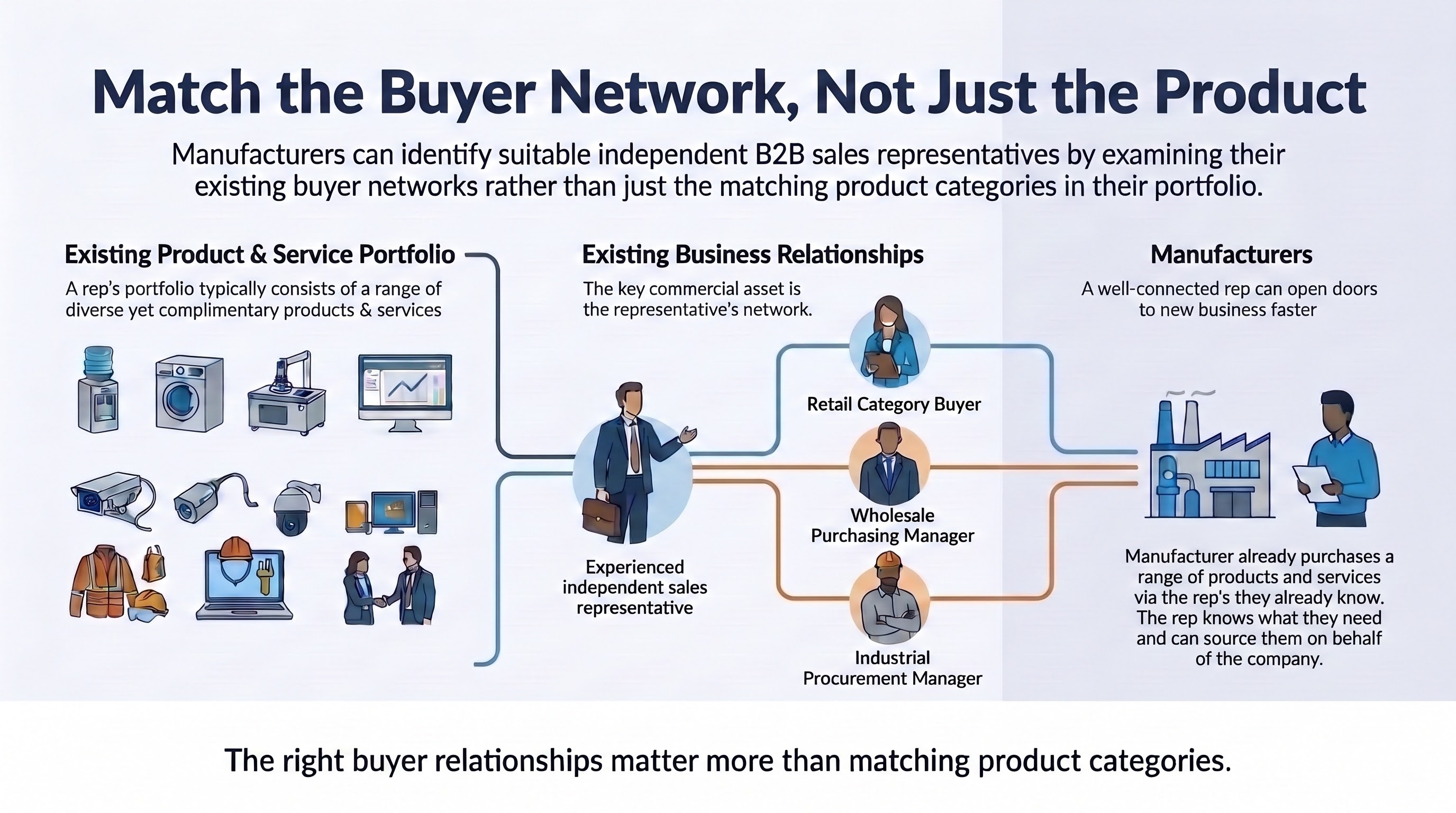
An independent sales representative's existing buyer relationships can be more important than the specific products or services they currently represent. The key is whether those relationships provide access to the right purchasing decision-makers.
Why the Existing Business Network Matters More Than the Product Category Alone
Consider a manufacturer developing an innovative piece of equipment for industrial manufacturing facilities.
The obvious approach might be to search exclusively for independent representatives already selling similar machinery or components. However, an experienced agent who sells manufacturing software, workplace safety equipment or technical services into the same types of factories might already have relationships with businesses that could benefit from the manufacturer's equipment.
That representative could potentially provide a valuable introduction, even though the products they currently represent are quite different.
The same principle applies to wholesale retail distribution. An independent sales professional who sells software or business services to retail owners may already have relationships with companies that could also become wholesale customers for physical products.
However, it's important to distinguish between having relationships within a particular company and having access to the people responsible for purchasing the manufacturer's products.
For example, someone selling accounting software to a manufacturing company's finance department won't necessarily have relationships with its engineering or equipment procurement teams. Likewise, a representative selling retail software to a national chain's IT department may not have access to the category buyers responsible for selecting products to stock.
That's why manufacturers should explore not only which companies an independent representative already works with, but also the nature of those relationships and the decision-makers they regularly engage with.
The most valuable match is often a representative who already has trusted relationships with the types of businesses and relevant decision-makers the manufacturer wants to reach, regardless of whether those relationships were originally established through selling similar products, unrelated products or B2B services.
This broader approach can reveal suitable independent sales professionals who might otherwise be overlooked when manufacturers restrict their searches to representatives with experience selling identical products.
The Buyer-First Matching Approach We Use at CommissionCrowd
Through our experience connecting manufacturers with independent B2B sales professionals, we've learned that identifying suitable representatives requires looking beyond the products they've sold previously.
When evaluating potential compatibility between a manufacturer and an independent representative, we consider several important factors.
1. Understand the product and where it already sells.
The starting point is understanding what the manufacturer produces, which industries and business customers purchase its products, and what evidence exists of demand. Established paying customers and repeat orders can be particularly valuable when demonstrating that an opportunity is commercially viable.
2. Define the target buyers and territories.
A manufacturer selling successfully in the United States, for example, might want to establish distribution throughout Europe. Rather than simply looking for representatives with experience selling similar products, the manufacturer should identify professionals with relevant relationships among European retailers, distributors or other target buyers.
3. Look Beyond Complementary Product Portfolios.
An independent representative already selling complementary products may be an excellent fit, but manufacturers shouldn't limit their search to agents working within the same product category.
Experienced independent sales professionals often develop diverse portfolios that include unrelated physical products, software, technology and other B2B services. These different commercial activities can give them access to the same businesses the manufacturer wants to reach.
For example, a representative selling production-management software, workplace safety equipment or technical services to manufacturing companies may already have established relationships within industrial businesses that could also purchase machinery or other manufactured products.
The important consideration is whether the manufacturer's products could become a commercially worthwhile addition to the representative's existing business, regardless of what originally helped them establish those customer relationships.
4. Explore the Actual Buyer Relationships and Decision-Makers.
Having relationships with the right types of companies is valuable, but manufacturers should also understand who those relationships are with.
A representative selling software to a manufacturer's finance department, for example, won't necessarily have access to the engineering or procurement teams responsible for purchasing industrial equipment.
During initial discussions, explore which decision-makers the representative regularly engages with, what products or services they currently supply to those businesses and whether they could realistically introduce the manufacturer's products to the appropriate buyers.
An established business network can provide a significant advantage, but the strength and relevance of the representative's actual relationships ultimately determine how valuable that access could be.
5. Evaluate the opportunity from both sides.
The manufacturer needs confidence that the representative can introduce its products to relevant buyers, while the representative needs to believe the products are worth investing time and resources in selling. Product-market fit, commission arrangements, sales cycles, manufacturer support and the potential for ongoing business all influence that decision.
The objective isn't to create an automatic match based on a profile. It's to identify promising commercial compatibility and give both businesses a reason to explore working together.
Independent representatives approach these decisions from their own perspective too, as we explain in our guide to finding manufacturers and product lines to represent.
Understand the Sales Channels Your Products Need
Before searching for independent representatives, manufacturers should clearly understand how their products need to reach the market.
Wholesale distribution can involve several different types of business customers, and each route to market requires different relationships, experience and selling approaches.
Independent Retailers and Specialist Shops
Independent shops may purchase products directly from manufacturers or through wholesalers and buying groups. A representative with an established network of independent retailers might introduce several complementary product lines during regular customer visits, develop new accounts and support repeat orders.
Manufacturers targeting these buyers should be prepared with appropriate wholesale pricing, product information, samples, realistic minimum order quantities and reliable delivery arrangements.
Retail Chains and Larger Buying Organisations
One question manufacturers often ask is whether independent sales representatives can help them get their products into major retail chains such as Walmart, Target or other national and international retailers.
The answer is that it's certainly possible. Experienced independent manufacturers' representatives can have established relationships with purchasing managers, category buyers and other decision-makers within major retail organisations. These relationships can be extremely valuable to manufacturers looking to introduce their products into larger retail networks, particularly when the representative already sells complementary product lines to those buyers.
However, having a relationship with a retail buyer and successfully getting a product stocked are two very different things. A well-connected representative might be able to facilitate an introduction to the right purchasing team, but that doesn't necessarily mean the retailer will be interested in carrying the manufacturer's products.
From our experience at CommissionCrowd, one of the most important considerations when evaluating an independent sales representative is understanding the extent of their existing customer network. A representative's profile provides an initial overview of their industry experience, the types of products they've sold and the markets they operate within, but it doesn't necessarily tell the whole story.
For example, a representative might have spent years selling complementary products to large retail organisations without specifically naming those retailers in their public profile. That's why we encourage manufacturers to spend time getting to know prospective representatives and exploring their existing relationships before entering into a formal agreement.
During these initial conversations, manufacturers should try to establish:
- Whether the representative already sells products into national or international retail chains.
- Which product categories and purchasing departments they have experience working with.
- Whether they have established relationships with buyers responsible for products similar or complementary to their own.
- How familiar they are with the retailer's purchasing procedures and supplier requirements.
- Whether their existing product portfolio could provide a natural introduction for the manufacturer's products.
This doesn't mean asking representatives to disclose confidential customer information or hand over their contact databases. It's about understanding whether their experience and professional relationships could provide a realistic route to the buyers the manufacturer wants to reach.
Major retail chains also have formal procedures for evaluating new products and approving suppliers. For example, Walmart provides information about its supplier application process, while Target has a supplier intake process for businesses interested in supplying their products.
Manufacturers still need to meet the relevant retailer's requirements concerning product suitability, pricing, compliance, production capacity and fulfilment. An existing relationship with a buyer doesn't remove these responsibilities or guarantee that a product will be accepted.
Ultimately, an experienced independent manufacturer's representative with the right retail connections can provide a valuable route to market. The opportunity lies in gaining access to relevant decision-makers through relationships that may have taken years to develop, while recognising that the commercial success of those introductions will still depend on the products themselves and the manufacturer's ability to meet the retailer's requirements.
Wholesalers and Trade Distributors
Wholesalers and distributors typically purchase products for resale to other businesses. An independent representative may help manufacturers establish relationships with these organisations, negotiate stocking opportunities or develop demand among the distributor's existing customers.
For example, a manufacturer of specialist electrical accessories might benefit from working with a representative who already knows purchasing managers at regional electrical wholesalers.
Securing a distributor account could potentially provide access to a much wider network of business customers. However, the distributor still needs a convincing commercial reason to stock, promote and reorder the manufacturer's products.
Dealers, Trade Merchants and Buying Groups
Dealer networks, trade merchants and buying groups often have purchasing requirements involving product availability, margins, compatibility, servicing and customer demand.
Independent representatives who already understand these buying processes and maintain relationships with relevant purchasing teams can be valuable, particularly when their existing portfolios contain complementary products sold through the same channels.
Businesses Buying Products for Their Own Use
Not every B2B sale involves selling products to businesses that intend to resell them.
Manufacturers of industrial equipment, technical components, machinery and commercial supplies may sell directly to factories, installers, contractors or commercial facilities that purchase products for their own operations.
These sales can involve purchasing managers, engineers, operations directors and technical decision-makers. Depending on the product, the purchasing process may also involve detailed specifications, demonstrations, approvals and considerably longer sales cycles.
Independent Rep, Distributor or Dealer: What's the Difference?
These roles are related, but they aren't interchangeable.
Independent Sales Representative
- Promotes or sells products on behalf of manufacturers, generally earning commission on qualifying sales.
- Typically doesn't purchase stock for resale.
- Often represents several complementary manufacturers or product lines.
Wholesaler or Distributor
- Typically purchases or otherwise supplies products for resale.
- Earns money through a trading margin.
- May hold inventory and manage fulfilment through its own distribution network.
Dealer or Reseller
- Purchases or supplies products to its own customers.
- Usually operates under a resale or dealer arrangement.
Sales Broker
- May arrange introductions or transactions in return for a fee or commission.
- Responsibilities vary depending on the market and commercial agreement.
The U.S. Census Bureau distinguishes businesses selling goods on their own account from agents and brokers arranging sales for others.
Which arrangement makes the most sense depends on how the manufacturer wants to reach customers and manage distribution.
An independent manufacturer's representative may be particularly suitable when the manufacturer wants to develop direct relationships with retailers, dealers or other business customers while retaining responsibility for supplying and fulfilling their orders. A distributor may be more appropriate when the manufacturer needs a trading partner that purchases products for resale, potentially holds inventory and manages distribution through its own customer network.
Some manufacturers benefit from both arrangements. Independent representatives can help establish relationships with distributors or develop demand among the businesses those distributors serve.
The important consideration is understanding who purchases the products, who manages inventory and fulfilment, and how each party earns money from the arrangement.
Where Can Manufacturers Find Independent Sales Representatives?
There isn't one method that works for every manufacturer, product category or territory. A practical search often combines specialist networks, industry contacts, referrals and direct research.
1. Specialist B2B Sales Networks
One of the most direct ways to find independent manufacturers' representatives is through networks dedicated to connecting companies with self-employed B2B sales professionals.
However, finding an independent representative is different from recruiting a conventional employee, and not every platform is designed around that distinction.
Experienced manufacturers' reps operate their own businesses, often representing complementary manufacturers and selling into established customer networks. They may describe themselves as manufacturers' representatives, independent commercial agents, sales agencies or self-employed sales professionals rather than simply identifying as commission-only salespeople.
This is one of the reasons the independent sales industry can be difficult for manufacturers to navigate, particularly when they're unfamiliar with the business model.
Why We Built CommissionCrowd as a Specialist B2B Sales Network
Our understanding of these challenges comes from first-hand experience.
Before launching CommissionCrowd in 2015, our founding team was responsible for developing the UK market for a large American company featured on the Inc. 500 list. As part of that expansion, we needed to build our own independent sales team.
Like many companies approaching independent representation for the first time, we initially explored conventional recruitment channels and generic job websites. Although these generated interest from people willing to work on commission, we discovered that finding professionals who genuinely understood and operated within the independent B2B sales model was considerably more difficult.
The real cost wasn't simply advertising for salespeople. It was the time spent evaluating applicants, discussing opportunities, negotiating commission structures, establishing agreements and onboarding individuals who didn't necessarily have the experience, customer relationships or commercial understanding required to make the partnership successful.
We eventually recognised a broader problem. The independent sales industry was highly fragmented, with experienced professionals operating across different industries, territories and product categories, often under different professional titles.
That experience became the foundation for CommissionCrowd. We set out to build a dedicated B2B network and technology platform that could connect companies with genuinely independent, commission-only sales professionals while making their ongoing working relationships easier to manage.
Today, we work with company members to help them understand what experienced independent representatives look for, assess whether their products are suitable for commission-only representation and develop commercially attractive sales opportunities. The platform also provides tools to support relationships, contracts, customer leads and commission payments.
You can read more about the experience that led us to establish CommissionCrowd in our founding story.
What Should Manufacturers Look for When Choosing a Sales Rep Platform?
When evaluating a platform for finding independent manufacturers' representatives, it's worth looking beyond the number of registered salespeople.
Consider whether the platform:
- Specialises in independent B2B representation. There is an important difference between experienced self-employed professionals building their own businesses and candidates looking for conventional employment.
- Helps identify commercially relevant representatives. Industry experience matters, but so do existing buyer relationships, territories and complementary product portfolios.
- Allows manufacturers to present their opportunities properly. Experienced representatives need to understand the products, target customers, evidence of demand and proposed commission arrangements before deciding whether to explore a partnership.
- Provides relevant guidance and support. Manufacturers unfamiliar with independent representation can benefit from understanding commission structures, autonomy, mutual expectations and the importance of establishing commercially viable relationships.
- Supports ongoing working relationships. Finding a promising representative is only the beginning. Both businesses still need to establish agreements, communicate effectively and manage their commercial activities.
No platform can guarantee that every manufacturer will find a suitable representative for every product or territory. Even when a promising connection is made, both parties need to carry out their own due diligence and decide whether the relationship makes commercial sense.
2. Ask Existing Business Customers
Existing retailers, dealers and distributors can be valuable sources of recommendations. Ask which independent representatives regularly visit them, what product lines those representatives carry and whether they know anyone who might be interested in representing complementary products.
The usefulness of a referral will depend on the customer's buying channel. A representative recommended by an independent retailer may have excellent regional relationships without necessarily having access to purchasing teams at national retail chains.
3. Speak to Complementary Manufacturers
Manufacturers selling non-competing products to the same types of business customers may know suitable independent representatives.
For example, a manufacturer of commercial lighting equipment might approach suppliers of complementary electrical products to learn about independent agencies covering electrical wholesalers, contractors or commercial buyers.
Existing representation agreements and commercial confidentiality should always be respected, particularly where products could compete with lines an agent already carries.
4. Attend Relevant Trade and Buying Events
Industry trade shows and buying events can provide opportunities to meet independent representatives, complementary manufacturers and businesses already operating within your target distribution channels.
The most relevant events are generally those attended by the business buyers you want to reach. A trade event focused on your target wholesale or industrial market may be considerably more useful than a consumer-facing exhibition.
Manufacturers should be prepared with clear product information, an understanding of their ideal customers and a concise explanation of the commercial opportunity.
5. Search Professional Networks and Industry Communities
Professional networks and industry communities can also help identify independent representatives operating within specific sectors or territories.
Search using relevant terms such as independent manufacturers' representatives, commercial agents, independent sales agencies and commission-only B2B sales professionals. Combining these terms with the intended territory and customer channel will generally produce a more targeted search.
For example, searching for representatives who sell into electrical wholesalers in a particular region is more focused than searching for anyone with experience selling electrical products.
It's also important to verify that potential contacts genuinely operate as independent businesses, rather than assuming everyone describing themselves as a sales representative is self-employed.
How to Approach an Independent Manufacturer's Rep About Representing Your Products
Finding an independent representative with experience in your target industry is one thing. Getting that person genuinely interested in representing your products is another.
Experienced independent sales professionals are already busy managing customer relationships, developing opportunities and selling the product lines within their existing portfolios. They're often approached by manufacturers looking for commission-only representation, but not every manufacturer fully understands how independent sales works or what makes an opportunity attractive.
From our experience at CommissionCrowd, one of the most effective approaches is to demonstrate from the outset that you understand the representative's business model and respect the value of their existing relationships.
Your initial approach doesn't need to explain every detail of your products, commission arrangements or sales strategy. However, it should provide enough information for the representative to recognise that you've thought seriously about the commercial opportunity and how it might fit into their existing business.
Rather than simply announcing that you're looking for commission-only salespeople, consider highlighting:
- Your products and target market: What you manufacture, which businesses purchase your products and which territories you're looking to develop.
- Evidence of existing demand: Whether you have established wholesale customers, successful initial orders, repeat business or other credible proof of product-market fit.
- The potential sales opportunity: Relevant information about typical order values, sales cycles and opportunities for continuing business.
- Commission arrangements: An indication of the proposed commission structure, including opportunities to earn continuing commissions on qualifying repeat orders.
- Compatibility with existing portfolios: Recognition that the representative already sells other products and that yours could complement those lines and appeal to their existing customer network.
Perhaps most importantly, your approach should make it clear that you're interested in exploring a potential business partnership rather than recruiting someone to work exclusively for your company.
An Example of How to Approach an Independent Manufacturer's Rep
Imagine a manufacturer of innovative wireless charging accessories that has established successful wholesale distribution in the United States and now wants to expand into the UK and other European markets.
An initial approach might look something like this:
Hello [Name],We're a manufacturer of innovative wireless charging accessories, currently supplying electronics retailers and distributors across the United States. We've established a growing base of wholesale customers, with strong evidence of product-market fit and repeat orders.We're now looking to expand our distribution into the UK and Europe and would be interested in speaking with experienced independent manufacturers' representatives who already have relationships with electronics retailers, specialist resellers and distributors.We appreciate that you operate your own independent sales business and already represent a portfolio of products. We believe our range could complement existing product lines being sold into these channels and provide an additional revenue opportunity through your established customer relationships.We're offering commissions on initial sales together with continuing commissions on qualifying repeat orders, and we're happy to discuss the commercial arrangements in more detail.We'd welcome an initial conversation to learn more about your existing network, introduce our products and explore whether there might be a good fit for both businesses.
This is an illustrative example rather than a real manufacturer's sales opportunity. It provides enough information for the representative to understand the potential fit without overwhelming them with technical specifications or detailed commercial terms.
It also communicates something particularly important: the manufacturer understands that the representative already operates an established business and is considering whether another product line would be a worthwhile addition to their portfolio.
Manufacturers should only make claims about existing customers, repeat orders, sales cycles or commission arrangements that they can genuinely substantiate.
The objective of the initial approach shouldn't be to secure an immediate commitment. It's to establish whether there's sufficient mutual interest to justify a more detailed conversation in which both parties can evaluate the opportunity and decide whether a working relationship makes sense.
How to Tell Whether a Representative Has the Right Relationships
An impressive sales background isn't enough on its own. Manufacturers need to establish whether a representative has genuine access to the businesses and purchasing decision-makers they want to reach.
Consider which buyers the agent currently works with, where those businesses are located and whether their existing portfolio includes complementary product lines. A representative who regularly visits relevant customers may have an advantage over someone who understands the product category but has little existing access to the intended market.
It's equally important to consider the complexity of the products being sold. A straightforward retail product supported by samples and trade pricing may require different expertise from technical equipment involving detailed specifications, demonstrations or lengthy approval processes.
Six Useful Questions to Ask a Potential Independent Rep
- Which types of business buyers do you currently work with in our target market?
- Which product lines do you represent, and how would ours complement them?
- Which territories and accounts could you realistically cover?
- What is the normal purchasing process for customers in this channel?
- What support would you need from us to introduce and sell the product effectively?
- What would make this product line commercially worthwhile for your business?
Ask for relevant examples and references where appropriate, but respect customer confidentiality. A representative shouldn't need to disclose their private customer database to establish credibility.
The objective is to identify a commercially sensible match rather than simply finding someone enthusiastic about the products. Existing buyer relationships create opportunities for introductions, but neither experience nor access guarantees that customers will place orders.
Treat the First Meetings as Mutual Due Diligence
From our experience at CommissionCrowd, identifying a promising representative is the beginning of a relationship-building process rather than the conclusion of a recruitment exercise.
Before signing an agreement, manufacturers and representatives should spend time getting to know each other, whether through video calls, telephone conversations or in-person meetings.
The manufacturer will want to understand the representative's buyer network, existing portfolio, capacity and approach to developing business. Equally, the representative will want to examine product-market fit, customer demand, commissions, territories, manufacturer support and the company's ability to fulfil orders reliably.
These discussions are particularly important when expanding internationally. A US manufacturer might have established domestic customers and want an independent representative to develop European accounts. Relevant buyer relationships are valuable, but the manufacturer must also establish whether its products meet applicable requirements and can be legally and practically supplied in the intended territories.
A representative's customer relationships cannot compensate for unresolved product certification, compliance, logistics or fulfilment problems.
Not every manufacturer and representative will be suitable for each other. Both businesses should have the opportunity to evaluate whether the commercial fit is strong enough before committing significant time and resources.
What Experienced Manufacturers' Reps Look for Before Representing Your Products
One of the clearest lessons we've learned from working with manufacturers and independent sales professionals since 2015 is that proof of product-market fit often matters more to an experienced representative than an attractive commission percentage alone.
An innovative new product can certainly generate interest. It might improve an existing product that is already successful or address an unmet need within a particular industry. However, an experienced independent representative generally doesn't want to invest substantial time and resources discovering whether there is any demand for the manufacturer's products in the first place.
Independent sales professionals incur their own expenses and put their existing customer relationships and professional reputations at risk when introducing new product lines. Before agreeing to represent a manufacturer, they'll usually want credible evidence that the opportunity has commercial potential.
This might include:
- Existing business customers who have placed meaningful paid orders.
- Evidence that those customers are successfully selling or using the products.
- Repeat orders where the product category and purchasing cycle make them relevant.
- Workable wholesale pricing and sufficient customer demand.
- Reliable manufacturing, fulfilment and customer support.
At CommissionCrowd, we often explore whether a manufacturer can demonstrate at least a small base of paying business customers and evidence of repeat purchasing. This helps us understand whether the opportunity is commercially ready for experienced independent representation, although there is no universal numerical requirement suitable for every industry.
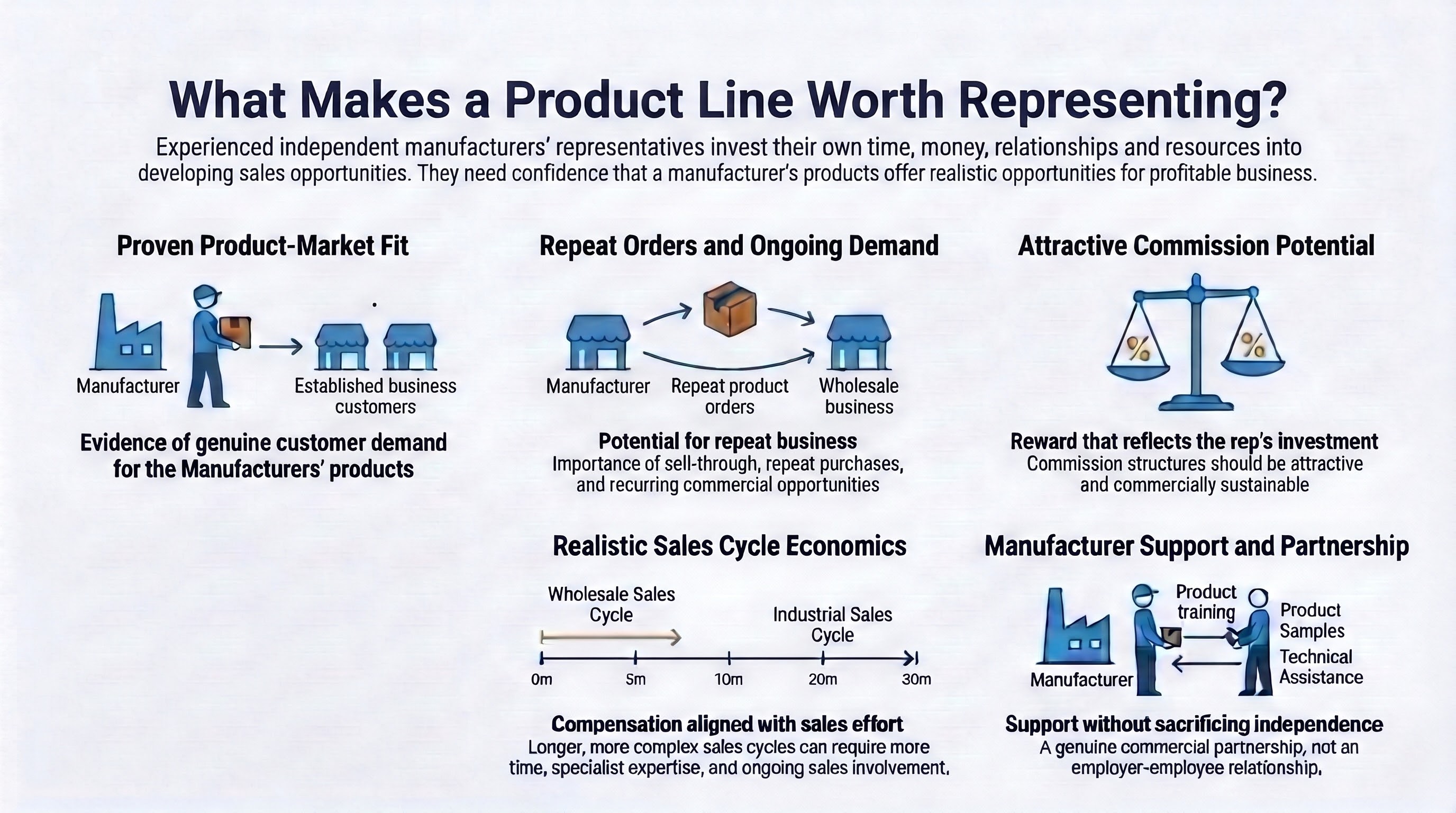
Experienced manufacturers' representatives evaluate the complete commercial opportunity, including evidence of demand, repeat-order potential, commission arrangements, sales-cycle length and the support available from the manufacturer.
Why an Opening Order Isn't the Whole Story
Consider a retailer that agrees to place a relatively small initial order to test a new product. The independent representative may have invested considerable time developing that relationship and securing the account.
However, if the products don't sell successfully through the retailer, further orders may never materialise. The representative has incurred the expense of introducing the product but may receive little additional income from the customer.
An opening order demonstrates that a business is willing to try a product. Repeat orders can provide much stronger evidence of sustained demand, particularly for products intended to be purchased regularly.
This is important because many independent manufacturers' representatives negotiate commission arrangements that provide continuing earnings from qualifying future orders placed by customers they introduce or develop.
These are commonly described as repeat-order or residual commissions. Depending on the product, territory, responsibilities and agreement, continuing commission arrangements may extend over a defined period or be linked to the ongoing customer relationship.
There is no universally applicable duration or automatic entitlement to commissions on every future order. The terms need to be negotiated clearly and must comply with applicable law.
Why Established Networks Influence Commission Negotiations
Experienced independent representatives may spend a decade or more developing trusted relationships with business customers. Those networks represent a valuable commercial asset built through years of selling, customer service and relationship development.
A representative who can introduce a manufacturer's products to relevant buyers through established relationships may be able to provide a faster route to meaningful sales conversations than someone developing a completely new customer network.
Understandably, that experience and market access can influence commission negotiations. A representative with an extensive network may seek stronger or longer-lasting commission arrangements in recognition of the value they're bringing to the manufacturer.
Manufacturers should approach these discussions fairly, recognising that independent sales professionals incur their own business expenses and receive none of the guaranteed salary or employment benefits associated with conventional employees.
The strongest opportunities combine demonstrated product demand, relevant buyer relationships and commercial arrangements that allow both businesses to benefit from the customers they develop together.
Will Your Product Line Be Worth Representing?
Even when a manufacturer has an excellent product and identifies a representative with the right customer network, the opportunity still needs to make financial sense for both businesses.
Independent representatives invest their own time, resources and expenses in learning products, meeting buyers and developing accounts. They're also deciding which opportunities deserve space within portfolios that may already contain several established product lines.
The commission percentage matters, but so does the amount of business that can realistically be generated, how frequently customers purchase and how much effort is required to secure those orders.
What Commission Percentage Should You Offer an Independent Manufacturer's Rep?
One of the questions manufacturers ask us most frequently at CommissionCrowd is what commission percentage they should offer an independent sales representative.
Our answer is that there is no universally correct percentage. The appropriate structure depends on the manufacturer's margins, products, average order values, purchasing frequency, sales cycle and the representative's responsibilities.
Based on our experience working with manufacturers and independent sales professionals, we commonly see initial commission offers for physical products in the region of 5–10% of qualifying sales.
However, this is an observation from the opportunities we've encountered, not a formal industry-wide benchmark or a recommended ceiling. Some products and commercial arrangements can justify significantly higher commissions, while others may support lower percentages.
Our advice to manufacturers is to be as generous as their commercial circumstances reasonably allow.
When approaching an experienced manufacturer's representative, you're not offering a salary in exchange for full-time dedication to your business. You're asking an independent professional to make room within their existing portfolio and invest their time, customer relationships and business resources in promoting your products, often without any guarantee of immediate earnings.
The proposed commission structure needs to make that investment worthwhile.
Start With Your Product Margins
Before deciding what commission to offer, manufacturers should establish what their products can realistically support.
This involves considering:
- Wholesale selling prices.
- Manufacturing or product acquisition costs.
- Packaging, shipping and fulfilment expenses.
- Distributor or retailer discounts.
- Returns, warranties and other variable costs.
- The margin remaining to cover commissions, overheads and profit.
The U.S. Small Business Administration's guidance on break-even calculations provides a useful framework for understanding selling prices, variable costs and contribution margins.
A manufacturer producing relatively inexpensive consumer products for wholesale distribution may have very different economics from a company manufacturing complex, high-value industrial equipment.
For example, specialist equipment sold into the petrochemical industry may involve substantial production costs, technical support requirements and lengthy purchasing procedures. A high-volume retail product, on the other hand, might generate relatively modest individual orders but considerable ongoing business through regular replenishment.
Neither category automatically justifies a particular commission percentage. What matters is the relationship between the available margin, the representative's potential earnings and the effort required to generate sales.
Consider the Representative's Potential Earnings
A 5% commission on substantial, recurring wholesale orders might be commercially attractive, while a 15% commission on occasional small orders might be considerably less appealing, particularly if the representative must invest heavily in prospecting, travel or customer development.
Manufacturers should consider the realistic earnings available to the representative rather than evaluating the percentage in isolation.
Useful questions include:
- How much business could a representative realistically generate through their existing buyer network?
- What is the average opening order from a new business customer?
- How frequently do customers place repeat orders?
- How long does the typical sales cycle last?
- How much work is required before a sale is completed?
- What support can the manufacturer provide throughout the sales process?
The answers help establish whether the opportunity is likely to justify the representative's investment of time and resources.
Factor In the Length and Complexity of the Sales Cycle
The length and complexity of the sales cycle is another important consideration when negotiating commissions with independent manufacturers' representatives.
Not all products require the same amount of time, expertise or effort to sell.
Consider a representative selling relatively straightforward, fast-moving products to established retail customers. An introduction might lead to an initial order within days or weeks, particularly if the retailer already understands the product category and has an established relationship with the representative.
If those products sell successfully, the customer may place regular repeat orders. Depending on the arrangement, the representative could generate continuing commissions without needing to repeat the entire initial sales process every time.
Now compare that with an independent representative selling highly specialised equipment into medical technology, petrochemicals or industrial manufacturing.
These opportunities may involve:
- Sales cycles lasting many months or potentially years.
- Multiple meetings with purchasing teams and technical decision-makers.
- Detailed product demonstrations and technical evaluations.
- Complex purchasing and approval procedures.
- Significant ongoing communication and relationship development.
- Considerable technical expertise and industry knowledge.
Throughout this period, the representative may be investing substantial time and resources without earning commission until a qualifying sale is completed.
The commission structure therefore needs to compensate the representative appropriately for the time, expertise, effort and commercial risk involved in developing that business.
This doesn't necessarily mean that every product with a longer sales cycle requires a higher commission percentage. A relatively small percentage of a substantial equipment sale could generate attractive earnings, while a much higher percentage on a low-value transaction might not justify the representative's investment.
The important consideration is whether the potential earnings make the opportunity worthwhile in relation to the work required and the time before payment.
A Simple Wholesale Commission Example
Imagine a manufacturer selling accessories through independent retailers. For illustration only, assume that during one year an independent representative develops 20 active wholesale accounts.
Opening Orders
- 20 retail accounts.
- Average opening order: $1,200.
- Total opening-order sales: $24,000.
Repeat Orders
- Four reorders per account during the year.
- Average reorder: $600.
- Total repeat-order sales: $48,000.
Total Illustrative Annual Wholesale Sales: $72,000.
At an illustrative, negotiated commission rate of 10%, these sales would generate $7,200 in gross commissions for the representative, assuming that all orders qualify for commission and are completed and paid.
This is a hypothetical example rather than an industry-average rate, forecast or promised result. It also doesn't account for the representative's business expenses or time investment.
Would $7,200 justify the work involved?
Potentially, if the products were a natural addition to an established portfolio and the representative could introduce them during existing customer visits. However, it might be considerably less attractive if developing those accounts required extensive travel, lengthy negotiations or building a new customer network from scratch.
From the manufacturer's perspective, $72,000 in sales doesn't represent $72,000 in profit. Production, wholesale discounts, fulfilment, customer support and commissions all need to be accounted for.
This illustrates why manufacturers and representatives should evaluate the complete commercial opportunity rather than concentrating solely on the commission percentage.
Don't Overlook Continuing Commissions on Repeat Orders
For many independent manufacturers' representatives, continuing commissions on qualifying repeat orders are an important part of making a product line commercially worthwhile.
A representative might invest considerable time opening an account with a retailer, dealer or distributor. If that customer goes on to place regular orders, the representative will often seek to negotiate continuing commissions in recognition of the relationship they introduced or developed.
The duration and structure can vary considerably. Some arrangements provide continuing commissions for a defined period, while others include different provisions depending on account responsibilities, the ongoing representation relationship or the commercial agreement.
Manufacturers and representatives should clarify which customers and orders qualify, how directly placed orders are treated, when commissions are payable and what happens if the representation agreement ends.
For a wider discussion of how experienced independent sales professionals assess potential opportunities, see our guide to choosing the right companies to represent as an independent sales rep.
Ultimately, the objective should be to create a commission structure that is commercially sustainable for the manufacturer while providing sufficient incentive for the representative to invest in developing valuable long-term customer relationships.
Can New and Innovative Product Brands Attract Experienced Reps?
Yes. A manufacturer doesn't need to be a large, established company to attract experienced independent representation, and genuinely innovative products can be particularly interesting to sales professionals looking for new opportunities.
However, innovation alone isn't necessarily enough.
An emerging manufacturer should be able to demonstrate that the product addresses a genuine need and that there is credible demand from the types of business customers it wants to reach.
This might begin with supplying a manageable group of independent retailers or other B2B customers, gathering feedback and establishing whether those businesses are successfully selling or using the products and placing additional orders.
The results can help demonstrate product-market fit and identify which customer segments and territories offer the strongest opportunities for expansion.
Rather than immediately seeking representatives across numerous countries, an early-stage manufacturer may benefit from concentrating on markets where it has already demonstrated demand and can reliably support customers.
Independent representatives can provide access to relevant business buyers, but they shouldn't be expected to fund a manufacturer's market-validation exercise or compensate for unresolved product, production or fulfilment problems.
Get Your Product Line Ready Before Approaching Representatives
Experienced independent manufacturers' representatives are selective about the opportunities they pursue, so manufacturers should make it straightforward for them to evaluate the commercial potential of their products.
Before approaching representatives, prepare the information they'll need to understand the product range, target customers, market demand, territories and proposed commercial arrangements.
Manufacturer Readiness Checklist
Wholesale Pricing and Order Terms
- Trade prices, minimum order quantities and relevant buyer terms.
- Sufficient margin information to evaluate customer and representative economics.
Product Information and Samples
- Clear product sheets, images, specifications and sales materials.
- Physical samples or demonstrations where buyers need to evaluate the products.
Evidence of Demand
- Genuine paying business customers and relevant order history.
- Repeat-order or sell-through evidence where available.
Manufacturing and Fulfilment
- Production capacity, stock availability, lead times and shipping arrangements.
- Returns, warranty and after-sales support appropriate to the products.
Commission and Manufacturer Support
- Proposed commission arrangements, including qualifying repeat orders and account attribution.
- Responsive quotation, product, technical and customer support.
The precise requirements will vary by product. Technical equipment may require drawings, certifications and specialist training, while retail products may require packaging details, case quantities and merchandising materials.
The objective is to help prospective representatives understand the opportunity and establish confidence in the manufacturer's ability to support the business they generate.
Build a Partnership That Works for Both Businesses
One of the most important things manufacturers should remember is that they're establishing a commercial relationship with another independent business, not recruiting an employee without paying a salary.
A mistake we've encountered when speaking with manufacturers unfamiliar with independent representation is the temptation to manage commission-only representatives as though they were conventional employees. This can involve expectations around fixed working hours, rigid day-to-day activity requirements or demands that representatives dedicate their entire working time to one manufacturer.
However, an independent representative's existing portfolio of complementary products is usually an advantage rather than something the manufacturer should try to eliminate.
That portfolio means the representative may already be in regular contact with relevant business buyers, creating opportunities to introduce additional products through established relationships.
Both parties can agree on appropriate objectives, responsibilities and performance indicators, but these arrangements should respect the representative's independence and be appropriate under applicable local law.
Establish Clear Commercial Agreements
Before beginning a working relationship, manufacturers and representatives should agree on the practical issues most likely to cause misunderstandings.
Territories and Customers
Which geographical regions, customer categories or named accounts are covered? Are any existing customers reserved by the manufacturer? Does the arrangement include exclusivity, and if so, what exactly does that cover?
Commissionable Business
Which transactions earn commission? How are repeat orders, direct purchases, discounts, returns, cancellations and unpaid invoices handled? When are commissions calculated and paid?
Responsibilities
Who provides quotations, samples, demonstrations, product training and technical assistance? Who manages customer enquiries, order fulfilment and after-sales support?
Relationship Continuity
What happens to opportunities already in progress if the agreement ends? Are there notice periods, continuing commission provisions or other contractual or statutory obligations?
Sales agency and independent contractor rules vary across jurisdictions, so agreements should be reviewed appropriately for the countries involved. Manufacturers shouldn't assume that an agreement suitable for one territory will necessarily be appropriate elsewhere.
For a broader discussion of interviewing, agreements, onboarding and ongoing relationships, see our complete guide to hiring manufacturers' reps.
Start With a Defined Market, Then Develop the Relationship
Manufacturers don't necessarily need independent representatives covering every market from day one. It often makes more sense to begin with a clearly defined customer segment or territory where there is credible evidence of demand and the manufacturer can provide appropriate support.
An experienced representative may be able to begin exploring opportunities through existing buyer relationships relatively quickly. However, an introduction or initial customer conversation shouldn't be confused with a confirmed order.
Both businesses should agree on sensible indicators of progress, taking account of the products and their typical purchasing cycles. These might include qualified buyer introductions, product demonstrations, sample requests, quotations, customer feedback and the development of genuine sales opportunities.
Such information can be shared through mutually agreed communication methods or CRM tools without treating the representative as a monitored employee.
The support required will also vary depending on the complexity of the products and the representative's technical experience.
A straightforward retail product may require good product information, samples and reliable order handling. Highly specialised equipment, on the other hand, may require the manufacturer to participate in customer meetings, conduct demonstrations or provide detailed technical expertise throughout the sales process.
Even where an independent representative has excellent buyer relationships, the manufacturer still needs to play an active role in supporting the opportunities being developed.
Successful partnerships depend on open communication, realistic expectations, dependable support and both businesses honouring their agreed commitments.
Find Independent B2B Sales Representatives Through CommissionCrowd
CommissionCrowd is a global B2B network and SaaS platform dedicated to connecting companies with independent, self-employed, commission-only sales professionals.
Our community includes more than 33,000 registered sales agents across different industries, markets and territories.
Manufacturers and product brands can use CommissionCrowd to present their sales opportunities, make direct connections with independent professionals and access tools designed to support their ongoing working relationships.
Our team also works with company members to help them understand independent representation and prepare opportunities that make commercial sense for experienced sales professionals.
We're not an outsourced sales agency, and the professionals within our network aren't CommissionCrowd employees. Companies and independent representatives decide whether to work together and establish their own commercial relationships.
If you're looking to expand wholesale distribution, develop new retail or dealer accounts, or reach other B2B customers, start by identifying the buyers you want to reach and what an independent representative would need to make your products a worthwhile addition to their portfolio.
Explore how CommissionCrowd can help you connect with independent B2B sales professionals.
About the Author
Ryan Mattock is Co-Founder and CMO of CommissionCrowd, a global B2B network connecting manufacturers and other businesses with experienced, independent commission-only sales professionals.
Ryan co-founded CommissionCrowd after experiencing first-hand the challenges of building and managing an independent sales team. Since the platform launched in 2015, he has worked closely with manufacturers, product brands and self-employed sales professionals, helping companies understand what attracts experienced representatives and how to build successful, long-term commercial partnerships.
His insights draw on years of practical experience in the independent B2B sales industry, particularly around product-market fit, buyer networks, commission structures and the importance of respecting the autonomy of independent sales professionals.
Frequently Asked Questions
How do I find independent sales reps to sell my products to retail stores?
Start by identifying the types of retailers you want to reach and the people responsible for purchasing decisions. Look for independent representatives who already sell complementary products to those buyers through specialist B2B networks, customer referrals, manufacturers, trade events and professional connections. Evaluate their existing relationships, territories and portfolio compatibility before agreeing to work together.
What are the best platforms for manufacturers to find independent sales representatives?
The most suitable platform depends on the manufacturer's products, target buyers and territories. Manufacturers should look for specialist B2B networks that focus on genuinely self-employed sales professionals, support the presentation of commission-based opportunities and help both parties evaluate commercial compatibility. CommissionCrowd is a dedicated global network and SaaS platform for independent, commission-only B2B sales professionals, providing connections, guidance and tools to support ongoing working relationships.
Can independent sales representatives sell products that consumers eventually buy?
Yes. Independent representatives may sell household goods, electronics accessories, sporting products, hardware and many other categories wholesale to retailers, distributors and dealers. Although consumers may ultimately purchase these products, the representative's customers are businesses. This is B2B representation rather than direct-to-consumer selling or affiliate marketing.
Should I find a sales agent or a distributor for my products?
An independent sales agent generally develops business on behalf of a manufacturer in return for commission without purchasing stock for resale. A distributor typically buys or otherwise supplies products for resale and earns a trading margin. The most suitable arrangement depends on who will manage customer relationships, inventory, fulfilment and ongoing distribution. Some manufacturers benefit from working with both.
Is product experience or existing buyer access more important when choosing a rep?
Both are important, but established relationships with your ideal business buyers can be a particularly valuable starting point. A representative selling complementary products into the same customer network may be well placed to introduce your range, even without experience selling an identical product. Specialist technical expertise becomes increasingly important where products require detailed demonstrations, engineering knowledge or complex approvals.
How should I approach an independent manufacturer's rep about representing my products?
Approach the representative as a potential business partner rather than a job applicant. Briefly explain your products, target customers, evidence of existing demand, territories and proposed commission arrangements. Demonstrate that you understand the representative operates an independent business and already carries other product lines. The initial objective should be to establish whether your products could complement their existing portfolio and justify a more detailed conversation.
What commission percentage should I offer an independent wholesale sales representative?
There is no fixed industry-wide commission percentage. Based on CommissionCrowd's experience working with manufacturers, initial offers for physical products commonly fall around 5–10% of qualifying sales, although actual arrangements may be higher or lower depending on the products, margins, order values, sales cycles and work involved. Manufacturers should aim to be as generous as their commercial circumstances reasonably allow while considering the representative's potential earnings from both initial and repeat orders.
Do independent manufacturers' reps earn commission on repeat orders?
Many independent manufacturers' representatives negotiate continuing commissions on qualifying orders from customers they introduce or develop. The rate, eligible accounts, duration and treatment of direct orders should be agreed clearly in writing. Arrangements vary depending on the industry, responsibilities, commercial agreement and applicable law, and continuing commissions aren't automatically guaranteed on every future purchase.
Can a new product brand find experienced independent sales agents?
Yes, provided the commercial opportunity is credible. Innovative products can attract interest, but experienced representatives generally want evidence of paying business customers, workable wholesale pricing, reliable fulfilment and manufacturer support. Repeat orders or other convincing evidence of product-market fit can strengthen the opportunity. Without sufficient market validation, the manufacturer may need to establish demand before seeking widespread independent representation.
Can independent reps help manufacturers sell to major retail chains such as Walmart or Target?
Potentially, yes. Some experienced independent manufacturers' representatives have established relationships with purchasing teams and category buyers at major national and international retailers. Manufacturers should explore these relationships during their initial discussions with prospective representatives, even if specific retailers aren't named in their profiles. An existing buyer relationship can provide a valuable introduction, but it doesn't guarantee a retail listing or bypass the retailer's supplier approval requirements.
How quickly should a manufacturer expect results from an independent sales rep?
An experienced representative may be able to begin conversations with existing buyer contacts relatively quickly. However, the time required to secure orders depends on the product, customer requirements, sales cycle and purchasing process. Both parties should agree on meaningful early indicators of progress, such as qualified introductions, sample requests, demonstrations and genuine opportunities, without assuming immediate revenue or imposing employee-style controls.
What should a manufacturer prepare before contacting independent reps?
Manufacturers should prepare clear product information, target buyer profiles, intended territories, wholesale pricing, evidence of demand, delivery capabilities, sales materials and proposed commission arrangements. They should also be ready to explain how repeat orders, customer support and ongoing working relationships will be managed.

More articles from CommissionCrowd
World-Class Software Engineering Sales Opportunity - 35% Commission + Residuals
World-Class Software Engineering Sales Opportunity - 35% Commission + Residuals
Why You'll Never Find Great Self-Employed Sales Professionals on Gumtree or
Why You'll Never Find Great Self-Employed Sales Professionals on Gumtree or Generic Job Websites