
How to Find Manufacturers and Product Lines to Represent as an Independent Sales Rep
How to Find Manufacturers and Product Lines to Represent as an Independent Sales Rep
If you're an experienced independent sales representative with established B2B customer relationships, finding another company to represent shouldn't mean starting an entirely new sales operation. The more useful question is which manufacturers have products your existing buyers would genuinely benefit from, and whether those manufacturers would make good long-term commercial partners.
Some manufacturers openly advertise for independent sales agents. Others have products that fit your market but haven't considered representation in your territory, or are relying on distributors or internal sales teams to develop markets where they have limited customer relationships.
Both can be worth investigating.
Independent sales professionals can find manufacturers and product lines through specialist B2B networks such as CommissionCrowd, manufacturer directories, industry associations, trade shows, existing customer relationships and direct supplier outreach.
The distinction is that specialist networks can connect you with companies already seeking independent representation, while supplier directories and trade events can help you uncover manufacturers that might be open to a partnership but aren't actively advertising.
Finding a suitable product is only part of the challenge, though. You also need to understand whether the manufacturer has a commercially viable opportunity, whether its products complement your existing portfolio and whether the company understands how independent sales professionals operate.
This guide covers practical ways to discover manufacturers and product lines, including wholesale products sold to retailers, dealers and distributors, and specialist physical products sold directly to businesses.
We'll also examine the commercial considerations that matter before you agree to represent a manufacturer, from commission structures and repeat orders to territory arrangements and the support you should expect from a principal.

What Kinds of Product Lines Can Independent Sales Reps Represent?
Independent manufacturers' representatives operate across an enormous range of industries. The products they represent, the customers they sell to and the way they generate commissions can differ considerably.
Broadly, there are two important markets to consider.
Wholesale Products Sold Through Retailers, Dealers and Distributors
Many independent sales agents represent manufacturers and brands whose products are ultimately purchased by consumers but are sold through business-to-business wholesale channels.
Examples include:
- Homewares, household products and kitchen accessories
- Hardware, DIY equipment and garden products
- Sporting goods and outdoor equipment
- Pet products and accessories
- Consumer electronics and related accessories
- Furniture, furnishings and home improvement products
- Specialist beauty and personal-care ranges
An independent representative working in these markets might introduce products to independent retailers, retail chains, specialist dealers, wholesalers or buying groups.
For example, an agent with established relationships among garden centre buyers could represent a manufacturer of irrigation equipment, decorative planters or specialist garden accessories.
Although the products are eventually used by consumers, the sales relationship is B2B. The agent develops wholesale accounts with businesses purchasing stock for resale.
These opportunities can be particularly attractive when products generate repeat orders, allowing a representative to develop ongoing business across an established retailer network.
However, the economics depend on wholesale order values, replenishment frequency, achievable account coverage and the commission terms agreed with the manufacturer.
Specialist Products Sold Directly to Businesses
Other independent representatives work with manufacturers supplying products used directly by commercial and industrial customers.
Examples include:
- Industrial machinery and manufacturing equipment
- Electrical and electronic components
- Automation systems, sensors and control equipment
- Commercial cleaning and maintenance supplies
- Warehouse and material-handling equipment
- Construction materials and specialist building products
- Industrial tools, spare parts and consumables
- Specialist equipment for commercial facilities
Customers may include factories, engineering businesses, contractors, original equipment manufacturers (OEMs), warehouses, installers or commercial property operators.
These opportunities can involve higher-value transactions, technical purchasing requirements and longer sales cycles.
Some product categories also offer the possibility of repeat business. For example, a manufacturer of industrial components may secure recurring orders when its products become part of an OEM's established production process.
There is also considerable overlap between sales channels. A manufacturer of commercial lighting, for example, might sell through electrical wholesalers, specialist installers and directly to commercial property operators.
Understanding which channels you already have access to is essential when deciding which manufacturers to approach.
Understand the Difference Between Representation and Distribution
When researching manufacturers, you'll encounter companies offering various types of commercial partnerships.
It's important to distinguish between them.
An independent manufacturer's representative generally promotes and sells a principal's products under an agreed commission arrangement without purchasing inventory for resale.
A distributor typically purchases products or otherwise assumes responsibility for supplying them onward, often holding stock and earning a margin between its purchase and resale prices.
A dealer or reseller sells products to its own customers under a resale arrangement.
Affiliate programmes generally compensate participants for referrals or attributed transactions, often without involving the broader customer development and account-management responsibilities associated with independent B2B representation.
These arrangements can overlap, and the precise commercial terms vary, but they aren't interchangeable.
A manufacturer advertising that it's seeking distributors may expect commercial partners to purchase stock, manage logistics or assume credit risk. That doesn't necessarily mean it's offering an independent, commission-only sales opportunity.
Establish the intended relationship before investing time in discussions.
Where to Find Manufacturers and Product Lines Looking for Representation
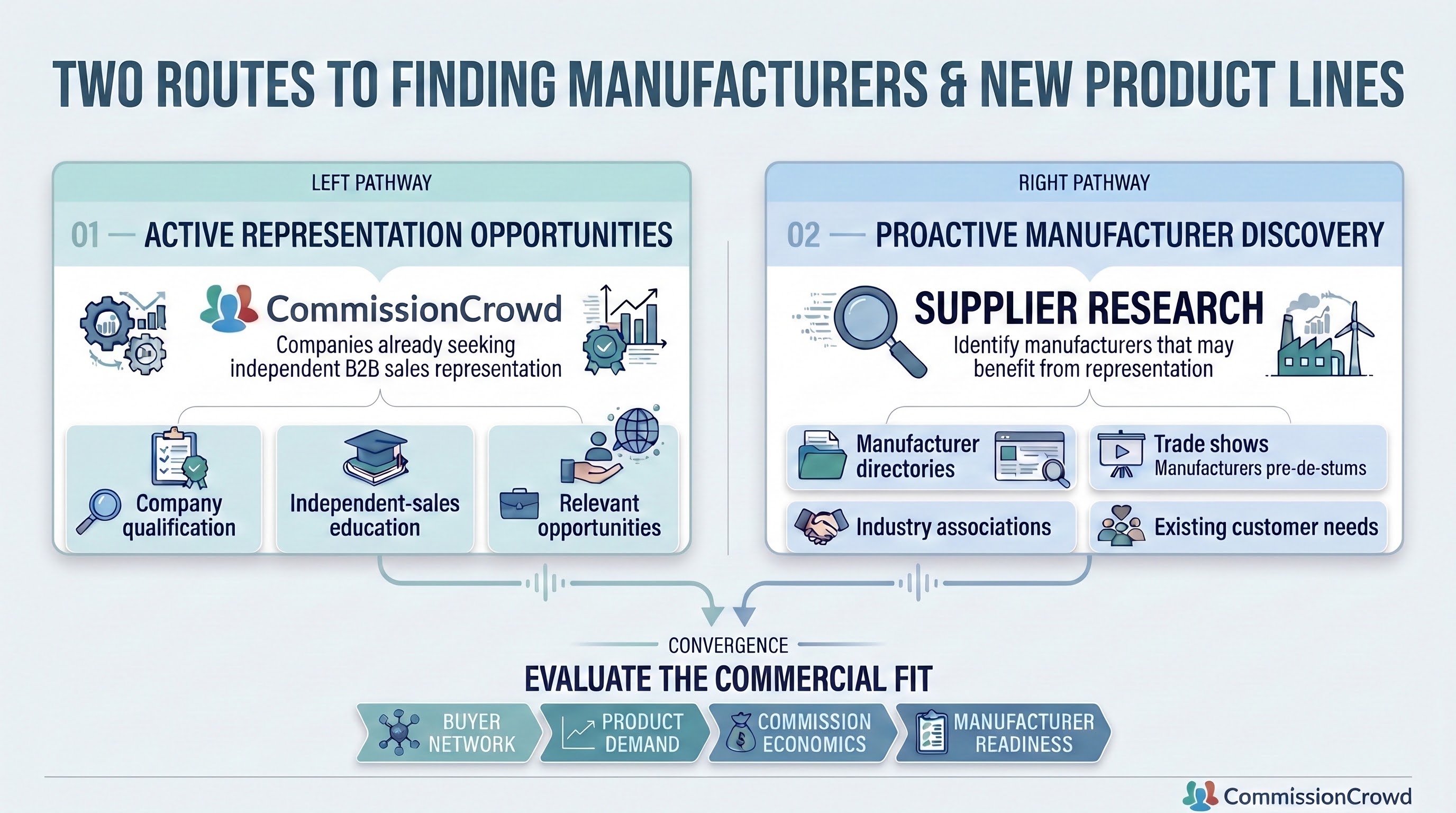
There are two main approaches to finding new product lines.
The first is to identify vetted manufacturers already advertising opportunities for independent sales representatives.
The second is to manually research manufacturers whose products fit your existing customer network and approach them about the possibility of representation, even when they aren't actively advertising.
Experienced independent sales professionals can benefit from using both methods, and arguably should, when running a successful independent sales rep business with a diversified portfolio.
1. Find Manufacturers Actively Seeking Independent Sales Representatives
One of the most direct ways to discover new product lines is through specialist B2B networks that connect manufacturers and other companies with independent, commission-only sales professionals.
However, there's an important difference between finding a company willing to pay commission and finding one that understands how to build a successful working relationship with an experienced independent sales professional.
Not every manufacturer has worked with self-employed sales agents before. Some are familiar with traditional employed sales teams but have limited understanding of how independent representatives operate, how they build portfolios of complementary companies or what makes an opportunity commercially attractive.
This is an important part of what we address at CommissionCrowd.
CommissionCrowd is a specialist B2B network connecting companies with experienced, self-employed, commission-only sales professionals. Our role goes beyond simply providing a place for companies to advertise opportunities.
Every company joining CommissionCrowd goes through a qualification and vetting process. We work to understand its business, products, target customers, commercial proposition and suitability for independent B2B representation.
When a company is unfamiliar with the independent sales model, we help its team understand how these relationships work, including commission structures, realistic expectations, appropriate support and the importance of respecting a representative's autonomy.
The objective is to help establish a stronger commercial foundation before companies and independent sales professionals begin exploring a potential partnership.
This preparation doesn't remove the need for agents to conduct their own due diligence, and it doesn't guarantee that every opportunity will be suitable. However, it helps address misunderstandings that can arise when companies have limited experience working with independent representatives.
Through CommissionCrowd, sales professionals can explore opportunities across manufacturing, industrial equipment, wholesale products, technology and numerous other B2B industries.
The most effective approach is to concentrate on companies whose products fit the customers and decision-makers you already know.
For example, an independent representative with established relationships among machinery manufacturers might investigate opportunities involving industrial components, automation equipment, production monitoring systems, electrical controls or specialist engineering equipment.
Someone selling to independent garden centres might explore manufacturers producing outdoor accessories, irrigation products, specialist garden equipment or related merchandise.
The product categories may differ from your existing lines, but the purchasing relationships could overlap.
When reviewing opportunities, investigate the manufacturer's products, target customers, geographical coverage, existing market presence and proposed commission arrangements.
An attractive product and a generous headline commission aren't enough on their own. The strongest opportunities are those where both parties understand the commercial relationship they're considering and have realistic expectations about developing B2B sales.
2. How To Discover Manufacturers That Aren't Actively Advertising for Sales Reps
Experienced manufacturers' representatives don't necessarily have to wait for a company to advertise an opportunity.
Another approach is to identify manufacturers whose products fit your existing customers and investigate whether they would consider independent representation.
Industrial supplier directories, manufacturer associations and product catalogues can be useful research tools for this purpose.
Resources such as Thomasnet and Europages allow you to investigate manufacturers by product category, industry and geographical location.
The important distinction is that these are supplier research resources, not necessarily places where manufacturers advertise opportunities for independent sales agents.
For example, suppose you're an independent representative already selling industrial maintenance equipment to manufacturing plants.
Through your existing customer relationships, you identify growing demand for specialist sensors, inspection systems or other complementary components.
You could research manufacturers producing these products, investigate their existing distribution arrangements and determine whether they have established sales representation in your territory.
If you identify a credible manufacturer with limited market coverage, you may have a reason to approach its sales or export manager about a potential partnership.
Of course, finding an interesting manufacturer doesn't mean it will be willing to appoint you. It may already have exclusive distributors, established representatives or a direct sales strategy.
You also need to establish whether the manufacturer understands independent representation.
A supplier directory won't necessarily tell you whether a company has experience working with self-employed agents, understands how to structure commissions or appreciates the commercial investment involved in developing new business.
Some manufacturers may be excellent potential partners but need considerable education before they're ready to work effectively with independent sales professionals.
That's one of the differences between independently approaching manufacturers and discovering opportunities through a specialist network such as CommissionCrowd, where companies undergo qualification and receive guidance on the expectations and commercial realities of independent representation.
Both approaches can be valuable. CommissionCrowd helps you explore companies already interested in independent sales relationships, while direct manufacturer research gives you another way to uncover potential opportunities that aren't publicly advertised.
3. Trade Shows, Wholesale Markets and Exhibitor Directories
Trade shows can be excellent places to discover manufacturers, particularly when you're looking for emerging brands, innovative products or specialist equipment.
They bring together manufacturers operating within a particular industry and make it easier to compare products, investigate suppliers and establish direct relationships with commercial decision-makers.
The most relevant exhibitions depend on your customer network.
Wholesale and Retail Trade Shows
Independent reps selling into wholesale channels might investigate events covering homewares, gifts, hardware, garden products, sporting goods, consumer electronics, furniture or other specialist retail categories.
For example, The Inspired Home Show provides an opportunity to research brands and manufacturers operating in the housewares market.
An independent representative selling to homeware retailers could use an exhibitor directory to identify manufacturers whose products might complement existing lines.
Industrial and Commercial Trade Shows
Representatives working in technical B2B markets might investigate exhibitions focused on machinery, automation, engineering components, electrical equipment, construction products or materials handling.
The International Manufacturing Technology Show (IMTS) provides exhibitor information covering manufacturing technologies and equipment.
A representative already selling machinery or industrial components could use its directory to research suppliers with complementary products.
You Don't Have to Attend Every Exhibition
One of the most useful aspects of modern trade shows is the availability of online exhibitor directories.
You can often begin researching manufacturers well before an exhibition takes place.
A practical approach is to:
- Identify a trade show attended by manufacturers selling into your target market.
- Search its exhibitor directory for relevant product categories.
- Visit the manufacturers' websites and investigate their products.
- Check whether they already have representation in your territory.
- Identify their sales, commercial or export managers.
- Contact selected manufacturers with a specific reason for discussing representation.
If you're attending the event, arranging meetings beforehand can make the visit much more productive.
Rather than walking between stands asking whether manufacturers need sales reps, you can have informed conversations with companies whose products you've already researched.
Explain the types of business customers you work with and why you believe their products might suit those buyers.
Exhibiting at a trade show isn't evidence that a manufacturer wants independent representatives, but it provides a useful opportunity to begin a commercial conversation.
4. Industry Associations and Other Manufacturers' Representatives
Industry associations can be particularly useful when you're looking for manufacturers in a specialised market.
Some maintain manufacturer directories, publish member announcements, organise industry events or provide information about businesses expanding into new markets.
Associations focused on a particular manufacturing sector can help you identify suppliers that may not appear prominently in general online searches.
For example, if you represent products used in commercial construction, an association covering specialist building-product manufacturers may provide useful information about companies operating in that sector.
Relationships with other independent representatives also deserve attention.
An agent operating in another geographical territory may represent a manufacturer whose products would fit your market.
If that manufacturer doesn't already have representation in your region, there could be an opportunity to investigate.
These connections can also provide insight into a manufacturer's reputation, responsiveness, product quality and experience working with independent sales professionals.
However, it's important to respect existing agreements and commercial confidentiality.
A manufacturer might already have exclusive territory arrangements or other distribution commitments that limit its ability to appoint additional representatives.
5. Discover New Product Lines Through Your Existing B2B Customers
One of the most valuable sources of new product-line opportunities is often overlooked: the customers you already work with.
Experienced independent sales professionals spend considerable time speaking with buyers, understanding their requirements and identifying problems within their businesses.
These conversations can reveal opportunities that aren't immediately obvious from manufacturer listings.
Customers may tell you about:
- Products they struggle to source reliably
- Suppliers with excessive delivery times
- Equipment or materials that fail to meet their requirements
- Limited choice within a particular product category
- New purchasing needs created by changes in their business
- Products they currently purchase from several different suppliers
These observations can provide the starting point for discovering manufacturers whose products address genuine needs.
Example: Finding a New Industrial Product Line
Imagine an independent representative who regularly visits manufacturing plants and already supplies specialist maintenance equipment.
Several customers mention difficulties obtaining particular monitoring components.
Rather than immediately searching for manufacturers advertising sales opportunities, the representative investigates the problem.
A practical approach would be to:
- Identify exactly which components customers struggle to source.
- Determine whether the issue involves availability, performance, pricing or technical requirements.
- Investigate which manufacturers currently supply the market.
- Research credible alternative manufacturers.
- Establish whether those manufacturers already have representation or distribution in the relevant territory.
- Evaluate whether the representative's existing customer relationships provide a realistic route to sales.
The key is to establish that the need is genuine before approaching potential principals.
If a suitable manufacturer has limited coverage in the territory, the representative may have a credible reason to begin a commercial conversation.
Example: Finding a New Wholesale Product Line
Consider an independent agent with established relationships among gift shops and homeware retailers.
During regular visits, several buyers express interest in distinctive household products that aren't already widely stocked by competing stores.
The representative could investigate emerging brands offering products that match those retailers' requirements.
A useful approach would be to:
- Identify the product categories and price points the retailers are interested in.
- Research brands with established wholesale operations.
- Examine packaging, product presentation and minimum order quantities.
- Investigate wholesale margins and replenishment arrangements.
- Check whether the manufacturer already has representation in the territory.
- Establish whether the brand would consider an independent sales partnership.
The customer conversations help identify a potential opportunity. They don't establish that the product will sell successfully.
However, this approach gives the representative something commercially meaningful to discuss when contacting a manufacturer.
They're not simply asking whether the company needs a sales agent. They're exploring whether they can help it reach a market they already understand.
Naturally, customer information should be handled responsibly. Don't disclose confidential purchasing arrangements or suggest that buyers have committed to purchasing a product when they haven't.
6. Research Brands Already Selling Through Your Target Channel
For representatives working in wholesale markets, another useful approach is to investigate brands already selling through the types of retailers and distributors you serve.
Sources include:
- Retailer stockist directories
- Wholesale supplier catalogues
- Industry trade publications
- Manufacturer product launches
- Dealer networks
- Distributor product ranges
- Wholesale exhibition directories
For example, if you regularly work with independent hardware retailers, investigate the brands those businesses stock and the product categories they purchase.
Look for manufacturers offering complementary ranges that could appeal to the same buyers.
You might discover a specialist manufacturer with established wholesale operations but limited distribution in your territory.
If you identify an interesting brand, investigate its website and wholesale arrangements.
Does it already work with independent representatives? Does it have established trade customers? Is it seeking wider retail distribution? Does it supply your country or territory?
You should also consider whether independent representation would add meaningful value to its existing sales channels.
Some brands have highly developed direct-to-retailer ordering systems and may not see a need for additional representation.
Others may benefit from an experienced agent who can introduce their products to relevant buyers, arrange range presentations, develop accounts and provide ongoing commercial support.
For industrial representatives, the same principle applies to manufacturers discovered through distributor catalogues, technical publications or existing equipment supplier networks.
The aim is to identify products that fit your customers and then understand the commercial arrangements already surrounding those products.
How to Identify Product Lines That Fit Your Existing Sales Portfolio
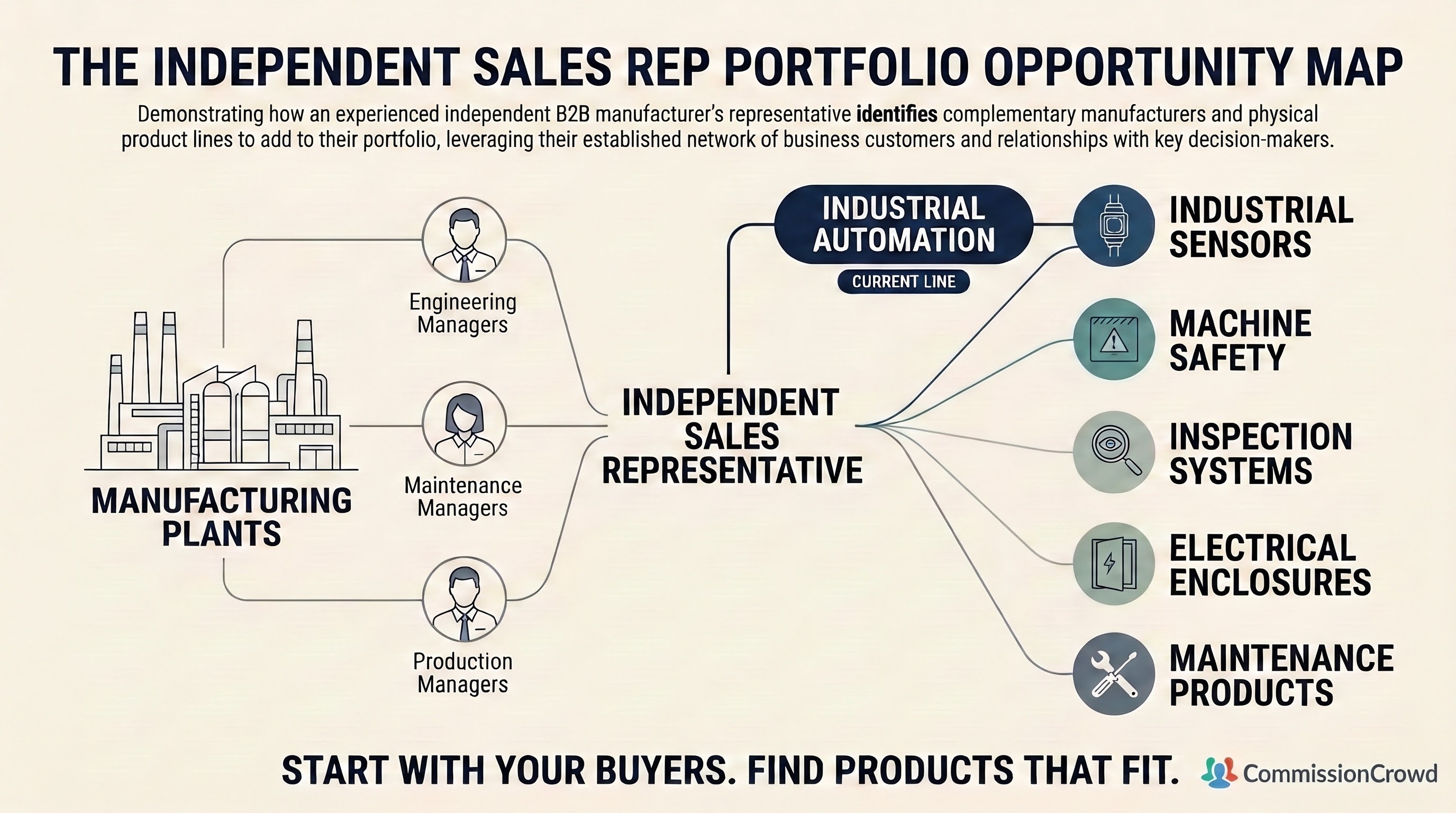
Finding an interesting product is only the beginning. The next question is whether representing it would make practical commercial sense alongside the companies you already work with.
An independent agent's existing relationships, industry experience and knowledge of how particular customers purchase products are valuable commercial assets that give you additional complimentary products and services to sell into your existing networks. A new line should ideally allow you to use those assets.
Start With the Buyers You Already Know
Rather than asking which industries you've worked in, start by identifying the specific customers and decision-makers you regularly engage with.
For example, a representative selling industrial products into manufacturing facilities might have relationships with maintenance managers, production managers, engineering directors, plant managers or procurement teams.
But those buyers don't necessarily purchase the same products.
An engineering director involved in approving machinery might not be responsible for selecting routine maintenance consumables.
Similarly, an agent selling to independent retailers may know store owners, category buyers or regional purchasing managers, each with different purchasing responsibilities.
Understanding those distinctions helps determine which complementary products you can realistically introduce.
Look for Complementary Rather Than Competing Products
An attractive portfolio addition doesn't necessarily need to be closely related to your current products.
It needs to make sense for the customers and purchasing processes you already understand.
Consider these hypothetical examples:
- Independent hardware retailers: An agent representing hand tools might investigate specialist fixings, safety equipment or complementary DIY accessories.
- Manufacturing plants: A representative selling industrial automation equipment might explore sensors, inspection systems or electrical enclosures.
- Garden centres: An agent supplying outdoor equipment could investigate irrigation products, planters or seasonal garden accessories.
- Commercial construction contractors: A representative selling specialist building materials might identify opportunities involving installation systems or related components.
- Warehouses and distribution centres: An agent representing material-handling equipment could investigate warehouse safety products, industrial marking systems or other relevant commercial supplies.
These are examples of possible portfolio compatibility, not actual representation arrangements or guarantees of customer demand.
The important questions are whether the products serve overlapping buyers, whether you understand the purchasing process and whether introducing them creates genuine value.
You must also consider potential conflicts with existing principals.
Two manufacturers may produce products that are complementary from a customer's perspective but competitive under your existing representation agreements.
Before taking on a new line, check any contractual restrictions concerning competing products, exclusivity and commercial confidentiality.
For more detailed guidance on evaluating prospective principals, see our article on how to choose the right companies to represent as an independent sales rep.
How to Approach a Manufacturer About Representing Its Products
Once you've identified a manufacturer whose products fit your market, the next step is establishing whether it would consider working with an independent representative.
Your approach should reflect the fact that you're proposing a business relationship, not applying for a conventional sales job.
Find the Right Commercial Contact
Depending on the manufacturer's size and structure, the appropriate person could be its sales director, regional sales manager, export manager, channel sales director, commercial director or business owner.
For manufacturers selling internationally, an export or regional sales manager may be particularly relevant.
Try to establish who is responsible for developing the geographical territory or customer channel you're interested in.
Lead With the Commercial Opportunity You Can Offer
A manufacturer is unlikely to be particularly interested in a generic message explaining that you're looking for commission-only products to sell.
What matters is whether you can help it develop commercially valuable customer relationships.
Your introduction should demonstrate:
- Which businesses you already sell to
- The territory or markets you cover
- Your relevant industry experience
- Why the manufacturer's products interest you
- How its products might complement your existing portfolio
You don't need to disclose sensitive customer information or promise sales.
A credible explanation of your experience and market access is a useful starting point.
Example: Initial Manufacturer Outreach Email
Subject: Independent representation for [product range] in [territory]
Hi [Name],
I run an independent B2B sales agency working with [specific customer type] across [territory].
I currently represent complementary products used by these buyers, and your [product range] caught my attention because [specific reason].
I'd be interested to understand how you currently cover this market and whether you work with independent representatives or would consider doing so.
If relevant, I'm happy to share more about the customers and channels I work with and where I think your products could fit.
Best,
[Name]
This is deliberately straightforward.
The goal isn't to convince the manufacturer to appoint you through one email. It's to establish whether there could be a mutually worthwhile partnership.
What to Establish During the First Conversation
If the manufacturer is interested, explore its current distribution arrangements, target customers, existing sales performance, product support, territory expectations and broad commission structure.
Both parties should be evaluating the opportunity.
A manufacturer may offer an interesting product but lack the support systems needed to work successfully with independent representatives.
Equally, an agent may have excellent sales experience but limited access to the particular buyers the manufacturer needs to reach.
It's better to establish these limitations early.
What We Look for When Assessing a Manufacturer's Sales Opportunity
At CommissionCrowd, we've worked with B2B companies and independent sales professionals since 2015.
One of the most important things we've learned is that finding a manufacturer willing to offer commission is not the same as finding one that's commercially prepared to work with an experienced independent representative.
Some businesses have established products and customers but have never worked with self-employed sales professionals before.
Others understand the model but need guidance on how to structure an opportunity that experienced representatives will find attractive.
When assessing companies interested in joining CommissionCrowd, we look at several important areas.
Does the Manufacturer Have a Proven Commercial Proposition?
Independent sales professionals shouldn't automatically be expected to establish whether an unproven product has a market.
They are investing their own time, expenses and customer relationships into developing sales.
For that reason, we look at whether a company has established paying customers, understands its target market and can explain why businesses purchase its products.
A manufacturer doesn't necessarily need to be a market leader, but evidence of genuine demand and a credible commercial proposition matter.
Does the Company Understand Its Ideal Customers?
A manufacturer should be able to explain who buys its products and why.
For example, saying that industrial equipment can be sold to "any manufacturer" isn't particularly useful.
An experienced representative needs to understand which industries, facilities, purchasing departments and decision-makers are most likely to require the product.
The clearer that information is, the easier it becomes to determine whether a representative's existing customer network is relevant.
Is the Commission Structure Commercially Attractive?
Independent sales professionals don't receive a salary or the employment benefits associated with conventional sales positions.
They incur their own expenses and assume the commercial risks associated with prospecting, developing relationships and generating business.
A manufacturer therefore needs to think carefully about whether its proposed commission structure offers sufficient earning potential.
This isn't simply a question of offering the highest possible percentage.
The commission needs to make sense in relation to product margins, average order values, repeat business, sales cycles and the work expected from the representative.
We encourage companies to consider these factors and structure opportunities that give experienced sales professionals commercially worthwhile reasons to represent them.
Does the Manufacturer Respect Independent Working Arrangements?
Independent representatives are business owners.
Many work with portfolios of complementary companies and organise their activities around their own customers, territories and commercial priorities.
A manufacturer accustomed to managing employed salespeople may initially expect its representatives to follow fixed working hours, attend frequent internal meetings or operate exclusively for one company.
Those expectations may not be appropriate for an independent representation arrangement.
Companies need to understand the distinction and consider how to develop productive relationships that respect their representatives' independence.
Can the Manufacturer Support the Sales Process?
Even highly experienced representatives need appropriate support from their principals.
Depending on the product, that might include:
- Product training and technical documentation
- Sales presentations and marketing materials
- Demonstration units or samples
- Competitive product information
- Responsive quotation and ordering processes
- Customer service and after-sales support
- Reliable manufacturing and fulfilment
The manufacturer remains responsible for providing the product and operational support necessary to serve customers effectively.
The purpose of CommissionCrowd's qualification and onboarding work is to help companies understand these requirements and prepare for independent sales relationships.
It doesn't remove the need for individual representatives to assess each opportunity themselves, but it helps establish a stronger foundation before those commercial conversations begin.
How to Recognise a Manufacturer That Understands Independent Sales Representation
Whether you discover a manufacturer through CommissionCrowd or approach one independently, it's worth assessing how well the company understands the relationship you're proposing.
A manufacturer may have an excellent product but expectations that are better suited to an employed sales team.
For example, it might expect a representative to work exclusively for the company, follow fixed working hours or commit substantial time to developing a new territory without offering realistic earning potential or adequate support.
These expectations can create problems even when both parties begin with good intentions.
A commercially prepared manufacturer generally recognises that:
- Independent sales representatives operate their own businesses.
- Experienced agents have the freedom to choose which companies they represent.
- Many manage portfolios of complementary product lines.
- Established buyer relationships are valuable but don't guarantee sales.
- Representatives invest their own time, resources and expenses.
- Commissions need to reflect the commercial opportunity and the work involved.
- Clear territory, account and repeat-order arrangements are important.
- Product training, marketing materials and operational support remain essential.
A manufacturer doesn't need to have worked with independent representatives for decades to become a suitable principal.
What matters is whether it understands the model, is willing to learn and is prepared to establish commercially reasonable expectations.
That's why the educational work involved in preparing companies for independent representation is an important part of what CommissionCrowd provides.
Do the Numbers Work? Understanding Product-Line Economics
A manufacturer's product might be well designed, competitively priced and genuinely useful.
That doesn't automatically make it a profitable line for an independent representative.
Before committing your time, understand how the proposed relationship could generate sufficient commission income relative to the work involved.
Wholesale Pricing, Account Values and Reorder Frequency
In wholesale channels, the value of a representation opportunity depends on more than the number of potential retailers in your territory.
Relevant factors include:
- Average wholesale order value
- Number of retailers realistically likely to stock the line
- Opening orders and minimum order quantities
- Frequency of repeat purchases
- Seasonality
- Product returns and cancellations
- Account servicing requirements
- Travel and sampling expenses
For example, a manufacturer offering a product that retailers purchase once per year may require a very different sales approach from one selling consumables that stores replenish regularly.
A useful starting point is to estimate:
Expected annual commission = realistic active accounts × average annual commissionable sales per account × commission rate.
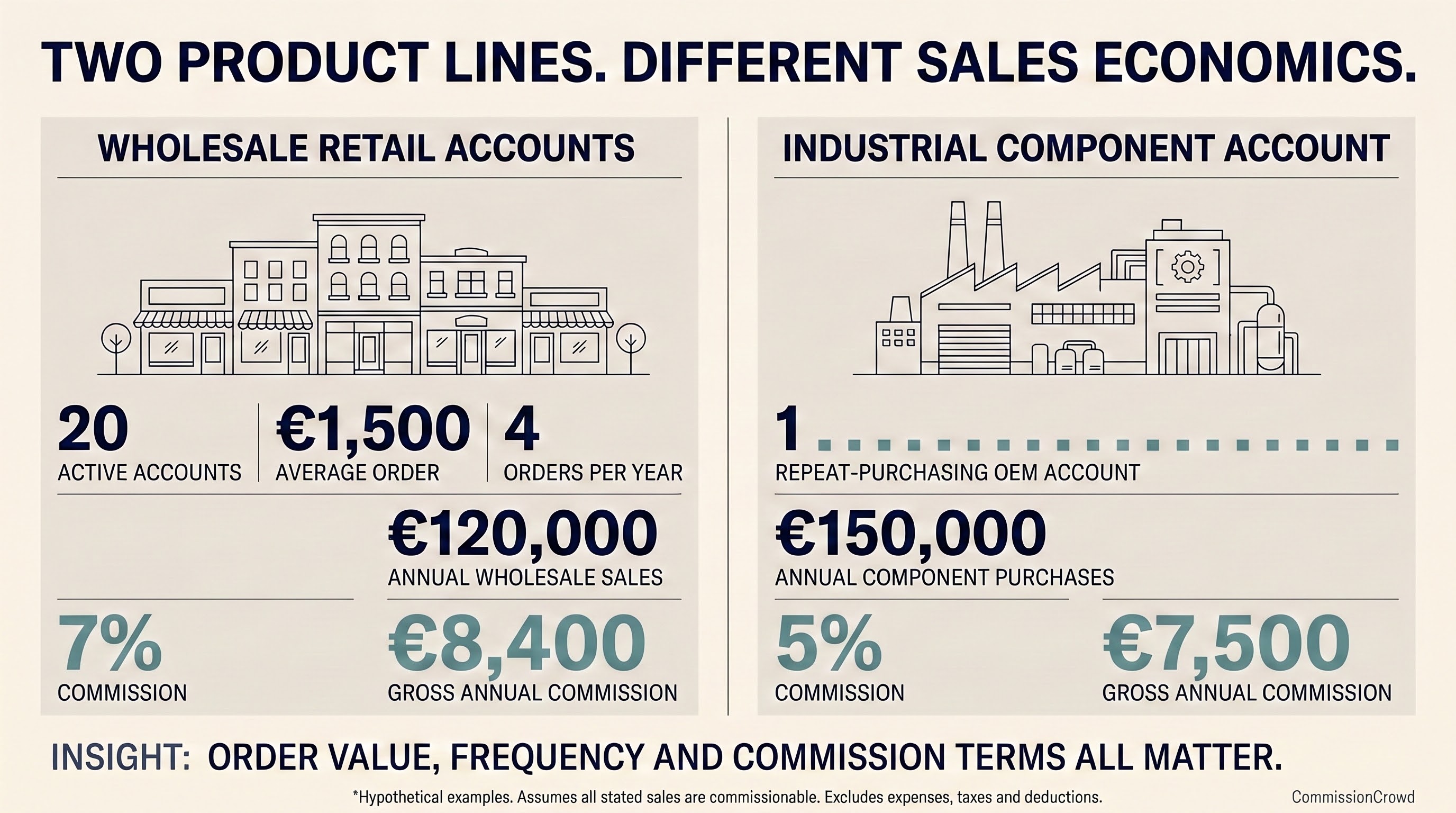
Let's look at a hypothetical calculation.
Suppose you represent a wholesale product line with:
- 20 active retail accounts
- An average order value of €1,500
- Four orders per account annually
- A 7% sales commission
The annual wholesale sales generated would be:
20 × €1,500 × 4 = €120,000
At 7% commission, that would produce €8,400 in gross annual commission.
This assumes every order is fulfilled and commissionable under the agreement. It excludes expenses and taxes and is intended only to illustrate the calculation, not predict typical earnings.
Now consider the time required to develop and maintain those accounts.
If you already visit those retailers regularly for other product lines, introducing another complementary range may be commercially efficient.
If you need to travel extensively, carry expensive samples or manage complicated orders, the economics may be considerably less attractive.
The commission percentage alone tells you very little.
Industrial Equipment and Components Have Different Economics
Industrial product lines can involve very different purchasing patterns.
A representative selling capital equipment may work on a relatively small number of high-value transactions involving lengthy evaluation and approval processes.
A component manufacturer might generate recurring purchases once its products become part of an OEM's established production process.
Industrial consumables may create more frequent repeat-order opportunities.
Consider two hypothetical situations.
In the first, an independent representative sells a €100,000 piece of industrial equipment at an agreed 5% commission.
The gross commission would be €5,000.
However, the sale might require months of technical discussions, customer visits and commercial negotiation.
In the second, a representative secures an industrial component account generating €150,000 in annual commissionable purchases.
At an agreed 5% commission, that would generate €7,500 annually, assuming all qualifying purchases remain commissionable.
The second arrangement could potentially generate ongoing income, although the representative may have invested considerable time securing the initial approval.
Neither example is inherently better.
The economics depend on achievable sales volume, the work required, manufacturer support, repeat-order rights and payment timing.
What Determines Independent Manufacturer Rep Commission Rates?
There is no universal commission percentage that applies to every physical product or market.
Rates depend on the product, selling channel, manufacturer margins, order values, established customer base and work expected of the representative.
A representative selling specialist machinery directly to commercial end users may be performing a different sales function from someone developing wholesale accounts through distributors.
Likewise, selling high-volume industrial components can involve different economics from occasional capital equipment sales.
Before comparing commission percentages, establish precisely what the manufacturer expects you to do.
Also clarify whether commission is calculated on gross sales, net sales after agreed deductions, collected revenue or another basis.
Freight, returns, discounts, unpaid invoices and excluded accounts can all affect the final amount.
Independent representatives should also consider the opportunity cost of carrying another line.
Every hour spent learning new products, visiting customers or developing a manufacturer's market is time that could be spent generating business for existing principals.
A lower commission percentage on established repeat business may sometimes provide better economics than a generous percentage on a largely unproven product.
Repeat Orders, Territory Rights and Commission Protection
For independent manufacturers' representatives, the commercial value of a product line often extends beyond the first sale.
A wholesale customer may place regular replenishment orders, while an industrial buyer may continue purchasing components or supplies over several years.
However, generating an initial customer relationship doesn't automatically entitle a representative to commissions on every future order.
These arrangements need to be discussed and documented.
What Happens When a Customer Places Another Order?
Consider an agent who introduces a wholesale product range to a retailer.
The retailer places an opening order through the representative. Several months later, it reorders directly through the manufacturer's website or customer service department.
Does the agent still earn commission?
The answer depends on the agreement.
Some arrangements provide commissions on qualifying repeat purchases from accounts developed by the representative.
Others link commissions to continuing sales involvement, particular territories or individual transactions.
Questions worth establishing include:
- Are commissions payable on repeat orders?
- Does the arrangement cover all qualifying sales from accounts you introduce?
- What happens when a customer orders directly from the manufacturer?
- Are commissions payable on sales processed through distributors?
- Must you remain actively involved in managing the account?
- Are any customers or product categories excluded?
These details can have a substantial effect on the long-term value of a product line.
Exclusive and Non-Exclusive Territories
Manufacturers may appoint independent sales representatives to particular geographical territories, customer groups or sales channels.
An exclusive arrangement might give one representative responsibility for an agreed territory.
A non-exclusive arrangement may allow the manufacturer to work with several representatives or continue developing its own direct sales relationships.
Neither arrangement is automatically better.
What matters is understanding precisely what the appointment covers and how business generated within the territory is handled.
For example, a manufacturer might appoint an agent to develop sales among independent retailers in a particular region while retaining direct relationships with national retail chains.
Alternatively, an industrial supplier might assign representatives to geographical territories but reserve certain existing customers as house accounts.
A house account is generally a customer relationship retained directly by the manufacturer rather than assigned to a representative.
Before accepting a territory, establish whether existing accounts are included in the commission arrangement or reserved by the manufacturer.
Also consider situations where several representatives contribute to a sale.
For example, one agent may introduce a product to an OEM's engineering team, while another representative services the manufacturing facility where the finished component is ultimately delivered.
In these situations, manufacturers sometimes establish split-commission arrangements.
The objective is to ensure that both parties understand how sales will be attributed before disputes arise.
What Happens to Commissions After the Agreement Ends?
Termination provisions deserve particular attention when a representative has invested substantial time developing customer relationships.
Questions include:
- What happens to commissions already earned but not yet paid?
- Are accepted orders fulfilled after termination still commissionable?
- What happens to repeat business from accounts developed during the agreement?
- How are long-running industrial projects or production programmes treated?
- Does the agreement provide for any post-termination commission period?
There isn't a single worldwide rule governing how long commissions should continue after a representation agreement ends.
Contractual provisions and applicable laws differ between jurisdictions.
For commercially significant relationships, it makes sense to obtain independent legal advice before signing an agreement.
Commercial Due Diligence Before Adding a Manufacturer's Product Line
An independent sales professional puts their own reputation in front of customers.
If a manufacturer repeatedly delivers late, supplies defective products or fails to provide adequate support, the consequences may extend beyond that manufacturer's reputation.
Your customers may associate those problems with you.
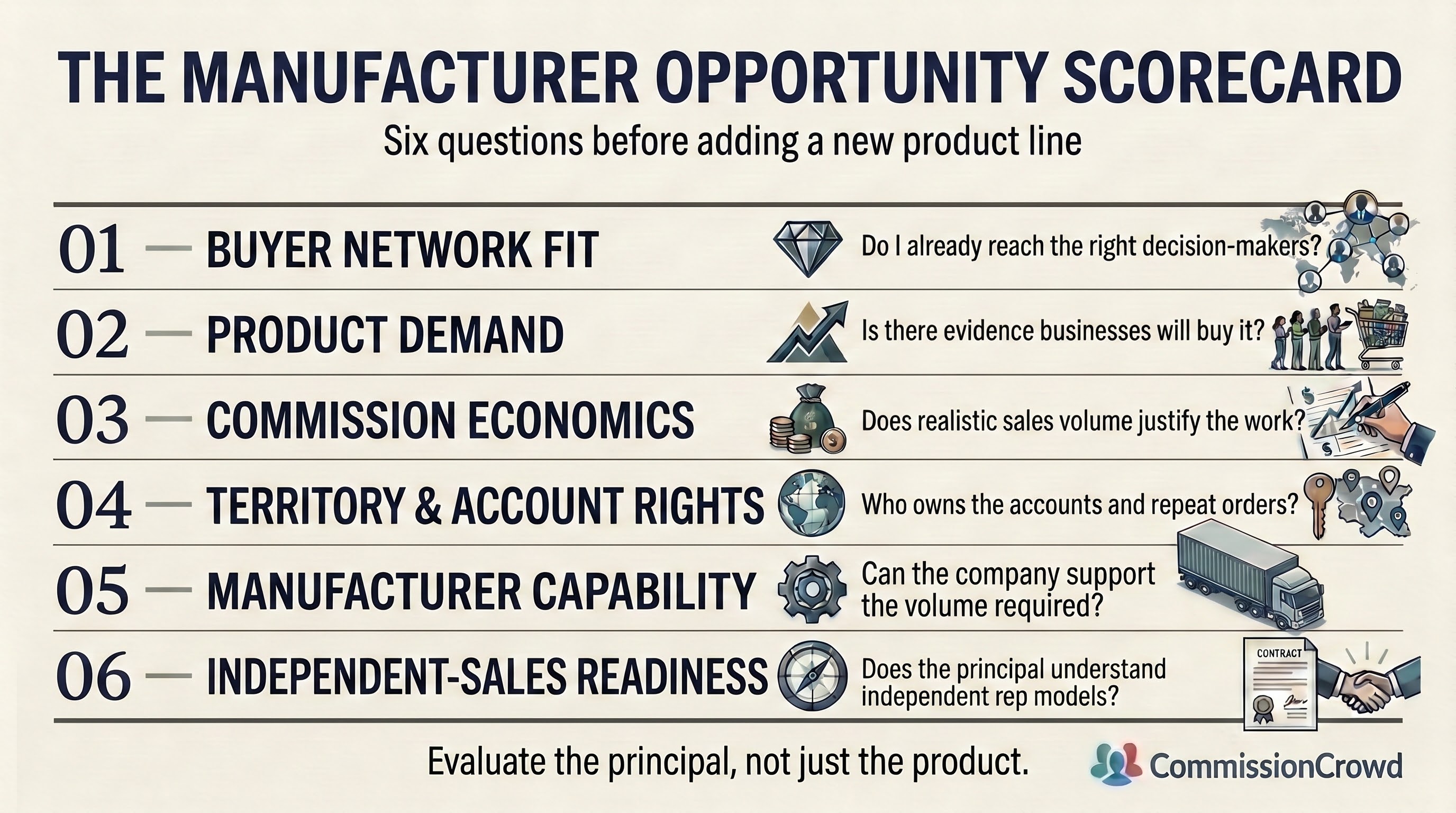
Before introducing a new product line to established business relationships, investigate whether the manufacturer can deliver what it promises.
Is There Evidence of Genuine Market Demand?
An interesting product isn't necessarily a product customers will purchase.
Ask the manufacturer about its existing customers, established sales channels and the commercial problems its products solve.
Where appropriate, look for:
- Evidence of existing business customers
- Established distributor or retailer relationships
- Product demonstrations or technical performance data
- Customer references or case studies
- Repeat purchasing activity
- Clear competitive advantages
A newly developed product may have genuine potential, but representatives should be realistic about the additional work and risk involved in developing an unproven market.
If a manufacturer's sales proposition relies entirely on ambitious forecasts, investigate how those forecasts were produced.
Can the Manufacturer Supply Customers Reliably?
Physical products introduce operational considerations that don't exist in the same way with many service-based opportunities.
Investigate manufacturing capacity, product availability, delivery lead times, minimum order quantities, stockholding, returns, warranties and after-sales customer service.
For technical products, confirm the relevant certifications and regulatory requirements.
If products are manufactured overseas, establish how international shipping, customs arrangements and local customer support will be handled.
A representative should understand who is responsible for each stage of the customer experience.
Does the Manufacturer Understand the Sales Channel?
For wholesale products, examine whether the manufacturer has a commercially workable proposition for retailers and distributors.
This includes wholesale pricing, reseller margins, trade packaging, catalogues, samples, merchandising materials and replenishment arrangements.
A product might have an attractive consumer retail price but still fail to offer suitable economics for the retailers expected to stock it.
For industrial products, investigate technical documentation, demonstrations, engineering assistance, installation requirements and maintenance support.
A technically complex product may require substantial manufacturer involvement during the sales process.
That isn't necessarily a problem, provided the necessary support is available.
Will the Manufacturer Be a Good Long-Term Principal?
The relationship itself matters.
Does the manufacturer respond promptly to customer enquiries? Will it provide suitable training? How are quotations handled? Does it understand that independent representatives often manage portfolios of complementary companies?
Ask how it communicates pricing changes, product availability and important developments affecting customers.
Where appropriate, speaking with existing representatives can help you understand how the manufacturer operates in practice.
Potential warning signs include:
- Unclear or constantly changing commission arrangements
- Lack of evidence supporting product claims
- Unrealistic promises about potential earnings
- Poorly defined territory or account ownership
- Insufficient product information or training
- Unreliable delivery arrangements
- Unwillingness to document important commercial terms
Not every concern automatically disqualifies a manufacturer, but significant unanswered questions should be resolved before you invest heavily in developing its market.
For a broader discussion of evaluating prospective principals, read our guide to choosing the right companies to represent as an independent sales rep.
A Practical Process for Finding Your Next Product Line
Finding a worthwhile manufacturer doesn't require investigating every supplier in your industry.
A focused approach built around your existing B2B market can make the process considerably more manageable.
Here is a practical sequence to follow.
- Define your existing buyer network. Identify the businesses, purchasing departments and decision-makers you already have relationships with.
- Identify complementary product needs. Consider what those customers regularly purchase, which problems they encounter and what products might fit alongside your existing lines.
- Build a manufacturer shortlist. Use specialist B2B networks, supplier directories, trade shows, industry associations and direct research to find relevant manufacturers.
- Investigate existing sales coverage. Establish how each manufacturer currently reaches your market, whether it already works with representatives and whether there are genuine gaps you could help address.
- Approach suitable manufacturers. Explain your relevant experience, customer network and reasons for believing their products could fit your market.
- Evaluate the commercial opportunity. Assess realistic order values, purchasing frequency, commission calculations, territory arrangements and the costs involved in developing the line.
- Agree the working relationship. Establish expectations around product support, account ownership, commissions, repeat orders and termination before committing substantial time.
As your customer relationships develop, new product needs may emerge.
A carefully selected portfolio can allow independent representatives to provide several complementary solutions to the same business customers, creating additional commercial opportunities without continually having to enter unfamiliar markets.
Our article on how independent sales reps turn one client into multiple commission streams explores that wider portfolio strategy in more detail.
Find Manufacturers and B2B Product Lines Through CommissionCrowd
If you're an experienced independent sales professional looking for new manufacturers, brands or physical product lines to represent, CommissionCrowd provides a specialist B2B network where you can connect with companies actively seeking independent sales relationships.
But there's more to finding the right principal than discovering a company offering commission.
At CommissionCrowd, we qualify and vet the companies joining our network and work with them to help establish the foundations for successful relationships with independent sales professionals.
For companies unfamiliar with the model, this includes guidance on how experienced self-employed representatives operate, the importance of respecting their independence and what makes a commission-only opportunity commercially attractive.
Our role is to help companies prepare for those relationships while giving independent sales professionals access to opportunities they can evaluate according to their own experience, territories and customer networks.
You can explore opportunities across manufacturing, industrial equipment, components, wholesale products and other B2B industries.
For a starting point, browse current opportunities in:
Joining CommissionCrowd is free for independent sales professionals.
Ultimately, finding the right manufacturer isn't just about identifying a product you can sell. It's about establishing a commercially rewarding relationship with a company that understands the value of your experience, respects your independence and provides the support and commission structure needed to make the partnership worthwhile.
Frequently Asked Questions
Where Can Independent Sales Reps Find Manufacturers Looking for Representation?
Specialist B2B networks such as CommissionCrowd provide a starting point for discovering companies interested in independent sales representation.
You can also research prospective manufacturers through industry associations, trade-show exhibitor directories and supplier databases.
Remember that a manufacturer appearing in a supplier directory isn't necessarily advertising for sales agents. You may need to approach it directly to explore whether independent representation is appropriate.
Can I Approach Manufacturers That Aren't Advertising for Independent Sales Reps?
Yes. Independent representatives can approach manufacturers directly when they have a credible commercial reason for proposing a partnership.
For example, you may have established relationships in a territory where the manufacturer has limited sales coverage.
Research its existing distribution and representation arrangements first, then contact the appropriate commercial decision-maker to discuss whether there could be mutual value in working together.
How Do I Find Wholesale Product Lines to Sell to Retailers and Dealers?
Start by identifying products that fit the purchasing needs of the retailers or dealers you already work with.
Research manufacturers through wholesale trade shows, exhibitor directories, supplier catalogues and industry publications.
Then investigate each brand's existing wholesale arrangements, geographical coverage, trade pricing and willingness to work with independent representatives.
Can Independent Sales Reps Represent Several Manufacturers at Once?
Yes. Many independent manufacturers' representatives build portfolios containing complementary products from multiple companies.
However, the arrangements depend on individual representation agreements.
Before adding another manufacturer, check for competing-product restrictions, exclusivity provisions, territory obligations and potential conflicts of interest.
You should also consider whether you have sufficient capacity to support the additional product line.
Do Manufacturers Pay Commissions on Repeat Orders?
Some manufacturers pay commissions on qualifying repeat purchases from accounts developed by their representatives. Others use different arrangements based on territory, account ownership, continuing involvement or individual orders.
Repeat-order commission isn't automatic.
Establish exactly which transactions qualify, how direct customer reorders are handled and what happens when the representation agreement ends.
These terms should be clearly documented.
What Should I Look for in a Manufacturer Before Agreeing to Represent Its Products?
Look for evidence of genuine customer demand, reliable products, appropriate manufacturer support, commercially attractive commission arrangements and a realistic understanding of independent representation.
The manufacturer should understand that independent sales professionals operate their own businesses, may represent complementary companies and invest their own time and resources in developing sales.
A promising product is important, but a strong commercial relationship also requires mutual understanding, clear expectations and suitable contractual arrangements.

More articles from CommissionCrowd
World-Class Software Engineering Sales Opportunity - 35% Commission + Residuals
World-Class Software Engineering Sales Opportunity - 35% Commission + Residuals
Why You'll Never Find Great Self-Employed Sales Professionals on Gumtree or
Why You'll Never Find Great Self-Employed Sales Professionals on Gumtree or Generic Job Websites